Guide · Gloves
How to Break In Boxing Gloves
A new leather glove is stiff because the shell and the padding have not yet taken the shape of your fist. The only method that works is using it — short, light bag rounds for two to four weeks. Everything else people suggest, from soaking to steaming to beating them with a hammer, damages the padding you paid for.
Written by Mike M. · Owner, Iron Mako Media
Published
Bag & Bell is reader-supported. Product links go through our affiliate resolver and we may earn a commission from qualifying purchases at no cost to you. Prices are the retailer's, come from Amazon's own product data on the date shown, and change — the button always opens the live listing.
Part of the Gloves hub.
How to break in boxing gloves · 6 steps
Step 01
Wrap your hands and put them on
Use the wraps you will actually train in, because the glove is going to form around your wrapped fist, not your bare one. If the glove is unwearable with wraps on, it is the wrong size and no amount of break-in will change that.
Step 02
Close your fist, hard, fifty times
Out of the bag, sitting down. Make a full fist, squeeze, release. This works the shell at the natural crease across the knuckles, which is the stiffest part of a new leather glove and the part that limits your fist.
Step 03
Do two or three light bag rounds
Straight punches at maybe half power on a soft-to-medium bag. You are compressing the padding evenly, not testing it. Resist the urge to go hard: the padding has not settled, so a heavy session now is the one most likely to hurt your hand.
Step 04
Air them open and leave them a day
Pull the cuff open, stand them cuff-down, let them dry fully. Padding settles as it dries. A glove used damp day after day breaks down rather than breaks in.
Step 05
Repeat for two to four weeks
Add power and round length gradually as the glove closes more easily. For a leather glove, expect two to four weeks of normal training before it feels like yours. A synthetic glove will be essentially finished after the first couple of sessions.
Step 06
Re-check the fit at the end
Once the glove has settled, redo the fit test: knuckles on the knuckle padding, a small gap at the fingertips, strap closing in the middle of its travel. A broken-in glove that still slides on your hand was always the wrong size.
What breaking in actually changes
Two separate things are happening. The shell softens and learns the crease across your knuckles, so the glove stops fighting you when you close your fist. And the padding compresses unevenly — more where your knuckles land, less at the edges — which is what people mean when they say a glove moulds to the hand. Neither of those is achieved by force. They are achieved by repeated, moderate loading and then letting the glove dry.
This is also why the material decides how much work there is to do. A polyurethane shell does not stretch and arrives close to its final shape; hide does both. If you want none of this, the honest answer is to buy synthetic — see leather vs synthetic boxing gloves.
How long it takes
| Glove | Break-in | What changes |
|---|---|---|
| Synthetic training glove | A session or two | Lining settles; shell barely moves |
| Engineered leather | One to two weeks | Knuckle crease forms, padding settles |
| Genuine leather, layered foam | Two to four weeks | Shell softens and takes the hand shape |
| Hand-made leather, dense padding | Three to six weeks | Slowest and most noticeable change |
The methods you will be told about, and what they do
- Soaking them in water. Saturates the foam. It takes days to dry from the middle, and the padding loses density permanently. This is the single worst thing you can do to a glove.
- Heat — hairdryer, radiator, oven, car dashboard. Hardens foam and cracks leather. A hardened knuckle area transmits impact straight into your hand.
- Freezing them. Does nothing to the shell and does not kill the smell either. The smell is handled by drying and wraps — see how to clean boxing gloves.
- Hitting them with a hammer or a mallet. Flattens the padding in one spot, which is the opposite of what you want. Whatever you gain in flexibility you lose in protection, exactly where you need it.
- Leather conditioner. Useful on a dry leather shell after months of use, applied thinly to the outside only. Not a break-in method, and never on a glove that is damp inside.
Break-in versus the wrong glove
People spend weeks breaking in a glove that was never going to fit. The difference is straightforward:
| Symptom | What it is |
|---|---|
| Shell resists closing the fist; eases over weeks | Normal break-in |
| Padding feels hard at first, softens with use | Normal break-in |
| Fingertips press the end of the compartment | Glove is too short — size up or buy a hand-sized model |
| Hand slides and rotates inside the glove | Glove is too big; the strap is compensating |
| Strap closes at the very end of its travel | Wrong size, not a break-in issue |
| Numbness or tingling in the fingers | Too tight, or wrapped too tightly. Stop and re-check |
If you are in the first two rows, keep going. If you are in the last four, the fix is a different glove or a different wrap — start with the size chart, and if your hands are large, gloves for big hands covers the models with the room.
A note on new synthetic gloves that feel stiff
Entry synthetic gloves sometimes feel rigid out of the packet, and it is usually the pre-curve of the padding rather than the shell. Fifty hard fist closes and one light session almost always settles it. If it has not after a week of use, that glove is not going to change much — it is built the way it is built, and the question is whether it fits, not whether it is broken in.
Picks
Gloves that need breaking in, and one that does not
Two leather gloves where the break-in is part of the purchase, and a synthetic training glove that is ready on day one — the right answer if you do not want to spend a month getting there.
Key specs
- Weights
- 12 · 14 · 16 · 18 oz
- Shell
- 100% genuine leather
- Padding
- Layered latex memory foam
Scores · editorial, out of 10
- Wrist support
- 9
- Knuckle padding
- 8
- Fit & closure for beginners
- 8
- Materials & durability
- 9
- Value for a first pair
- 8
Pick 01 · Boxing gloves
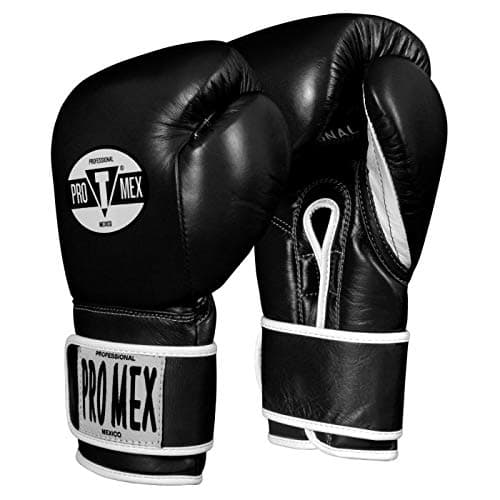
Pro Mex Professional Training Gloves 3.0
Pro Mex
Where real leather starts: 100% genuine leather, layered latex memory foam and a full wrap-around leather wrist strap, in four weights up to 18 oz.
Best for
The first leather glove, once you know you will keep training
Pros
- Genuine leather at roughly a third of what the hand-made Mexican gloves cost
- Full wrap-around leather wrist strap with hook-and-loop — the long-strap spec, in leather
- Longer cuffs than a standard training glove, which is where the wrist support comes from
- Layered latex memory foam rather than a single block, plus an articulated cuff and attached thumb
- Goes to 18 oz, so it covers heavier adults and sparring
- Nylon satin water-repellent inner lining — the part of a leather glove that usually rots first
Cons
- No 8 oz or 10 oz option, so it is not a glove for a very light adult or a teenager
- Leather needs a dry room and air-drying after every session; a damp garage is hard on it
- Pro Mex publish no foam thickness or layer count, so you cannot compare the padding on paper
Specs from TITLE Boxing — Pro Mex Professional Training Boxing Gloves 3.0 (shell, foam, strap, cuff).
Key specs
- Closure
- Leather strap with hook-and-loop
- Padding
- 2 in. in the punch area
- Origin
- Hand made in Mexico
Scores · editorial, out of 10
- Wrist support
- 8
- Knuckle padding
- 9
- Fit & closure for beginners
- 7
- Materials & durability
- 10
- Value for a first pair
- 3
Pick 02 · Boxing gloves
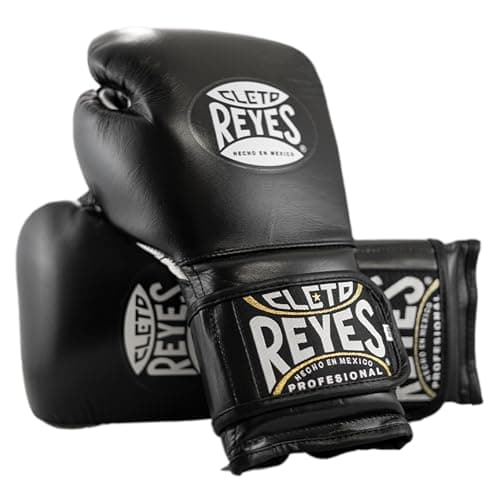
Cleto Reyes Hook & Loop Training Gloves
Cleto Reyes
The hand-made Mexican reference glove, with two inches of padding in the punch area and a leather strap over hook-and-loop — the answer to "are Cleto Reyes worth it?" is yes, later.
Best for
The upgrade you buy after a year, not the first pair
Pros
- Two full inches of padding in the punch area, per Ringside's listing
- Leather strap over hook-and-loop closes firmer and faster than the classic laced Reyes
- Hand made in Mexico — the glove pros train in
Cons
- Reyes padding is famously firm and takes weeks to break in
- Costs three to five entry pairs
Specs from Ringside — Cleto Reyes Hook & Loop Training Gloves (specs).
Key specs
- Weights
- 8 · 12 · 14 · 16 oz
- Closure
- Full-length hook-and-loop, splint-style wrist
- Padding
- Triple-layer C3 foam
Scores · editorial, out of 10
- Wrist support
- 8
- Knuckle padding
- 8
- Fit & closure for beginners
- 9
- Materials & durability
- 6
- Value for a first pair
- 9
Pick 03 · Boxing gloves
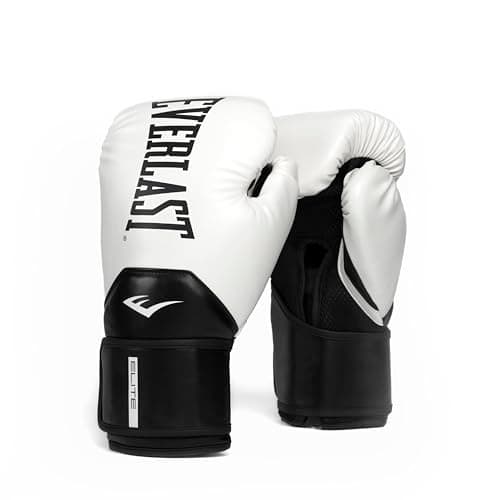
Everlast Elite Boxing Gloves
Everlast
The safe default first pair: a full-length hook-and-loop strap with a splint-style wrist, triple-layer foam, and a published weight chart to size it by.
Best for
A first pair for bag work, sized by body weight
Pros
- Everlast publishes a weight-to-ounce chart for this glove (12–14 oz at 101–150 lb, 14–16 oz at 151–175 lb, 16–18 oz over 175 lb)
- EverShield wedge-shaped strap runs the full length of the wrist — easy to close one-handed
- Mesh palm and soft lining make it comfortable for the 30-minute sessions a beginner actually does
- Attached thumb and a foam grip bar encourage a correct fist
Cons
- PVC outer shell rather than leather — expect it to show wear sooner than a leather pair
- No 10 oz option; the jump from 8 oz to 12 oz skips the size some smaller adults want
Specs from Everlast — Elite Boxing Gloves (specs and size chart).
FAQ
Frequently asked questions
How long does it take to break in boxing gloves?
Two to four weeks of normal training for a genuine leather glove, one to two weeks for engineered leather, and essentially no break-in for a synthetic training glove.
How do you break in boxing gloves fast?
Close your fist hard inside the glove fifty or so times before each session, then do two or three light bag rounds rather than one heavy one, and let them dry fully open in between. There is no safe shortcut past that — the fast methods people suggest all damage the padding.
Can you use water to break in boxing gloves?
No. Water saturates the foam, takes days to dry from the centre and permanently reduces padding density. It is the most damaging thing you can do to a glove.
Should new boxing gloves feel tight?
Snug with wraps on, yes. Tight enough to numb your fingers, press your fingertips into the end of the glove, or stop you closing a fist at all — no, that is a sizing problem and break-in will not fix it.
Do synthetic boxing gloves need breaking in?
Barely. A polyurethane shell does not stretch, so what little settling happens is in the lining and padding over the first session or two.
Next in your kit
Best heavy bag for beginners →Keep reading
Related guides
- Leather vs synthetic boxing gloves →
Whether you need to break anything in at all.
- How to clean boxing gloves →
Drying, which is half of breaking in.
- Boxing glove size chart →
If the stiffness is really a fit problem.
- Are Cleto Reyes gloves worth it? →
The longest break-in of any glove here.
- How long do boxing gloves last? →
The other end of a glove's life.
Sources
- —TITLE Boxing — Pro Mex Professional Training Boxing Gloves 3.0 (shell, foam, strap, cuff) · titleboxing.com
- —Ringside — Cleto Reyes Hook & Loop Training Gloves (specs) · ringside.com
- —Everlast — Elite Boxing Gloves (specs and size chart) · everlast.com