Guide · Conditioning
Jump Rope vs Running for Boxing
Boxers do both, and not out of tradition. Running builds the aerobic base that lets you recover between rounds; the rope trains the things a round actually asks of you — staying on the balls of your feet, moving in rhythm, and keeping your shoulders working while your legs do. If you only have time for one, pick the rope.
Written by Mike M. · Owner, Iron Mako Media
Published
Bag & Bell is reader-supported. Product links go through our affiliate resolver and we may earn a commission from qualifying purchases at no cost to you. Prices are the retailer's, come from Amazon's own product data on the date shown, and change — the button always opens the live listing.
Part of the Conditioning hub.
The short answer
They are not interchangeable, and the reason is specificity. Three minutes of skipping puts you on the balls of your feet, moving in a rhythm, with your shoulders and forearms working the whole time — which is a reasonable imitation of a boxing round. A 5 km run does almost none of that, but it builds the aerobic capacity that decides how recovered you are when the bell goes for round four. One trains the shape of the work; the other builds the engine under it.
For somebody boxing at home three times a week, our honest recommendation: rope on every training day as a warm-up and a conditioning block, and one easy run a week if you enjoy running. If you hate running, you can get most of what you need from rope rounds plus bag rounds, and nobody should force themselves onto the road for tradition's sake.
The comparison table
| Jump rope | Running | |
|---|---|---|
| Trains | Footwork, rhythm, coordination, calves | Aerobic base, endurance, leg stamina |
| Boxing specificity | High - balls of the feet, round-length bouts | Low to moderate, depending on the session |
| Upper body involvement | Shoulders and forearms, continuously | Minimal |
| Space needed | A few square feet and ceiling height | A road, a park or a treadmill |
| Cost | The cheapest kit in boxing | Shoes, which are not cheap |
| Weather dependent | No | Yes, unless you own a treadmill |
| Main injury load | Calves, Achilles, feet | Knees, hips, shins |
| Learning curve | Real - weeks to be smooth | None |
| Noise | Significant on an upper floor | None at home |
Why boxers skip, specifically
- It puts you on the balls of your feet. Which is where boxing footwork lives. A skipping session is three minutes of practising a weight distribution you want to be automatic.
- It is rhythmic. Boxing is a timing sport, and a rope gives you an audible, repeating beat to move with. This is a real part of why the rope survived as boxing's warm-up.
- It fits the round structure. Skipping in two- or three-minute rounds with a minute of rest conditions you for exactly the work-to-rest ratio you will fight in — see round timer settings.
- It works your shoulders at the same time. Keeping your hands up for twelve minutes of skipping is its own kind of useful.
- It is cheap and it fits anywhere. A rope and a few square feet. No weather, no excuse.
Why running still earns its place
The thing a rope does less well is build raw aerobic capacity at low intensity, because most people cannot skip continuously for forty minutes while they are still learning. Easy-paced running does that comfortably, and aerobic base is what determines how quickly your heart rate drops in the sixty seconds between rounds. It is also mentally simpler: when your footwork is terrible, a run still gets the work in, while a rope session becomes thirty frustrated attempts.
What we would avoid as a beginner is hard road sprint work. It carries the highest injury load of anything discussed here, and bag rounds already give you intervals — see the beginner heavy bag workout, where round seven is the interval block.
A beginner week that uses both
| Day | Session | Notes |
|---|---|---|
| Mon | Rope 3 rounds, bag 3-4 rounds | Rope as the warm-up, bag as the session |
| Tue | Easy run, 20-30 min | Conversational pace, not a test |
| Wed | Rest or a walk | Calves need this more than you think |
| Thu | Rope 4 rounds, bag 4-5 rounds | Add a round to each every week or two |
| Fri | Rest | |
| Sat | Rope 5 rounds, shadowboxing, stretching | The skill-and-rhythm day |
| Sun | Rest or an easy walk |
If you can only buy one thing
Buy the rope. It costs a fraction of a pair of running shoes, it trains something boxing-specific, and it works in a garage in February. Sizing matters more than price — a rope that is too long trips you and a rope that is too short clips your feet — so read how to size a jump rope before you order, and best jump rope for boxing for the full ranking. If you are skipping on concrete, the mat is not a luxury: it is what stops your calves and the rope itself from taking a beating — jump rope mats.
What about weighted ropes?
A heavier rope slows the turn down, which genuinely helps a beginner feel where the rope is, and it loads the shoulders more. It also makes fast footwork drills impossible. Most people should learn on a light speed rope and treat a weighted rope as a second purchase — speed rope vs weighted rope has the full trade, and the jump rope workout for beginners is where to start either way.
Picks
What the rope side of this needs
Two ropes — one for learning boxing rhythm, one adjustable pair of handles you can size yourself — and the mat that makes skipping on a concrete floor sustainable.
Key specs
- Rope
- 2.8 oz PVC, tangle-free
- Lengths
- Up to 6 ft 2 in · over 6 ft 2 in
- Handles
- Grip-taped
Scores · editorial, out of 10
- Cable & speed for beginners
- 10
- Handles & bearings
- 7
- Adjustability
- 7
- Durability on concrete
- 6
- Value
- 8
Pick 01 · Jump ropes
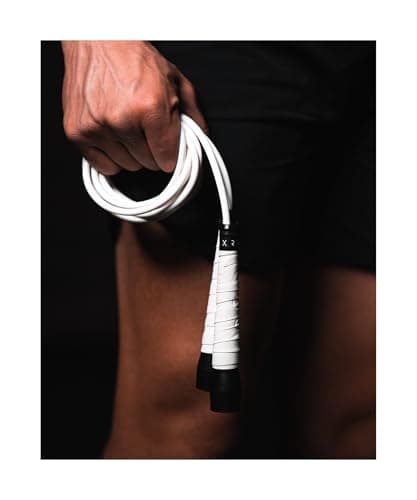
BOXROPE Vol. I
BOXROPE
The rope built for boxers first: a 2.8 oz PVC rope heavy enough to feel and time, taped handles, and two length options — the best starting rope if footwork rounds are the goal.
Best for
Learning boxing footwork and rhythm — the rope you can feel turning
Pros
- A heavier PVC rope (2.8 oz) gives a beginner the feedback a thin steel cable doesn't — you can hear and feel the turn
- Two sizes by height; BOXROPE lists it as tangle-free
- Handle grip tape for control when hands are sweaty
Cons
- PVC wears faster on bare concrete than a coated cable — jump on a mat or rubber floor
- Only two length bands; you trim to fit within each
Specs from BOXROPE — Vol. I (rope weight, sizes).
Key specs
- Rope
- 5 mm PVC, string core, 10 ft
- Handles
- 5.5 in polymer, dowel action
- Sizing
- Snap-lock cord ends
Scores · editorial, out of 10
- Cable & speed for beginners
- 9
- Handles & bearings
- 8
- Adjustability
- 9
- Durability on concrete
- 7
- Value
- 9
Pick 02 · Jump ropes
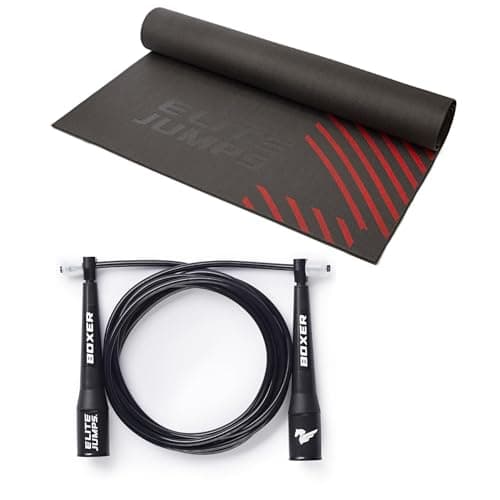
Elite Jumps Boxer Jump Rope 3.0
Elite Jumps (Elite SRS)
The classic boxer's rope done well: a 5 mm PVC cord with a string core, 10 ft to trim, polymer handles with a smooth dowel action and snap-lock ends so resizing takes a minute.
Best for
A first rope you can size yourself and use outdoors
Pros
- 5 mm PVC cord with a string core — a steadier turn than hollow PVC and more forgiving on concrete than bare cable
- 5.5 in polymer handles with a dowel swivel and dimpled slip-resistant grips
- Snap-lock cord ends make trimming to your height simple and reversible
- 10 ft cord fits tall jumpers before trimming
Cons
- A speed-rope bearing turns faster than the dowel if double-unders are the goal
- Lighter feel than the BOXROPE — less feedback for a raw beginner
Specs from Elite Jumps — Boxer Jump Rope 3.0 listing (cord, handles, sizing).
Key specs
- Thickness
- 1/4 in high-density vinyl foam
- Sizes
- 36 × 48 in · 43.5 × 86.5 in (jumbo)
- Testing
- Third-party tested: no phthalates, no toxins
Scores · editorial, out of 10
- Cushion for repeated impact
- 9
- Grip on a hard floor
- 9
- Size for a rope arc
- 7
- Durability under a cable
- 8
- Value
- 7
Pick 03 · Jump rope mats
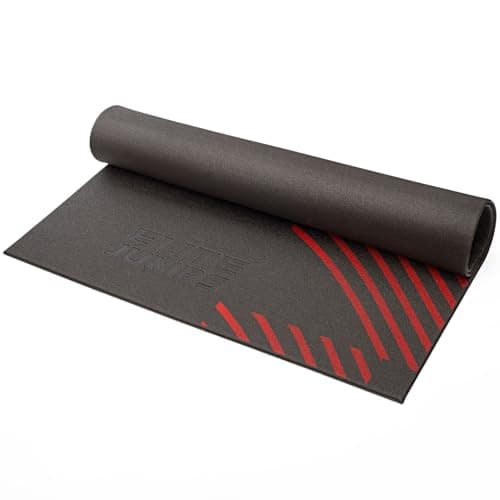
Elite Jumps Jump Rope Mat
Elite Jumps (Elite SRS)
The one mat built for rope specifically: ¼ in high-density vinyl foam, two published sizes, third-party tested for phthalates, and it stays put on a smooth floor.
Best for
Skipping rounds on concrete, tile or a hard wood floor — including upstairs
Pros
- Vinyl foam rather than a rubber yoga blend — Elite Jumps says it damps the bounce noise that carries to a flat below
- Two sizes published in inches, so you can check your rope arc against the footprint
- Rated by the maker for concrete, pavement, wood, tile, carpet, grass and brick
- Third-party tested for phthalates and toxins, which they state on the page
- Optional travel bag for the standard size
Cons
- The standard 36 × 48 in is tight for anyone over about 6 ft — the arc clips the edge
- The jumbo-with-bag combination was out of stock when we checked on 2026-09-26
- Costs more than a generic exercise mat of the same thickness
Specs from Elite Jumps — Jump Rope Mat (thickness, sizes, surfaces, testing).
FAQ
Frequently asked questions
Is jump rope better than running for boxing?
For boxing-specific conditioning, yes — it trains footwork, rhythm and staying on the balls of your feet, in round-length bouts. Running is better at building the low-intensity aerobic base that decides how well you recover between rounds. Most boxers do both.
Can jump rope replace running for boxing?
Largely, if you skip in rounds and build up the volume. The gap is long, easy aerobic work, which most beginners cannot yet do continuously on a rope. Combining rope rounds with bag rounds covers most of it.
How long should a boxer jump rope?
Start with three rounds of two minutes with a minute of rest and build from there. Ten to fifteen minutes of skipping as a warm-up is a normal boxing gym default once your calves have adapted.
Is skipping bad for your calves?
It loads them heavily, which is the point — and why going from nothing to ten minutes is how people end up with sore Achilles tendons. Build up over weeks and skip on a surface with some give rather than bare concrete.
Should beginners run for boxing?
One easy run a week is plenty alongside rope and bag work, and only if you enjoy it. Avoid hard road sprints early — bag rounds already give you intervals at far lower injury risk.
Next in your kit
Best boxing round timer →Keep reading
Related guides
- Best jump rope for boxing →
The ropes, ranked.
- How to size a jump rope →
The spec that matters most.
- Jump rope workout for beginners →
The session, round by round.
- Speed rope vs weighted rope →
Which rope to learn on.
- Heavy bag workout for beginners →
The other half of the week.
Sources
- —BOXROPE — Vol. I (rope weight, sizes) · boxrope.com
- —Elite Jumps — Boxer Jump Rope 3.0 listing (cord, handles, sizing) · amazon.com
- —Elite Jumps — Jump Rope Mat (thickness, sizes, surfaces, testing) · elitejumps.co