Guide · Heavy Bags
Heavy Bag Workout for Beginners
Your first heavy bag session should be three rounds long and feel too easy. Punch volume is not the skill you are building in week one — hitting straight, with a locked wrist, from a stance you can move in, is. Here is the session, the progression to eight rounds, and the four punches that make up all of it.
Written by Mike M. · Owner, Iron Mako Media
Published
Bag & Bell is reader-supported. Product links go through our affiliate resolver and we may earn a commission from qualifying purchases at no cost to you. Prices are the retailer's, come from Amazon's own product data on the date shown, and change — the button always opens the live listing.
Part of the Heavy Bags hub.
A beginner's first heavy bag session · 7 steps
Step 01
Wrap your hands
Every session, without exception. A 180 in wrap for an adult hand: knuckles, between the fingers, then spend real length crossing the wrist in both directions. Follow our wrapping guide the first few times rather than improvising.
Step 02
Set the timer: 3 rounds of 2 minutes, 1 minute rest
Set a timer and let it run the session. Two-minute rounds with a full minute of rest is the right starting structure; it stops you from turning the session into one long shapeless effort.
Step 03
Round 1 - stance and the jab only
Feet shoulder-width and staggered, hands up, chin down. Throw nothing but the jab at perhaps half power, returning the hand to your cheek every time. Watch your wrist: the back of your hand and forearm should be a straight line at contact.
Step 04
Round 2 - jab and cross
Add the rear-hand straight. Rotate the rear foot and hip as the hand goes out - the punch comes from the ground, not the shoulder. One-two, reset, one-two. Keep the power at half and the form at full.
Step 05
Round 3 - move
Same two punches, but circle the bag. Step, punch, step. The point is to learn to punch from a stance you have just moved into, which is the skill a static bag session never teaches.
Step 06
Finish and check your hands
Stop at three rounds even if you feel fine. Unwrap, look at your knuckles and wrists, and note anything sore. Soreness in the knuckles or wrist after a first session means technique or wraps, not toughness - fix it before the next session.
Step 07
Add one round a week
Week two: four rounds, and add the lead hook in round four. Week three: five rounds, add the rear hook. Build to eight rounds of two minutes over roughly six weeks, then start extending rounds to three minutes instead of adding more.
The four punches, and nothing else for now
Every beginner heavy bag workout on the internet is a recombination of four punches. Learn these and you have the vocabulary for months of training:
| Punch | Hand | What it is for | The common mistake |
|---|---|---|---|
| Jab | Lead | Range, timing, keeping the bag honest | Pushing it instead of snapping it back |
| Cross | Rear | The power punch, driven from the rear foot | Throwing it with the arm only |
| Lead hook | Lead | Around a guard, at short range | Swinging wide with a bent wrist |
| Rear hook | Rear | Follows a lead hook or a cross | Over-rotating and losing balance |
Note what is missing: uppercuts, combinations longer than three punches, and anything thrown at full power. Those come later and they come from a coach or a course, not from a bag. This page is about structuring the time and not hurting yourself.
The eight-round session to build to
Once three rounds feels comfortable — usually two or three weeks — this is the shape of a full beginner session. Two minutes per round, one minute rest.
| Round | Focus | Intensity |
|---|---|---|
| 1 | Shadowbox, no bag. Loosen up, find the stance | Easy |
| 2 | Jab only, straight and snapping back | Half |
| 3 | Jab and cross, from a planted stance | Half |
| 4 | Jab and cross while circling the bag | Moderate |
| 5 | Add the lead hook: jab, cross, hook | Moderate |
| 6 | Freestyle the four punches, keep the hands up | Moderate |
| 7 | Ten-second bursts, twenty seconds light | Hard in bursts |
| 8 | Jab only again, clean technique, cool down | Easy |
Round seven is the only place where effort matters more than form, and it is deliberately short. If your technique falls apart during it, cut it and come back to it next week.
Round and rest times, and why two minutes
Amateur boxing runs three-minute rounds with a minute of rest, and that is where you are heading. Starting there as a beginner usually means the last 40 seconds of every round are thrown with bad technique, which is practice at punching badly. Two minutes with a full minute of rest keeps the quality up. Add rounds first, then lengthen them. Our round timer settings for beginners has the progressions in a table, and a timer that calls the rounds out loud genuinely changes how a session goes — see best boxing round timer.
How hard should you hit the bag?
Much less hard than you want to. Power on a heavy bag comes from the legs and hips rotating, and that coordination has to be learned slowly; hitting hard early mostly teaches you to push with the shoulder and land with a soft wrist. A useful test: if you cannot stop the punch halfway through, you are throwing it too hard for your current control. Build to full power over months, not in week one.
How often, and what else to do
Three bag sessions a week is plenty to start, with a day between them — your hands, wrists and the tendons in your forearms adapt more slowly than your lungs do. On the other days, skip rope: it builds the footwork and the conditioning that make bag rounds better, and it is the cheapest piece of kit in boxing. See the jump rope workout for beginners and jump rope vs running for boxing.
What you need before you start
- Wraps. 180 in for an adult hand — the roundup.
- Gloves in the right weight. Sized by body weight and use — the size chart.
- A bag that is properly hung or properly ballasted. Best heavy bag for beginners and how to hang it.
- A timer. A phone works; a timer you do not have to look at works better.
That is the whole kit. No mouthguard, no headgear, no shoes required for bag work — those belong to sparring, which is a different conversation entirely: the first sparring kit checklist.
Picks
The three things this session needs
Wraps, gloves and something to call the rounds. In that order — the wraps are the part people skip and the part that protects your hands.
Key specs
- Length
- 180 in (4.5 m)
- Fabric
- Stretch cotton-polyester blend
- Closure
- Hook-and-loop, wide-mouth thumb loop
Scores · editorial, out of 10
- Support & elasticity
- 9
- Length options
- 7
- Thumb loop & closure
- 9
- Wash durability
- 8
- Value
- 9
Pick 01 · Hand wraps
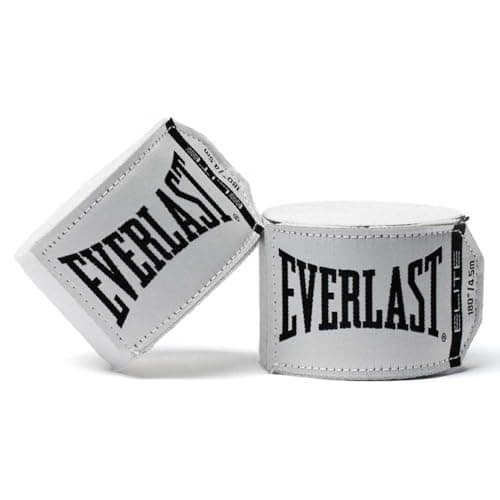
Everlast Elite Hand Wraps (180 in)
Everlast
The default adult wrap: 180 inches of stretchy cotton-poly, a wide-mouth thumb loop, hook-and-loop, machine washable.
Best for
Every adult's first wraps
Pros
- 180 in covers Mexican-style wrapping with knuckle padding for adult hands
- Wide-mouth thumb loop is easier to start than a narrow one
- Machine washable — you will wash these every week
Cons
- Only 180 in; buy the Core 120 in for small hands or kids
- Stretch wraps loosen slightly as they age
Specs from Everlast — Elite Hand Wraps 180 in (specs).
Key specs
- Weights
- 8 · 12 · 14 · 16 oz
- Closure
- Full-length hook-and-loop, splint-style wrist
- Padding
- Triple-layer C3 foam
Scores · editorial, out of 10
- Wrist support
- 8
- Knuckle padding
- 8
- Fit & closure for beginners
- 9
- Materials & durability
- 6
- Value for a first pair
- 9
Pick 02 · Boxing gloves
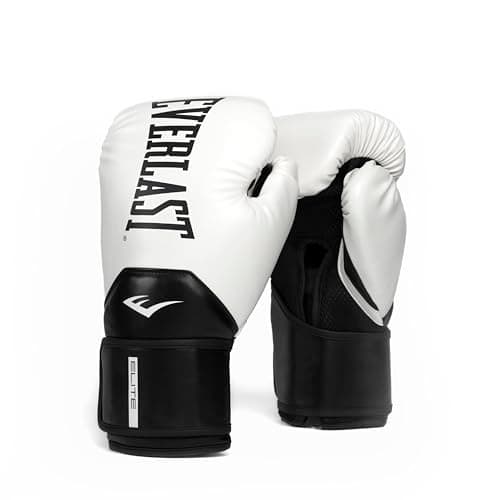
Everlast Elite Boxing Gloves
Everlast
The safe default first pair: a full-length hook-and-loop strap with a splint-style wrist, triple-layer foam, and a published weight chart to size it by.
Best for
A first pair for bag work, sized by body weight
Pros
- Everlast publishes a weight-to-ounce chart for this glove (12–14 oz at 101–150 lb, 14–16 oz at 151–175 lb, 16–18 oz over 175 lb)
- EverShield wedge-shaped strap runs the full length of the wrist — easy to close one-handed
- Mesh palm and soft lining make it comfortable for the 30-minute sessions a beginner actually does
- Attached thumb and a foam grip bar encourage a correct fist
Cons
- PVC outer shell rather than leather — expect it to show wear sooner than a leather pair
- No 10 oz option; the jump from 8 oz to 12 oz skips the size some smaller adults want
Specs from Everlast — Elite Boxing Gloves (specs and size chart).
Key specs
- Intervals
- 1 or 2 · 2 s to 99 min · 99 repeats
- Alerts
- Beep + vibrate
- Power
- 1 AAA battery
Scores · editorial, out of 10
- Round / rest programmability
- 8
- Loudness & visibility
- 5
- Power (battery / plug)
- 9
- Mounting
- 4
- Value
- 10
Pick 03 · Round timers
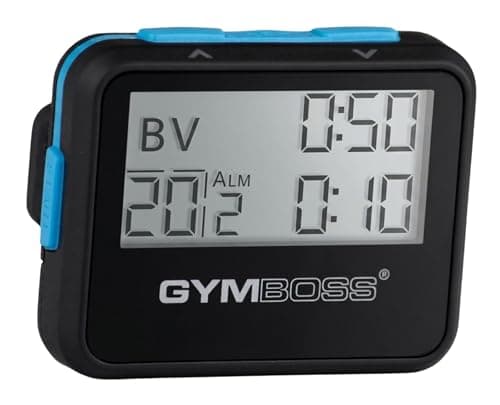
Gymboss Interval Timer and Stopwatch
Gymboss
The clip-on pocket timer: one or two intervals from 2 seconds to 99 minutes, up to 99 repeats, beep and vibrate alerts, one AAA battery — the timer you take to the park with the rope.
Best for
Rope rounds, shadowboxing anywhere, and anyone without a wall to mount a timer on
Pros
- Times one or two intervals (round + rest) and auto-repeats up to 99 times
- Beep and vibration alerts with a 1, 2, 5 or 9 second alarm length
- 2.25 x 1.75 x 0.5 in, sweat and impact resistant, removable belt clip
- Runs on a single AAA battery
Cons
- A beeper on your waistband is not a gym bell — hard to hear over music across a garage
- No lights and no display you can read from across the room
Specs from Gymboss — Interval Timer and Stopwatch (intervals, alerts, battery).
FAQ
Frequently asked questions
How long should a beginner's heavy bag workout be?
Three rounds of two minutes with a minute of rest, to start. Add one round a week and build to eight rounds over about six weeks before you lengthen the rounds to three minutes.
How many times a week should a beginner hit the heavy bag?
Three sessions a week with a rest day between them. Your hands, wrists and forearm tendons adapt more slowly than your cardio does, and that is where beginner injuries come from.
What punches should a beginner throw on the heavy bag?
Four: the jab, the cross, the lead hook and the rear hook. Learn those at half power with clean form before adding uppercuts or long combinations.
Should I hit the heavy bag hard?
Not at first. Power comes from the legs and hips rotating, and that takes months to coordinate. If you cannot stop a punch halfway through, it is harder than your control can currently handle.
Do I need gloves and wraps for the heavy bag?
Yes, both, every session. The glove spreads the impact and the wrap binds the small bones of the hand and stops the wrist folding. Bag work needs nothing else — no mouthguard, no headgear.
Is a heavy bag workout good cardio?
Yes, especially once you are doing six or more rounds with short rests. But treat the first few weeks as skill practice with a cardio side effect, not the other way round — chasing heart rate early is what wrecks technique.
Next in your kit
Best boxing round timer →Keep reading
Related guides
- Best heavy bag for beginners →
The bag this session assumes.
- Round timer settings for beginners →
Round and rest progressions.
- Can you hit a heavy bag without gloves? →
The short answer is no.
- How to wrap your hands →
Step one of every session.
- Jump rope workout for beginners →
What to do on the other days.
Sources
- —Everlast — Elite Hand Wraps 180 in (specs) · everlast.com
- —Everlast — Elite Boxing Gloves (specs and size chart) · everlast.com
- —Gymboss — Interval Timer and Stopwatch (intervals, alerts, battery) · gymboss.com