Guide · Protection
First Sparring Kit Checklist
Your first sparring session needs five things, and you probably already own two of them. Here is the checklist in buying order, the gym and USA Boxing rule behind each item, the three things people buy that they do not need, and the honest readiness test that matters more than any of the gear.
Written by Mike M. · Owner, Iron Mako Media
Published
Bag & Bell is reader-supported. Product links go through our affiliate resolver and we may earn a commission from qualifying purchases at no cost to you. Prices are the retailer's, come from Amazon's own product data on the date shown, and change — the button always opens the live listing.
Part of the Protection hub.
Before the list: the rule that outranks the gear
Sparring is not something you add to a home setup. It needs a coach watching, a partner who can control power, and a room where someone can stop the round. Every item below assumes that — and if you are building a garage setup and there is nobody else in the garage, the honest answer is that you are not buying a sparring kit yet, you are buying bag gloves. Nothing on this page makes unsupervised sparring a reasonable thing to do.
The second rule is that your gym's requirements beat this list. Ask before you buy: most gyms specify a glove weight, many specify full-coverage rather than open-face headgear for newcomers, and some supply loaner headgear so you only need to bring your own mouthguard and gloves. A five-minute question saves a return.
The checklist, in buying order
| # | Item | The spec that matters | Why it is in this position |
|---|---|---|---|
| 1 | Mouthguard | Boil-and-bite fit, adult or youth sizing | Cheapest item, hardest rule — USA Boxing Rule 39.1, and no gym waives it |
| 2 | Hand wraps | 180 in for an adult hand | You may already own these; they go on before the gloves every session |
| 3 | Gloves | 16 oz, sold in 16 oz, soft spread padding | The expensive decision, and the one most likely to be wrong if you reuse bag gloves |
| 4 | Headgear | Full coverage, cheek and chin, snug fit | Many gyms lend it, so buy after you know you will keep going |
| 5 | Shin guards | Instep coverage, hook-and-loop straps | Only if your gym spars with kicks — otherwise you do not need these at all |
1. Mouthguard — first, cheapest, non-negotiable
USA Boxing requires a mouthpiece for every boxer in competition (Rule 39.1), every gym requires one for sparring, and it costs less than a single pair of wraps. There is no version of a first sparring session where this is optional, which is why it is item one rather than item five.
A boil-and-bite guard is the right starting point: you drop it in hot water, bite, and get a fit close enough for training. The two things to check are that you bought the correct adult or youth size, and that you actually molded it rather than wearing it straight from the packet — an unmolded guard moves, and a guard that moves is a guard you spit out mid-round. Our fitting guide walks the process, and boil-and-bite vs custom covers when a dentist-made guard is worth the money.
Braces are a special case. You need a braces-specific guard, not a standard one molded around the brackets, and USA Boxing requires a molded mouthpiece plus a signed release to compete with braces (Rule 39.2). The braces roundup has the options.
2. Hand wraps — you may already own these
If you have been hitting a bag, your wraps carry over unchanged: 180 inches for an adult hand, wrapped the same way, on before the gloves every single session. Nothing about sparring changes the wrap. What it does change is how much you notice a bad one — a wrap that loosens over three rounds of bag work is annoying, and a wrap that loosens in a sparring round is how a thumb gets caught.
Buy two pairs if you are buying at all. They need washing, they take a day to dry, and the session you skip because your only pair is damp is a real thing. The wraps roundup ranks them, and the wrapping guide is the step-by-step. Quick wraps and gel wraps are a convenience product rather than an equal — see the comparison — and for sparring we would use real wraps.
3. Gloves — 16 oz, and your bag gloves probably are not
This is the item people get wrong, because it looks like a glove you already own. Nearly every gym asks adults to spar in 16 oz; some allow 14 oz for lighter adults; almost none allow 12 oz. That is not a padding-thickness rule so much as a spread rule — a heavier glove distributes the same punch across a wider, softer face, so the person in front of you takes less of it in one spot.
Two things to check before you order. First, that the model you want is made in 16 oz — plenty of beginner gloves top out at 14. Second, the padding type: a bag glove often has firm, concentrated knuckle padding that is excellent against a bag and wrong against a face. Bag gloves vs sparring gloves is the difference in detail, 12 vs 14 vs 16 oz is the weight decision, and the sparring glove roundup ranks seven pairs that are genuinely sold in 16 oz.
If the budget only stretches to one pair of gloves, buy the 16 oz sparring pair and use it on the bag too. A 16 oz glove is a slightly dull bag glove; a 12 oz bag glove is an unacceptable sparring glove. The compromise only runs one direction.
4. Headgear — buy it fourth, and fit it properly
Headgear is fourth for a practical reason: a lot of gyms keep loaners, so you can get through your first few sessions without owning any, and by then you will know whether you are going to keep going. USA Boxing requires it in all competition divisions (Rule 37.3) and every gym we know of requires it for training sparring, so you will need your own eventually — just not necessarily in week one.
When you do buy, fit is the whole specification. Headgear that moves is worse than headgear that is slightly tight: it slides over your eyes at the worst possible moment and it stops covering the thing it was bought to cover. Measure your head circumference above the brow and use the maker's chart rather than guessing S/M/L — the sizing guide has the method. For a first set, full coverage (cheeks and chin) is the right default, and many gyms require it for newcomers. The beginners roundup ranks six sets, and if you wear glasses or are protecting your nose, nose-bar headgear is a separate category.
5. Shin guards — only if you kick
If your gym is a boxing gym, stop at four items. You do not need shin guards, you will never put them on, and nobody will ask for them. If you are training kickboxing or Muay Thai and the gym spars with kicks, they move from optional to mandatory — a shin-on-elbow clash is one of the few injuries in the sport that ends a training block, and it happens at low intensity.
The specification to look for is instep coverage and a strap system that stays put, because a guard that rotates round your calf mid-round is not protecting your shin. Sizing runs to body height more than shoe size, so check the chart. Our kickboxing equipment guide covers how the rest of a kickboxing kit differs, and boxing vs kickboxing at home is the decision if you have not picked a discipline yet. Your gloves may need rethinking too — a class that catches kicks wants a more open hand than a boxing glove gives you, which is the whole of boxing gloves vs kickboxing gloves.
Three things to skip
- A chest guard, unless your gym requires one (some require them for women and for youth divisions — ask). For adult training sparring in a boxing gym it is not standard kit, and buying one before anyone asks is money that should have gone into the gloves.
- Boxing shoes. They are a real improvement on the floor and they have nothing to do with sparring safety. Train in whatever flat-soled shoes you own, and buy proper boxing shoes when the rest of the kit is settled.
- A “complete sparring bundle.” Bundles are priced to look like savings and they fail on sizing — the glove weight is usually 12 or 14 oz, the headgear comes in one size, and you end up replacing two of the four items. Our starter kit roundup explains which bundles are genuinely worth it, and they are the bag-and-glove ones, not the sparring ones.
The readiness test nobody sells you
Gear is the easy part. Before a first session, three things should already be true, and none of them is a purchase:
- You can throw a jab and a straight without your wrist collapsing. If bag work still leaves your wrists sore, that is a mechanics problem and sparring will make it worse — read the wrist pain guide first.
- You can keep your hands up for three full minutes. A dropped guard in round three is how beginners get hit cleanly, and it is a conditioning issue rather than a courage one. A round timer and honest three-minute rounds on the bag fix it.
- You know how to stop. Say “stop,” turn away, tap your partner's glove — whatever your gym uses. Agree it before the bell, not after something goes wrong.
How we put this list together
The rule citations come from the USA Boxing National Rule Book and the headgear evidence from the published study linked in the sources below, both read in full rather than summarized from elsewhere. The product specs come from each maker's own listing, cited under the cards, and every pick was confirmed currently sold before it went on the page. The ordering is our judgment of what a first sparring session actually requires, weighted for someone whose gear so far has been bought for bag work.
Picks
The five-item kit
In the order above: a boil-and-bite mouthguard, 180-inch wraps, a 16 oz glove, beginner-bracket full-coverage headgear, and shin guards only if your gym spars with kicks.
Key specs
- Sizes
- Youth (10 & under) · Adult (11+)
- Fit
- Boil-and-bite
- Build
- Triple layer, gel-fit liner
Scores · editorial, out of 10
- Fit & retention
- 8
- Breathing & speech
- 6
- Protection thickness
- 9
- Ease of molding
- 8
- Value
- 9
Pick 01 · Mouthguards
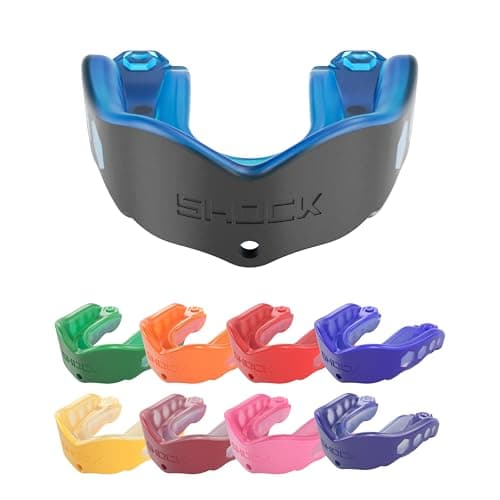
Shock Doctor Gel Max Mouthguard
Shock Doctor
The safe default boil-and-bite: a triple-layer guard with a gel-fit liner and an exoskeletal frame, in youth and adult sizes, with a convertible strap you can leave off for boxing.
Best for
A first mouthguard for an adult or a child over 10 who wants a full-thickness guard
Pros
- Triple-layer design with Shock Doctor's gel-fit liner and a heavy-duty exoskeletal frame
- Two age-based sizes
- Convertible tether — strapped for helmet sports, strapless for boxing
- Shock Doctor lists a limited dental warranty; HSA/FSA eligible per the product page
Cons
- Not compatible with braces — Shock Doctor points braces wearers to its dedicated models
- Thicker than a SISU; breathing and speaking take a session to get used to
Specs from Shock Doctor — Gel Max Mouthguard (features, sizing, fitting).
Key specs
- Length
- 180 in (4.5 m)
- Fabric
- Stretch cotton-polyester blend
- Closure
- Hook-and-loop, wide-mouth thumb loop
Scores · editorial, out of 10
- Support & elasticity
- 9
- Length options
- 7
- Thumb loop & closure
- 9
- Wash durability
- 8
- Value
- 9
Pick 02 · Hand wraps
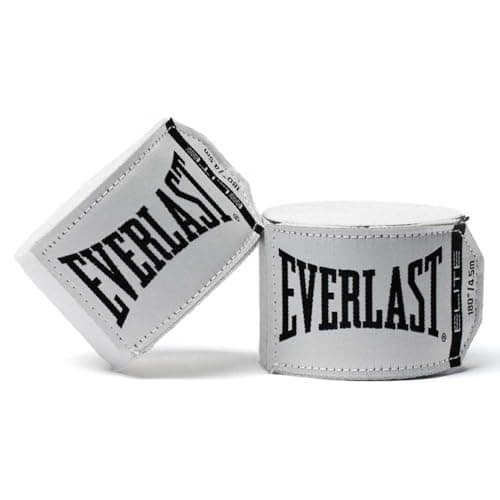
Everlast Elite Hand Wraps (180 in)
Everlast
The default adult wrap: 180 inches of stretchy cotton-poly, a wide-mouth thumb loop, hook-and-loop, machine washable.
Best for
Every adult's first wraps
Pros
- 180 in covers Mexican-style wrapping with knuckle padding for adult hands
- Wide-mouth thumb loop is easier to start than a narrow one
- Machine washable — you will wash these every week
Cons
- Only 180 in; buy the Core 120 in for small hands or kids
- Stretch wraps loosen slightly as they age
Specs from Everlast — Elite Hand Wraps 180 in (specs).
Key specs
- Weights
- 8 · 12 · 14 · 16 oz
- Closure
- Full-length hook-and-loop, splint-style wrist
- Padding
- Triple-layer C3 foam
Scores · editorial, out of 10
- Wrist support
- 8
- Knuckle padding
- 8
- Fit & closure for beginners
- 9
- Materials & durability
- 6
- Value for a first pair
- 9
Pick 03 · Boxing gloves
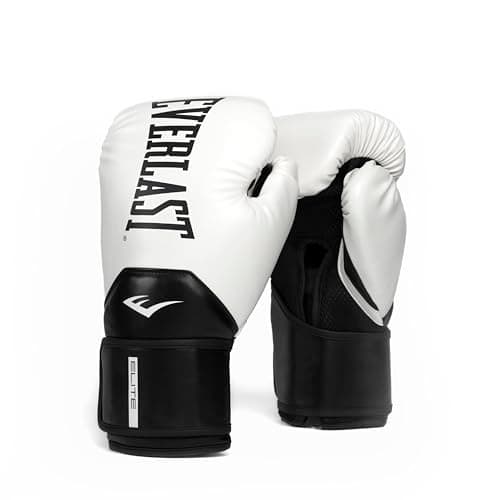
Everlast Elite Boxing Gloves
Everlast
The safe default first pair: a full-length hook-and-loop strap with a splint-style wrist, triple-layer foam, and a published weight chart to size it by.
Best for
A first pair for bag work, sized by body weight
Pros
- Everlast publishes a weight-to-ounce chart for this glove (12–14 oz at 101–150 lb, 14–16 oz at 151–175 lb, 16–18 oz over 175 lb)
- EverShield wedge-shaped strap runs the full length of the wrist — easy to close one-handed
- Mesh palm and soft lining make it comfortable for the 30-minute sessions a beginner actually does
- Attached thumb and a foam grip bar encourage a correct fist
Cons
- PVC outer shell rather than leather — expect it to show wear sooner than a leather pair
- No 10 oz option; the jump from 8 oz to 12 oz skips the size some smaller adults want
Specs from Everlast — Elite Boxing Gloves (specs and size chart).
Key specs
- Sizes
- S/M to 22.25 in · L/XL 22.25 in+
- Coverage
- Full face, with added chin padding
- Closure
- Hook-and-loop rear
Scores · editorial, out of 10
- Coverage
- 8
- Vision
- 8
- Fit & adjustability
- 8
- Weight & breathability
- 7
- Value
- 9
Pick 04 · Headgear
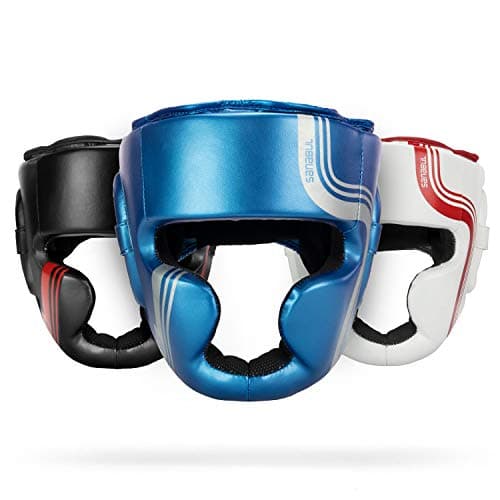
Sanabul Core Series Sparring Headgear
Sanabul
The value pick with a real size chart: two measured bands, engineered leather, full-face coverage with added chin padding, and a plain hook-and-loop closure — the specs a beginner needs and nothing they don't.
Best for
A first sparring headgear that fits by measurement, not guesswork
Pros
- Sanabul publishes the head-circumference cutoff (22.25 in) between its two sizes — measure once and you're sized
- Advanced full-face protection plus added chin padding, which the cheaper Sanabul headgear does not have
- Engineered-leather shell wipes clean; no break-in
Cons
- No face bar
- Two size bands only — the top and bottom of each band are a looser fit than a four-size model
Specs from Sanabul — CORE Series Sparring Head Gear (features, shell, closure and size guide).
Key specs
- Sizes
- XS · S/M · L/XL
- Padding
- Durasoft impact foam
- Closure
- Double hook-and-loop straps
Scores · editorial, out of 10
- Shin & instep coverage
- 7
- Strap security & fit
- 8
- Padding for a first pair
- 7
- Materials & durability
- 7
- Value
- 9
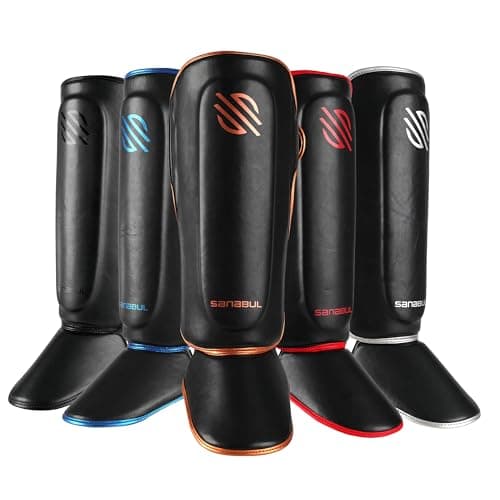
Pick 05 · Shin guards
Sanabul Essential Hook & Loop Shin Guards
Sanabul
The value pair with a small size: engineered leather, Durasoft foam, double straps and triple stitching, in XS through L/XL — the pick for a smaller adult or a teen.
Best for
A budget first pair, especially in the extra-small size the premium pairs skip
Pros
- Extra-small through L/XL — the only pair here that fits a smaller frame
- Triple-stitched throughout, per Sanabul; engineered-leather shell
- Double hook-and-loop strap fasteners and a contoured fit
Cons
- Sanabul's page doesn't detail instep coverage — check the size guide and photos for the foot section
- Thinner build than the Venum Elite; fine for pad work, less so for hard sparring
Specs from Sanabul — Essential Hook & Loop Shin Guards (features, sizes).
FAQ
Frequently asked questions
What gear do you need to spar in boxing?
A mouthguard, hand wraps, 16 oz gloves and headgear — plus shin guards if your gym spars with kicks. That is the whole list. The mouthguard is the one nobody waives, and many gyms lend headgear for your first few sessions.
Can I spar in my bag gloves?
Usually not. Most gyms require 16 oz for adult sparring and most bag gloves are 12 or 14 oz, with firmer, more concentrated knuckle padding that is wrong against a face. If you can only own one pair, buy the 16 oz sparring glove and use it on the bag — the compromise only works in that direction. See bag gloves vs sparring gloves.
Do I need headgear for my first sparring session?
Yes, but you may not need to own it yet — plenty of gyms keep loaner sets. USA Boxing requires headgear in all competition divisions (Rule 37.3) and gyms require it for training sparring, so you will buy your own eventually. Buy the mouthguard and the 16 oz gloves first.
How much does a first sparring kit cost?
The gloves dominate the total; the mouthguard and wraps together are a small fraction of one pair, and headgear sits between the two. We do not print figures because they move weekly — each button on this page opens the live price. For the whole-setup arithmetic, see what a home boxing setup costs.
Does headgear prevent concussion?
No, and no maker claims it does. Headgear is designed to reduce cuts, abrasions and clash injuries, and the published evidence supports that use. Spar with controlled power, a trusted partner and a coach in the room, and stop for any head knock.
Do I need a groin guard or a chest guard to spar?
Ask your gym — some require a chest guard for women and for youth divisions, and some require a groin protector for men. Neither is universal for adult training sparring in a boxing gym, so do not buy one before someone asks for it.
What size hand wraps for sparring?
180 inches for an adult hand, the same as for bag work — sparring does not change the wrap. 120 inch wraps suit children and small hands. See 180 vs 120 inch wraps.
Next in your kit
Best boxing gloves for sparring →Keep reading
Related guides
- When do you need boxing headgear →
Not for bags or pads — and what the evidence says.
- Best boxing gloves for sparring →
Seven pairs genuinely sold in 16 oz.
- Best boxing headgear for beginners →
Six sets ranked on fit and coverage.
- Best mouthguard for boxing →
The first protection purchase, ranked.
- How to size boxing headgear →
Measure above the brow, then use the chart.
Sources
- —USA Boxing National Rule Book, effective January 1, 2025 — Rule 37 (Headgear), Rule 39 (Mouthpiece), Appendix G (braces release) · usamastersboxing.com
- —Loosemore M et al. Use of Head Guards in AIBA Boxing Tournaments — A Cross-Sectional Observational Study. Clin J Sport Med 2017;27(1):86–88 · doi.org
- —Shock Doctor — Gel Max Mouthguard (features, sizing, fitting) · shockdoctor.com
- —Everlast — Elite Hand Wraps 180 in (specs) · everlast.com
- —Everlast — Elite Boxing Gloves (specs and size chart) · everlast.com
- —Sanabul — CORE Series Sparring Head Gear (features, shell, closure and size guide) · sanabulsports.com
- —Sanabul — Essential Hook & Loop Shin Guards (features, sizes) · sanabulsports.com