Beginner picks · Conditioning
Best Boxing Shoes for Beginners
A boxing shoe is a thin, flat, pivot-friendly sole with an ankle collar on top — nothing like a running shoe, and not something everyone training at home needs yet. Seven pairs you can actually buy today, ranked, with an honest answer on whether to buy any of them.
Written by Mike M. · Owner, Iron Mako Media
Published
Bag & Bell is reader-supported. Product links go through our affiliate resolver and we may earn a commission from qualifying purchases at no cost to you. Prices are the retailer's and change — every button opens the live price on Amazon rather than showing a stale number.
Part of the Conditioning hub.
Quick picks
| # | Product | Best for | Score | Price |
|---|---|---|---|---|
| 01 | 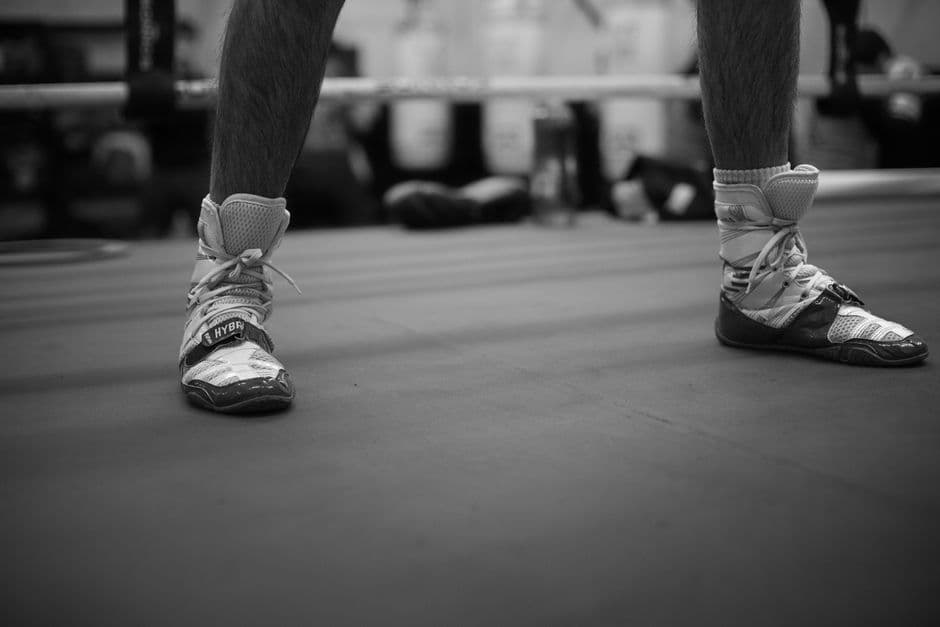 adidas Box Hog 4 The default first boxing shoe: a light mesh upper with inner reinforcements, a die-cut EVA midfoot wedge and a multidirectional outsole adidas tune for both ring canvas and hard gym floors — with the widest half-size run of anything here. | A first pair for bag work, footwork drills and a garage floor | 8.9 | |
| 02 | 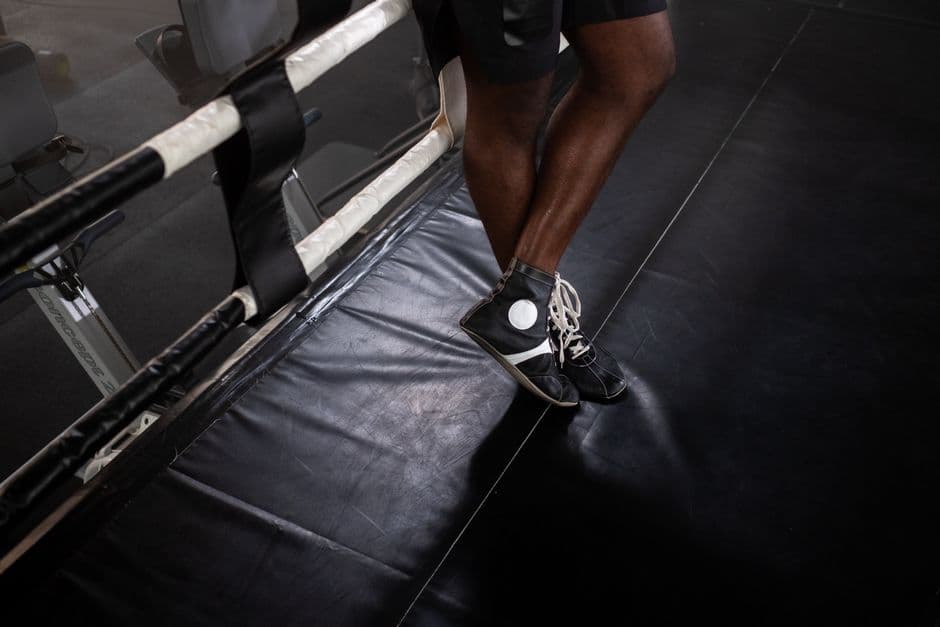 Everlast Elite 2 Boxing Shoes A high-top with an extra ankle strap on a Michelin sole, and the only shoe here that publishes a weight — 347 g in a size 9. The most support per dollar in this list. | A beginner who wants real ankle support and a published weight | 8.8 | |
| 03 | 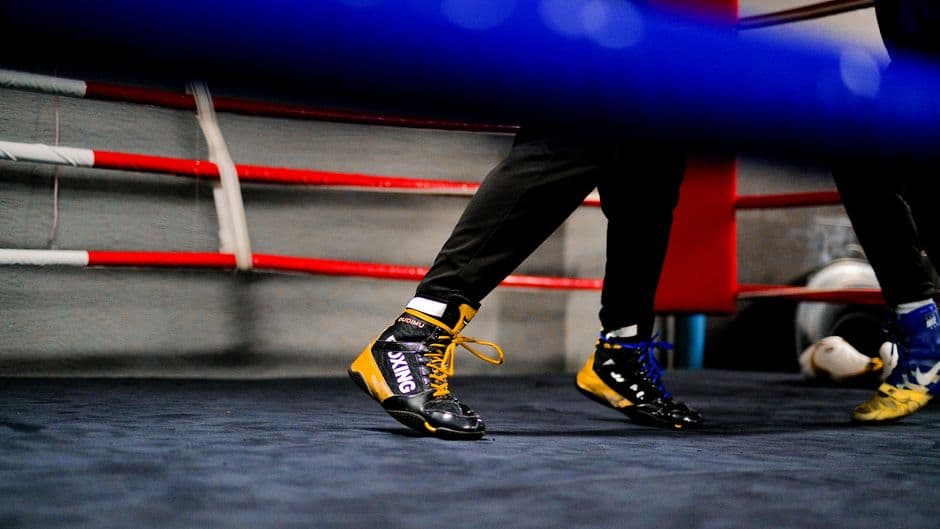 Rival RSX-Guerrero 03 High-Top Boxing Boots The traditional high-top boot, built like one: a suede or PU upper, a compound rubber outsole with a textured carbon fiber PU heel cap, and a molded EVA insole. Buy this if ankle coverage is the whole reason you are shopping. | Maximum ankle coverage and a boot that holds its shape | 8.1 | |
| 04 | 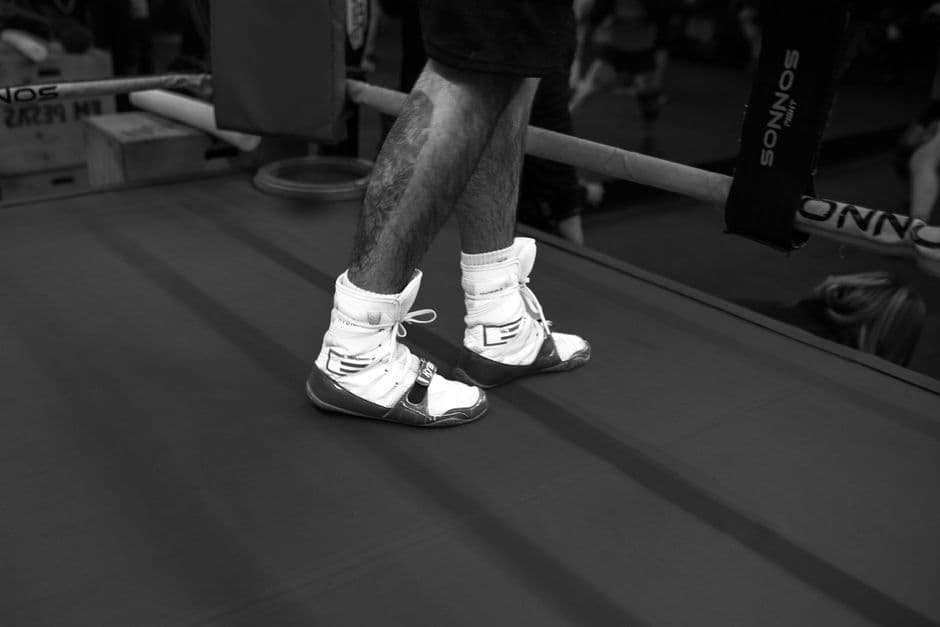 adidas Speedex Ultra The adidas flagship competition shoe: an ENERGYRODS outsole borrowed from their elite running line, a featherlight welded-mesh upper and a mid-cut collar. A genuinely excellent shoe and comfortably the wrong first purchase. | Competition, once you are actually competing | 8.0 | |
| 05 | Hayabusa Pro Boxing Shoes A mid-height shoe in microfiber leather and mesh, with a flexible grooved outsole and toe creases cut specifically for pivoting. The nicest-feeling shoe here short of the Speedex — but Hayabusa themselves say it runs large. | Pivot-heavy footwork and a shoe that feels close to the floor | 7.8 | |
| 06 | Venum Elite Boxing Shoes A mid-cut shoe in three materials — patent PU, PU Flex and honeycomb mesh — on a rubber outsole, with a glued anatomical insole. It wins this roundup on one thing nothing else comes close to: sizes 4 through 16, half sizes included. | Feet the other brands do not make a size for | 7.7 | |
| 07 | Ringside Diablo Boxing Shoes The cheapest honest way into a boxing shoe: breathable nylon mesh with a patent leather vinyl finish, a low-top collar and a non-slip rubber sole. Last on the rubric, and still the right answer on a tight budget. | Finding out whether you want boxing shoes at all | 6.9 |
Scores are our editorial judgment from published specs and manuals, weighted for a first home setup — not lab measurements. We have not tested these units.
First, the honest part: you may not need these yet
Boxing shoes are the one piece of kit on this site that a beginner can skip without any safety cost. Wraps and gloves protect your hands. A mouthguard protects your teeth. A boxing shoe does not protect anything — it changes how your feet move. That is a performance item, not a safety item, and the order you buy things in should reflect that.
If your training is bag rounds on a concrete garage slab, a flat-soled trainer you already own does most of the job. The thing that genuinely matters on concrete is that the sole is flat and does not grip so hard that your knee takes the twist your foot refused to. A chunky running shoe with a thick heel wedge is the wrong tool, because it lifts your heel, rolls your ankle outward on a pivot and puts a slab of soft foam between you and the floor. Swapping that for any flat shoe is 80% of the benefit of buying boxing shoes at all.
Boxing shoes start earning their price when one of these is true:
- You have started sparring or pad work with a coach, so you are moving laterally and pivoting under pressure rather than standing in front of a bag.
- You train on canvas, sprung wood or rubber matting, where a boxing outsole is tuned to release on a pivot and a running sole is not.
- Your ankles roll, and you want the collar height a trainer does not give you.
- You are entering an amateur bout, where a flat competition shoe is simply the standard.
If none of those apply, spend the money on the rest of the beginner kit first and come back to this page later. We would rather tell you that than sell you a shoe.
What a boxing shoe actually does differently
Strip away the colorways and there are four real differences from a normal gym shoe, and every pick below is some combination of them.
- A thin, flat sole. You want to feel the floor, because that feedback is how you learn to shift weight between your feet. There is no heel-to-toe drop worth speaking of and no cushioning stack. This is also why boxing shoes are poor for running and bad for lifting heavy — they are specialists.
- An outsole tuned to pivot. A boxer turns on the ball of the rear foot on every cross and every hook. A running outsole is built to grip in one direction and resist slip; a boxing outsole has to release predictably under rotation. Hayabusa cut angled grooves and toe creases into theirs for exactly this; adidas go further on the Speedex Ultra with an ENERGYRODS plate borrowed from their running line, placed to push you out of a pivot without giving up stability.
- Low weight. You pick your feet up thousands of times in a session. Everlast publish 347 g for a size 9 Elite 2, which is the only number in this category any manufacturer here will commit to in writing.
- An ankle collar. This is the one people shop on and the one that matters least for bag work. A collar gives lateral support and some proprioceptive feedback. It does not prevent a sprain, and the taller it is, the hotter and stiffer the shoe.
Low-top, mid-cut or high-top
Nearly all the shopping confusion in this category is here, and it is simpler than the marketing suggests. The cut is a trade between support and freedom, and a beginner is usually better served nearer the middle.
| Cut | What you get | What you give up | Who it suits |
|---|---|---|---|
| Low-top | Lightest, coolest, most ankle freedom | Almost no lateral ankle support | Bag work at home, hot garages, tight budgets |
| Mid-cut | Lateral support without the heat of a boot | Less coverage than a true high-top | Most beginners, most of the time |
| High-top | Maximum coverage, boot-like structure | Weight, heat, real break-in time | Ring work, sparring, ankles that roll |
For a first pair, a mid-cut is the safe default: enough collar to feel supported when you step laterally, little enough that you are not fighting the shoe on week one. Only two picks here sit outside that — the Ringside Diablo (low-top) and the Rival RSX-Guerrero 03 (high-top) — and both are on the list because they do their extreme well.
The specs manufacturers publish, and the ones they do not
This is a category with unusually thin published data. Gloves have weights in ounces; heavy bags have weights in pounds; boxing shoes have adjectives. Of the seven pairs here, exactly one publishes a weight. Four describe the outsole only as “rubber.” So the comparison below is built from what the manufacturers actually state, with blanks left as blanks rather than filled in.
| Pick | Cut | Upper | Outsole | Size run |
|---|---|---|---|---|
| adidas Box Hog 4 | Not stated | Breathable mesh, inner reinforcements | Multidirectional, canvas and hard floors | M04/W05 – M14/W15, half sizes |
| Everlast Elite 2 | High-top + ankle strap | Not stated | Michelin technical sole | US men's 6–13 |
| Rival RSX-Guerrero 03 | High-top | Suede (black) / PU (white) | Compound rubber, carbon fiber PU heel cap | 5–13 |
| adidas Speedex Ultra | Mid-cut | Mesh, welded overlays | ENERGYRODS with Torsion System | Full adidas run |
| Hayabusa Pro | Mid height | Microfiber leather and mesh | Flexible rubber, angled grooves | Runs large per Hayabusa |
| Venum Elite | Mid-cut | Patent PU, PU Flex, honeycomb mesh | Rubber | US 4–16, half sizes |
| Ringside Diablo | Low-top | Nylon mesh, patent leather vinyl | Non-slip rubber | Men's sizing, see chart |
How this list is ordered
By our published boxing shoe rubric: ankle support and stability at 25%, grip on canvas and hard floors at 25%, then weight and footwork feel, fit and size range, and value for a first pair. A shoe that publishes a number beats a shoe that publishes an adjective, because you can check a number. That is why the adidas Speedex Ultra sits at number four despite being the most advanced shoe here — it scores 2 out of 10 on value for a first pair — and why the Ringside Diablo is last on the rubric and still the right answer if your budget is the deciding factor.
We have not tested any of these shoes. We own no units, run no lab and have no wear data. Every spec on this page comes from the manufacturer page cited under each card, checked on 1 October 2026, including whether the model was still listed and in stock that day. Where a manufacturer does not publish something, we say so instead of guessing.
The picks in detail
Every pick, reviewed
Key specs
- Upper
- Breathable mesh, inner reinforcements
- Midsole
- Die-cut EVA wedge
- Outsole
- Multidirectional grip, canvas or gym floor
Scores · editorial, out of 10
- Ankle support & stability
- 8
- Grip on canvas and hard floors
- 9
- Weight & footwork feel
- 9
- Fit & size range
- 10
- Value for a first pair
- 9
Pick 01 · Boxing shoes · REF CON-01
adidas Box Hog 4
adidas
The default first boxing shoe: a light mesh upper with inner reinforcements, a die-cut EVA midfoot wedge and a multidirectional outsole adidas tune for both ring canvas and hard gym floors — with the widest half-size run of anything here.
Best for
A first pair for bag work, footwork drills and a garage floor
Why it is #1. It is the only shoe here that adidas explicitly describe as tuned for the ring canvas and hard gym floors — which is the actual situation of almost everyone reading this site, where the floor is a concrete slab, not a canvas. The mesh upper keeps weight down and the inner reinforcements stop it collapsing into a slipper after a month, which is the failure mode of cheap mesh. Then there is the size run: M04/W05 through M14/W15 with half sizes, in unisex sizing, which is the widest practical coverage of anything here outside the Venum. The trade is that adidas publish no weight and no collar height, so you are taking the fit on trust, and a mesh toe box scuffs on a gritty garage floor.
Pros
- adidas state the outsole is tuned for the ring canvas and for hard gym floors — the one pick here explicitly specced for a concrete slab as well as a ring
- Full half-size run from M04/W05 to M14/W15 in unisex sizing, so a smaller foot has somewhere to go
- Inner reinforcements hold the shape of a mesh upper, which is what cheap mesh shoes fail at first
- The upper is made with at least 50% recycled content
Cons
- A light mesh upper ventilates well and scuffs easily — grit on a garage floor will mark the toe box
- adidas publish no stated weight, so you cannot compare it on grams against the Everlast or the Speedex
- Less ankle coverage than a true high-top boot, if that is specifically what you are shopping for
Specs from adidas Combat Sports USA — Box Hog 4 (upper, midsole, outsole, size run).
Key specs
- Sole
- Michelin technical rubber
- Build
- High-top plus ankle strap
- Weight
- 347 g (size 9)
Scores · editorial, out of 10
- Ankle support & stability
- 9
- Grip on canvas and hard floors
- 10
- Weight & footwork feel
- 8
- Fit & size range
- 7
- Value for a first pair
- 9
Pick 02 · Boxing shoes · REF CON-02
Everlast Elite 2 Boxing Shoes
Everlast
A high-top with an extra ankle strap on a Michelin sole, and the only shoe here that publishes a weight — 347 g in a size 9. The most support per dollar in this list.
Best for
A beginner who wants real ankle support and a published weight
The most support per dollar. A high-top collar plus a separate ankle strap is more lockdown than anything else at this price, and the Michelin-made outsole is a named compound rather than a vague “non-slip rubber.” Everlast also do the thing nobody else in this roundup does: they publish a weight, 347 g in a size 9. The reason it is second and not first is the size run — US men's 6 to 13, no half sizes listed — which simply excludes a lot of people, and the fact that Everlast describe the sole in detail and never state what the upper is made of. Expect it to feel like a boot for the first week.
Pros
- Everlast publish the weight — 347 g in a size 9 — which almost nobody in this category does
- High-top collar plus a separate ankle strap: the most lockdown of any pick below the premium bracket
- A Michelin-made outsole, which is a named rubber compound rather than an unspecified non-slip rubber
- Four colorways, stocked directly by Everlast
Cons
- US men's 6 to 13 only, with no half sizes listed — smaller feet are not covered
- A high collar plus a strap is warmer and stiffer than a mid-cut; it takes a week or two to stop feeling like a boot
- Everlast do not state the upper material on the product page, only the sole technology
Specs from Everlast — Elite 2 Boxing Shoes (Michelin sole, ankle strap, 347 g, size run).
Key specs
- Upper
- Suede (black) or PU (white)
- Outsole
- Compound rubber, carbon fiber PU heel cap
- Insole
- Molded EVA
Scores · editorial, out of 10
- Ankle support & stability
- 10
- Grip on canvas and hard floors
- 9
- Weight & footwork feel
- 7
- Fit & size range
- 7
- Value for a first pair
- 6
Pick 03 · Boxing shoes · REF CON-03
Rival RSX-Guerrero 03 High-Top Boxing Boots
Rival Boxing
The traditional high-top boot, built like one: a suede or PU upper, a compound rubber outsole with a textured carbon fiber PU heel cap, and a molded EVA insole. Buy this if ankle coverage is the whole reason you are shopping.
Best for
Maximum ankle coverage and a boot that holds its shape
Buy this if ankle coverage is the entire reason you are shopping. It is a proper old-school boot: suede on the black model, a compound rubber outsole and — the detail that separates it — a textured carbon fiber PU heel cap, which is the part that deforms first on a fighter who pivots hard. The molded EVA insole is a step up from the die-cut sheet most shoes at this price use. Two honest caveats. The upper changes with the colorway, so the black suede and the white PU are not the same shoe to live in. And on a garage slab a high boot gives you the stiffness without much of the ring-canvas payoff; this is a shoe for people who train in a ring.
Pros
- A genuine old-school high-top silhouette — the most ankle coverage of anything in this roundup
- Rival specify a textured carbon fiber PU heel cap, which is the part of a boot that collapses first under a pivoting fighter
- Suede upper on the black model, with breathable mesh panels on both sides
- Molded EVA insole rather than a flat die-cut sheet
Cons
- The upper material changes with the colorway — black is suede, white is PU — so the two are not the same shoe to wear
- Sizes 5 to 13 only, and Rival do not list half sizes
- The stiffest pick here out of the box; a suede boot takes real break-in before it stops fighting your ankle
- Costs more than the Box Hog 4 or the Elite 2 without being a better first shoe
Specs from Rival Boxing US — RSX-Guerrero 03 (upper, outsole, heel cap, insole, sizes).
Key specs
- Outsole
- ENERGYRODS, with Torsion System
- Upper
- Mesh, welded overlays, 50%+ recycled
- Collar
- Mid-cut ankle support
Scores · editorial, out of 10
- Ankle support & stability
- 8
- Grip on canvas and hard floors
- 10
- Weight & footwork feel
- 10
- Fit & size range
- 8
- Value for a first pair
- 2
Pick 04 · Boxing shoes · REF CON-04
adidas Speedex Ultra
adidas
The adidas flagship competition shoe: an ENERGYRODS outsole borrowed from their elite running line, a featherlight welded-mesh upper and a mid-cut collar. A genuinely excellent shoe and comfortably the wrong first purchase.
Best for
Competition, once you are actually competing
The best shoe here and the wrong one to buy first. ENERGYRODS in the outsole plus a Torsion System for rotational movement is genuinely the most sophisticated thing in this category, and the mid-cut collar with welded mesh overlays is a smart compromise between support and heat. It is also roughly double the Box Hog 4, and the technology is tuned for a canvas ring — on concrete you are buying feel you will not register. It scores 2 out of 10 for value as a first pair, which is the whole story. If you have an amateur bout booked, it is a defensible purchase. If you have a heavy bag in a garage, it is not.
Pros
- ENERGYRODS in the outsole — adidas place the rods to push you out of a pivot without giving up stability, which nothing else here attempts
- A Torsion System supports rotational movement, the exact thing a rear-foot pivot asks of a shoe
- Welded overlays give the mesh structure without stitching weight
- Mid-cut collar: more ankle than a low-top, less heat than a full boot
Cons
- By far the most expensive shoe in this roundup, and roughly double the Box Hog 4
- The outsole is tuned for a canvas ring; on a concrete garage slab you are paying for feel you will not notice
- A competition-weight upper is thin by design and will not last as long as a trainer under daily bag work
Specs from adidas Combat Sports USA — Speedex Ultra (ENERGYRODS, Torsion, upper, collar).
Key specs
- Upper
- Microfiber leather and mesh
- Outsole
- Flexible rubber, angled grooves and toe creases
- Build
- Mid height, long laces, drop-in midsole
Scores · editorial, out of 10
- Ankle support & stability
- 8
- Grip on canvas and hard floors
- 9
- Weight & footwork feel
- 8
- Fit & size range
- 6
- Value for a first pair
- 7
Pick 05 · Boxing shoes · REF CON-05
Hayabusa Pro Boxing Shoes
Hayabusa
A mid-height shoe in microfiber leather and mesh, with a flexible grooved outsole and toe creases cut specifically for pivoting. The nicest-feeling shoe here short of the Speedex — but Hayabusa themselves say it runs large.
Best for
Pivot-heavy footwork and a shoe that feels close to the floor
The best outsole story under the flagship bracket. Angled grooves plus toe creases means the sole was designed around the pivot specifically rather than around traction in general, and a drop-in midsole is a nicer piece of construction than glued foam. Microfiber leather with mesh panels lands between the all-mesh adidas and the leather Rival on both structure and heat. The reason it sits fifth is fit risk, and it is Hayabusa's own warning, not ours: they state on the listing that these run large. On a shoe where a loose fit removes the entire point, buy from somewhere you can exchange.
Pros
- Angled sole grooves plus toe creases — the outsole is designed around the pivot rather than around general traction
- Microfiber leather with mesh panels: more structure than an all-mesh upper, less heat than a leather boot
- An ergonomic drop-in midsole, so the cushioning is a removable unit rather than glued foam
- Long laces run the full mid-height collar for genuine lockdown
Cons
- Hayabusa state on their own listing that these run large — read their chart, because a loose boxing shoe is worse than no boxing shoe
- A flexible sole means less underfoot support if you also lift in them
- Colorway availability on Hayabusa's own store is thin next to adidas or Venum
Specs from Hayabusa — Pro Boxing Shoes (materials, outsole, mid height, sizing note).
Key specs
- Upper
- Patent PU, PU Flex and honeycomb mesh
- Cut
- Mid-cut, for lateral support
- Sizes
- US 4 to 16, half sizes throughout
Scores · editorial, out of 10
- Ankle support & stability
- 8
- Grip on canvas and hard floors
- 8
- Weight & footwork feel
- 7
- Fit & size range
- 10
- Value for a first pair
- 5
Pick 06 · Boxing shoes · REF CON-06
Venum Elite Boxing Shoes
Venum
A mid-cut shoe in three materials — patent PU, PU Flex and honeycomb mesh — on a rubber outsole, with a glued anatomical insole. It wins this roundup on one thing nothing else comes close to: sizes 4 through 16, half sizes included.
Best for
Feet the other brands do not make a size for
The pick for feet the other brands do not serve. US 4 through 16 with half sizes throughout is not close to anything else on this list, and if you are at either end of that range this is effectively the only mid-cut option you have. The tri-material upper is sensibly arranged — honeycomb mesh where you need airflow, patent PU where the shoe must resist stretch — and gluing the insole in is a small, real detail that stops it sliding. What keeps it sixth is the data: Venum publish no weight and nothing about the outsole beyond “rubber,” at a price above the Everlast that does publish both.
Pros
- A US 4 to 16 run with half sizes — the widest size range of any shoe in this roundup by a distance
- Honeycomb mesh panels for airflow, with patent PU where the shoe needs to resist stretch
- The insole is glued in, which Venum say is specifically to stop it sliding under your foot
- Mid-cut collar aimed at lateral support, the direction a boxer actually loads a shoe
Cons
- Venum publish no weight and no sole compound detail beyond rubber outsole
- Patent PU is a synthetic finish — it looks sharp and it does not breathe where the mesh is not
- Premium pricing without the published specs to justify it against the Everlast Elite 2
Specs from Venum — Elite Boxing Shoes (tri-material upper, mid-cut, insole, size run).
Key specs
- Upper
- Nylon mesh with patent leather vinyl
- Collar
- Low-top
- Outsole
- Non-slip rubber
Scores · editorial, out of 10
- Ankle support & stability
- 5
- Grip on canvas and hard floors
- 7
- Weight & footwork feel
- 6
- Fit & size range
- 8
- Value for a first pair
- 10
Pick 07 · Boxing shoes · REF CON-07
Ringside Diablo Boxing Shoes
Ringside
The cheapest honest way into a boxing shoe: breathable nylon mesh with a patent leather vinyl finish, a low-top collar and a non-slip rubber sole. Last on the rubric, and still the right answer on a tight budget.
Best for
Finding out whether you want boxing shoes at all
Last on the rubric, and still the pick on a tight budget. Nylon mesh, a vinyl finish, a low-top collar and a non-slip rubber sole is a short spec sheet, and it is honest about what it is: the cheapest way to find out whether you want boxing shoes at all. For bag rounds in a hot garage, a light low-top in breathable mesh is arguably the most comfortable shoe here. It is last because it gives the least ankle support, publishes no numbers, and the vinyl will crease before leather or microfiber would. Also check the chart rather than Ringside's rule of thumb for women's sizing — subtracting two from your usual size is crude.
Pros
- The lowest price in this roundup, from a brand that has made boxing kit for decades
- A low-top is lighter and cooler, and for a beginner doing bag rounds it is genuinely enough shoe
- Breathable nylon mesh — the right material for a hot garage
- Ringside list it as available and stock it directly
Cons
- A low-top gives the least ankle coverage here; if ankle support is why you are buying, this is not the pick
- Ringside publish no weight, no sole compound and no upper thickness
- Ringside's own size note tells women to subtract two from their usual size, which is a crude conversion worth checking against the chart
- Patent vinyl creases and cracks sooner than leather or microfiber
Specs from Ringside — Diablo Boxing Shoes (upper, collar, sole, availability).
Buying guide
Sizing: boxing shoes are not sneaker-sized
This is where most of the returns in this category come from. Boxing shoes are built on a narrower last than a running shoe and are meant to fit close — close enough that your foot does not slide inside the shoe when you push off laterally. A half size of slop that you would never notice in a trainer becomes a blister and a lost pivot in a boxing shoe.
- Measure, do not assume. Every brand here publishes a chart in centimeters or inches; use it rather than your usual sneaker number. Hayabusa go as far as stating on their own listing that their Pro runs large.
- Try them with the socks you train in. Boxing socks are usually thinner than everyday socks, which is a half size of difference on its own.
- Lace to the top before judging fit. A mid-cut or high-top shoe fits completely differently half laced, which is how most people try them on at home.
- Buy where you can exchange. In a category this narrow, that is worth more than any spec on the box.
Women buying men's-sized models should use the brand's chart rather than a subtract-two rule of thumb. The adidas Box Hog 4 sidesteps the problem by listing both numbers on every size (M09/W10 and so on), which is one more reason it is our first pick.
Soles: concrete slab vs ring canvas
The surface you train on should drive this choice more than the brand does, and almost no roundup says so.
- Concrete, tile or a painted garage floor. You want a durable rubber compound with multidirectional grip, not a thin competition sole. The adidas Box Hog 4 is the only pick here whose maker names hard gym floors as a design target; the Ringside Diablo's plain rubber is also perfectly sensible on a slab. Expect any boxing sole to wear faster on concrete than on canvas.
- Canvas, sprung wood or rubber matting. This is where the pivot-specific designs earn their money — the Hayabusa grooves, the ENERGYRODS plate on the Speedex Ultra, the carbon fiber heel cap on the Rival.
- Rubber gym flooring over concrete. The best of both and the surface we would build a garage on. Our garage setup guide covers flooring, bag clearance and where the car goes.
Where shoes sit in a first kit
Near the end. The buying order that works for a home setup is wraps, then gloves, then a heavy bag, then a jump rope and a round timer. Shoes come after all of that, and after a mouthguard if sparring is anywhere on your horizon. The exception is if you are already training at a gym on canvas twice a week — in that case shoes move up, because that is the surface they are designed for.
A sensible intermediate step costs nothing: train in the flattest shoe you own. Court shoes, wrestling shoes and skate shoes are all closer to a boxing shoe than a running shoe is. If that already feels good, a real boxing shoe will feel better. If it makes no difference to you, you have your answer and you saved the money.
How long a pair lasts, and how to make it longer
Nobody in this category publishes a durability figure, so treat anyone who quotes you one with suspicion. What is predictable is the failure order: the outsole wears at the ball of the rear foot first, because that is where every pivot happens; then the upper creases and splits at the toe flex point; then the collar padding packs down. Thin competition shoes like the Speedex Ultra get there sooner than a trainer-weight shoe like the Box Hog 4, which is the real argument against buying a flagship first.
- Indoors only, always. Grit is the enemy of a thin sole.
- Air them out of the bag after every session; mesh uppers dry fast and stay dry if you let them.
- Loosen the laces before you take them off instead of heeling them off, which is what blows out the collar stitching.
- If you jump rope in them, do it on a mat — see jump rope mats — because repeated landings on concrete flatten a thin midsole quickly.
Mistakes to avoid
- Buying shoes before wraps and gloves. Shoes are a performance item; wraps and gloves are the ones protecting something.
- Buying a competition shoe for bag work. It is thinner, more expensive and wears faster, and the technology is tuned for a surface you do not have.
- Buying your sneaker size. Narrower last, closer fit, different chart. Check it.
- Assuming a high-top prevents ankle injuries. It adds lateral support and feedback. It is not a brace, and no manufacturer here claims it is.
- Wearing them to and from the gym. One walk across a parking lot puts grit in the sole for good.
- Buying on colorway. On the Rival, the color literally changes the upper material.
FAQ
Frequently asked questions
Do beginners need boxing shoes?
No. Boxing shoes are a performance item, not a safety item — unlike wraps, gloves and a mouthguard. For bag rounds on a garage floor, any flat-soled shoe you already own does most of the job. They start to earn their place once you spar, train on canvas or sprung wood, or enter an amateur bout.
What is the best boxing shoe for a beginner?
On our rubric, the adidas Box Hog 4 — it is the only pick whose maker specs the outsole for hard gym floors as well as ring canvas, and it has the widest practical half-size run. The Everlast Elite 2 is the pick if you specifically want high-top support and a published weight.
Can I use running shoes for boxing?
You can, and you should not for long. A running shoe has a raised cushioned heel that tips you forward, a soft midsole that absorbs the push you want to transmit through the floor, and an outsole built to resist slip rather than release on a pivot — which puts the rotation into your knee. A flat court, skate or wrestling shoe is a much closer substitute and costs nothing if you own one.
Low-top, mid-cut or high-top boxing shoes?
Mid-cut for most beginners: lateral support without the heat and break-in of a boot. Low-top if you train in a hot garage and mainly hit a bag. High-top if ankle coverage is the specific reason you are buying, and accept that it is heavier and stiffer.
Do boxing shoes run small?
They run narrow more than small, because they are built on a tighter last and intended to fit close. There is no universal rule — Hayabusa state on their own listing that their Pro runs large. Measure your foot, use the brand's chart, and buy somewhere you can exchange.
How much should a beginner spend on boxing shoes?
The entry bracket — where the Ringside Diablo sits — buys a real boxing shoe with a short spec sheet. The mid bracket, which covers the adidas Box Hog 4 and the Everlast Elite 2, is where published specs, half sizes and named sole compounds start appearing, and it is the sensible first purchase. The premium bracket is competition equipment. We do not print prices on this site because they move; the buttons open the live Amazon listing.
Can you wear boxing shoes outside?
No. The sole is thin and designed for a clean indoor surface; grit embeds in the rubber and then acts like ball bearings on a smooth gym floor. Carry them in your bag and change at the gym.
Are wrestling shoes the same as boxing shoes?
They are close cousins and a reasonable stand-in. Both are flat, light and high-ankled. Wrestling shoes grip harder by design because a wrestler does not want to slide, which makes them slightly less willing to release under a pivot. If you already own a pair, train in them before buying boxing-specific shoes.
Next in your kit
Best boxing round timer →Keep reading
Related guides
- Boxing equipment for beginners →
Everything that comes before shoes.
- Garage boxing gym setup →
Flooring decides which sole you want.
- Best jump rope for boxing →
The footwork tool to buy first.
- Best jump rope mats →
What saves a thin midsole on concrete.
- Best boxing gloves for beginners →
The purchase that actually protects you.
Sources
- —adidas Combat Sports USA — Box Hog 4 (upper, midsole, outsole, size run) · us.adidascombatsports.com
- —Everlast — Elite 2 Boxing Shoes (Michelin sole, ankle strap, 347 g, size run) · everlast.com
- —Rival Boxing US — RSX-Guerrero 03 (upper, outsole, heel cap, insole, sizes) · rivalboxing.us
- —adidas Combat Sports USA — Speedex Ultra (ENERGYRODS, Torsion System, upper) · us.adidascombatsports.com
- —Hayabusa — Pro Boxing Shoes (materials, outsole, mid height, sizing note) · hayabusafight.com
- —Venum — Elite Boxing Shoes (tri-material upper, mid-cut, insole, size run) · venum.com
- —Ringside — Diablo Boxing Shoes (upper, collar, sole, availability) · ringside.com