Guide · Conditioning
Do You Need Boxing Shoes?
Not to start. You need them the day your footwork gets good enough that the floor becomes the limiting factor, which for most people training at home is months in, not week one. Here is what they actually change, why running shoes are the genuinely bad option, and what to wear in the meantime.
Written by Mike M. · Owner, Iron Mako Media
Published
Bag & Bell is reader-supported. Product links go through our affiliate resolver and we may earn a commission from qualifying purchases at no cost to you. Prices are the retailer's, come from Amazon's own product data on the date shown, and change — the button always opens the live listing.
Part of the Conditioning hub.
The short answer
No, you do not need boxing shoes to start boxing at home. A beginner's first three purchases are gloves, wraps and something to hit, and nothing about a pair of boots changes how well those work. What boxing shoes give you is a thin, flat, grippy-but-pivotable sole and a snug fit around the foot, which starts to matter once you are moving properly and the floor is what is stopping you.
If you are shadowboxing in trainers and wondering why your pivots feel sticky, that is the moment the purchase makes sense. If you are three weeks in and still learning to throw a straight punch, it is not.
What boxing shoes actually change
Three things, and only one of them is what the marketing emphasises.
- The sole, which is the real reason. A boxing shoe has a thin, flat sole with multidirectional grip, designed so the ball of the foot can turn on the floor without catching. Every pivot in boxing — the rear foot on a cross, the lead foot on a hook — depends on the shoe letting you rotate. A thick, soft sole fights that rotation, and over hundreds of pivots that is both slower and harder on the knee.
- Ground feel. Less material between your foot and the floor means better proprioception, which is why boxing shoes feel "faster" even though they do not make you faster. You simply know where your weight is.
- Ankle support, which is the most oversold feature. A high-top boxing boot does hold the ankle, and that is worth something if yours rolls. But most of the perceived support in a boxing shoe comes from the snug fit and the flat base, not the height of the collar.
| Footwear | Pivot | Ground feel | Verdict for home training |
|---|---|---|---|
| Boxing shoes | Designed for it | Excellent | The right tool, once your footwork needs it |
| Flat-soled trainers (canvas, court shoes) | Good enough | Good | The sensible stand-in, and most people already own a pair |
| Bare feet on a mat | Excellent | Excellent | Fine for shadowboxing and bag work; no protection if you drop a plate |
| Wrestling shoes | Good | Excellent | Close cousin — grippier, built for mat not floor |
| Running shoes | Poor — the sole resists rotation | Poor | The one option to actively avoid |
Why running shoes are the bad option
This is worth being blunt about, because running shoes are what most people reach for. A running shoe is built to absorb repeated vertical impact and to roll forward through a gait cycle. That means a thick, soft midsole, a raised heel, and a tread pattern designed to grip in a straight line.
Every one of those is wrong for boxing. The soft midsole compresses sideways under a pivot, so your ankle moves relative to the floor and your base is unstable. The raised heel shifts your weight forward and changes your stance. The straight-line grip resists exactly the rotation you are trying to make. People who train in running shoes often report knee discomfort on pivots, and the shoe is the usual culprit.
If the only shoes you own are running shoes, train barefoot on a mat instead until you can buy something flat. That is a genuine recommendation, not a compromise.
When the purchase is worth it
Four signals, any one of which makes it a reasonable buy.
- Your pivots catch. You can feel the shoe gripping when you want it to turn. This is the main one, and it is the signal that your footwork has outgrown your footwear.
- You have started sparring or going to a club. Moving around a partner on a gym floor asks much more of a shoe than standing in front of a bag does.
- Your ankles roll. A high-top with a real ankle strap is a legitimate answer to a history of ankle problems.
- You train on a floor you cannot change. Rough concrete chews up canvas trainers and is unpleasant barefoot. A proper sole lasts longer on it.
Notice what is not on that list: wanting to look the part, and wanting to be faster. Neither is a reason, and the second is not something a shoe delivers.
Low-top, mid-cut or high-top?
Low-tops are the lightest and give the most ankle mobility, which suits bag work and footwork drills where you are not changing direction against a partner. Mid-cuts are the common compromise and what most first pairs are. High-tops wrap the ankle and often add a strap over it; they are heavier and warmer, and they are the pick if ankle support is genuinely why you are buying.
For a first pair at home, a low-top or mid-cut is the sensible choice. Full ranking of the field, with the sole and upper details for each, is in best boxing shoes for beginners.
Sizing, briefly
Boxing shoes run snug by design — the fit is part of the stability. Most brands size close to true street size, but the fit is narrower through the midfoot than a trainer and the toe box is shorter. Order from the brand's own chart, expect them to feel tighter than your everyday shoes, and wear thin socks rather than thick ones. A shoe you have sized up to be comfortable will slide inside itself on a pivot, which removes the reason you bought it.
What about wrestling shoes?
They are the nearest relative and plenty of people box in them. The sole is thin and flat like a boxing shoe's, but it is built for grip on a mat rather than rotation on a hard floor, so it can be stickier than you want on a pivot. The upper is usually softer and gives less lateral support. They are a reasonable substitute if you already own a pair, and we compare the two properly in boxing shoes vs wrestling shoes.
Where the money is better spent first
If you are building a home setup and the budget is finite, the order is not controversial: gloves that fit, two pairs of wraps, something to hit, and a timer. Shoes come after all of those, and usually after a mouthguard too if you have any intention of sparring. Our boxing equipment for beginners checklist sets the order out, and how much a home setup costs puts tiers around it.
Picks
If the answer is yes
A low-top to find out whether you want them at all, a mid-cut first pair for bag work and footwork drills, and a high-top with a real ankle strap if support is the reason you are buying.
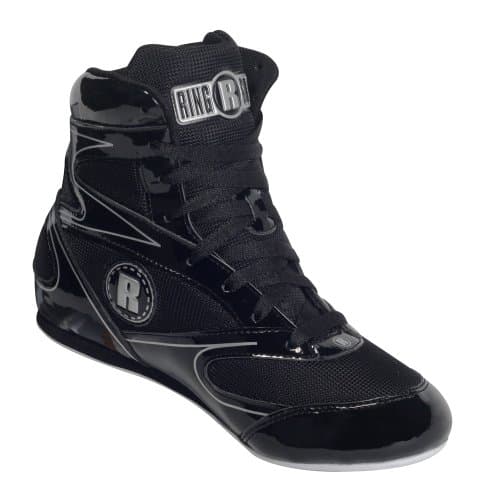
Key specs
- Upper
- Nylon mesh with patent leather vinyl
- Collar
- Low-top
- Outsole
- Non-slip rubber
Scores · editorial, out of 10
- Ankle support & stability
- 5
- Grip on canvas and hard floors
- 7
- Weight & footwork feel
- 6
- Fit & size range
- 8
- Value for a first pair
- 10
Pick 01 · Boxing shoes
Ringside Diablo Boxing Shoes
Ringside
The cheapest honest way into a boxing shoe: breathable nylon mesh with a patent leather vinyl finish, a low-top collar and a non-slip rubber sole. Last on the rubric, and still the right answer on a tight budget.
Best for
Finding out whether you want boxing shoes at all
Pros
- The lowest price in this roundup, from a brand that has made boxing kit for decades
- A low-top is lighter and cooler, and for a beginner doing bag rounds it is genuinely enough shoe
- Breathable nylon mesh — the right material for a hot garage
- Ringside list it as available and stock it directly
Cons
- A low-top gives the least ankle coverage here; if ankle support is why you are buying, this is not the pick
- Ringside publish no weight, no sole compound and no upper thickness
- Ringside's own size note tells women to subtract two from their usual size, which is a crude conversion worth checking against the chart
- Patent vinyl creases and cracks sooner than leather or microfiber
Specs from Ringside — Diablo Boxing Shoes (upper, collar, sole, availability).
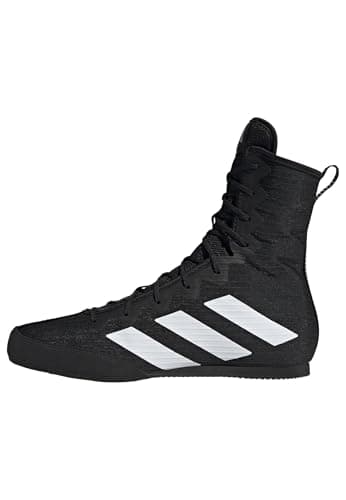
Key specs
- Upper
- Breathable mesh, inner reinforcements
- Midsole
- Die-cut EVA wedge
- Outsole
- Multidirectional grip, canvas or gym floor
Scores · editorial, out of 10
- Ankle support & stability
- 8
- Grip on canvas and hard floors
- 9
- Weight & footwork feel
- 9
- Fit & size range
- 10
- Value for a first pair
- 9
Pick 02 · Boxing shoes
adidas Box Hog 4
adidas
The default first boxing shoe: a light mesh upper with inner reinforcements, a die-cut EVA midfoot wedge and a multidirectional outsole adidas tune for both ring canvas and hard gym floors — with the widest half-size run of anything here.
Best for
A first pair for bag work, footwork drills and a garage floor
Pros
- adidas state the outsole is tuned for the ring canvas and for hard gym floors — the one pick here explicitly specced for a concrete slab as well as a ring
- Full half-size run from M04/W05 to M14/W15 in unisex sizing, so a smaller foot has somewhere to go
- Inner reinforcements hold the shape of a mesh upper, which is what cheap mesh shoes fail at first
- The upper is made with at least 50% recycled content
Cons
- A light mesh upper ventilates well and scuffs easily — grit on a garage floor will mark the toe box
- adidas publish no stated weight, so you cannot compare it on grams against the Everlast or the Speedex
- Less ankle coverage than a true high-top boot, if that is specifically what you are shopping for
Specs from adidas Combat Sports USA — Box Hog 4 (upper, midsole, outsole, size run).
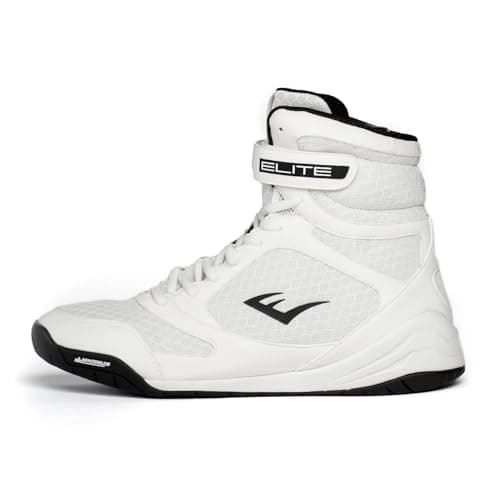
Key specs
- Sole
- Michelin technical rubber
- Build
- High-top plus ankle strap
- Weight
- 347 g (size 9)
Scores · editorial, out of 10
- Ankle support & stability
- 9
- Grip on canvas and hard floors
- 10
- Weight & footwork feel
- 8
- Fit & size range
- 7
- Value for a first pair
- 9
Pick 03 · Boxing shoes
Everlast Elite 2 Boxing Shoes
Everlast
A high-top with an extra ankle strap on a Michelin sole, and the only shoe here that publishes a weight — 347 g in a size 9. The most support per dollar in this list.
Best for
A beginner who wants real ankle support and a published weight
Pros
- Everlast publish the weight — 347 g in a size 9 — which almost nobody in this category does
- High-top collar plus a separate ankle strap: the most lockdown of any pick below the premium bracket
- A Michelin-made outsole, which is a named rubber compound rather than an unspecified non-slip rubber
- Four colorways, stocked directly by Everlast
Cons
- US men's 6 to 13 only, with no half sizes listed — smaller feet are not covered
- A high collar plus a strap is warmer and stiffer than a mid-cut; it takes a week or two to stop feeling like a boot
- Everlast do not state the upper material on the product page, only the sole technology
Specs from Everlast — Elite 2 Boxing Shoes (Michelin sole, ankle strap, 347 g, size run).
FAQ
Frequently asked questions
Do you need boxing shoes to box?
No, especially not as a beginner training at home. Gloves, wraps and something to hit come first. Boxing shoes become worth buying when your pivots start catching on the floor, which is a sign your footwork has outgrown your footwear.
Can you box in running shoes?
You can, and it is the worst common option. A thick, soft midsole compresses sideways under a pivot, the raised heel shifts your stance forward, and the straight-line tread resists the rotation you are trying to make. Train barefoot on a mat instead until you can buy something flat.
What can I wear instead of boxing shoes?
Flat-soled trainers — canvas shoes, court shoes, anything with a thin sole and no raised heel — or bare feet on a mat. Both pivot far better than a running shoe.
Do boxing shoes make you faster?
Not directly. They let your foot rotate without the sole fighting it and give you better ground feel, which makes good footwork easier to execute. The speed comes from the footwork, not the shoe.
Should boxing shoes be tight?
Snug, yes — the close fit is part of what makes them stable. They are narrower through the midfoot and shorter in the toe box than a trainer. Sizing up for comfort means the foot slides inside the shoe on a pivot, which defeats the purpose.
Low-top or high-top boxing shoes for a beginner?
Low-top or mid-cut for most people. They are lighter and give more ankle mobility, which suits bag work and footwork drills. Choose a high-top if your ankles roll and the support is specifically why you are buying.
Next in your kit
Best jump rope for boxing →Keep reading
Related guides
- Best boxing shoes for beginners →
The full field, if the answer is yes.
- Boxing shoes vs wrestling shoes →
The nearest substitute, compared.
- Boxing equipment for beginners →
What to buy before shoes.
- Best jump rope mats →
If you are training barefoot in a garage.
Sources
- —Ringside — Diablo Boxing Shoes (upper, collar, sole) · ringside.com
- —adidas Combat Sports USA — Box Hog 4 (upper, midsole, outsole) · us.adidascombatsports.com
- —Everlast — Elite 2 Boxing Shoes (Michelin sole, ankle strap, weight) · everlast.com