Guide · Gloves
How Tight Should Boxing Gloves Be?
Snug, with the fist closed, wraps on — tight enough that the glove moves with your hand rather than around it, loose enough that your fingers are not pressed into the end and nothing goes numb. That sounds vague until you have a test for it, so here is the five-point check, what each failure feels like, and the fix for each one.
Written by Mike M. · Owner, Iron Mako Media
Published
Bag & Bell is reader-supported. Product links go through our affiliate resolver and we may earn a commission from qualifying purchases at no cost to you. Prices are the retailer's, come from Amazon's own product data on the date shown, and change — the button always opens the live listing.
Part of the Gloves hub.
How to check boxing glove fit · 6 steps
Step 01
Put your usual wraps on first
Never test a glove bare-handed. A 180 in wrap with a knuckle pad adds real bulk and can change the fit by a full size. Test with the wraps you will actually train in.
Step 02
Slide the hand in and close a fist
Your hand should slide in with a little resistance, not drop in. With a closed fist, the knuckles should land on the thickest part of the knuckle padding — not behind it, and not off the top edge of it.
Step 03
Check the fingertips
A small gap between your fingertips and the end of the compartment is correct. Fingertips pressing the end means the compartment is too short; a large empty space means the glove is too big.
Step 04
Close the strap and look at where it lands
The strap should fasten around the middle of its travel. Closing at the very end of the strap, or having to double it back, both mean the glove is the wrong size for your hand and wrap combination.
Step 05
Shake the hand, then shadowbox a minute
The glove should move with the hand. If it rotates or slides on the hand, it is too loose. If your fingers tingle, go numb, or go cold, it is too tight — loosen the strap first, and if that does not fix it, the glove or the wrap is wrong.
Step 06
Hit something light
Two or three easy rounds on a bag will tell you what standing still cannot: whether the hand shifts forward on impact and whether the wrist stays in line. Both are fit problems, not technique problems.
The honest answer, in one sentence
A boxing glove should be snug with a closed fist and your usual wraps on — tight enough that it moves as one piece with your hand, loose enough that your fingers are not compressed and your circulation is unaffected. Everything below is a way of testing that without guessing.
Why too loose is the worse mistake
Most people err on the big side, usually because "more padding is safer" gets confused with "a bigger glove is safer". They are not the same thing. In a glove that is too large, three things go wrong on every punch. The fist sits back from the knuckle deck, so the impact lands on the edge of the padding rather than the middle. The hand slides forward inside the glove, which rubs the knuckles and bruises them. And the strap — designed to close around a fuller compartment — runs out of travel before it actually braces the joint, so the wrist is unsupported at exactly the moment a hook lands flat.
A slightly tight glove is uncomfortable and you will notice it immediately. A loose glove feels fine and quietly removes most of the protection you paid for. That asymmetry is why, when in doubt, you should err snug.
What each failure feels like
| Symptom | What it means | Fix |
|---|---|---|
| Fingertips press the end of the glove | Compartment too short for your hand | Size up within the same model, or switch to a glove sold by hand size |
| Knuckles sit behind the padding | Glove too big | Size down, or add a thicker wrap to fill it |
| Hand slides forward when you punch | Glove too big, or strap closed too low | Size down; re-close the strap over the wrist bone, not the forearm |
| Strap closes at the very end of its travel | Glove too big for your hand and wrap | Size down, or move from a 120 in to a 180 in wrap |
| Fingers tingle, go numb or go cold | Too tight — usually the wrap, not the glove | Loosen the strap; re-wrap with less tension across the hand |
| Wrist aches after bag rounds | Strap not bracing the joint | Close the strap across the wrist bone and check it lands mid-travel |
Wraps change the answer, which is why you test with them
A full 180 in cotton wrap with a proper knuckle pad takes up real volume across the hand. A 120 in wrap takes up noticeably less. Gel quick wraps take up less again. So the same glove can fit three different ways depending on what is underneath it — which cuts both ways, and is genuinely useful.
If your glove is a touch roomy, move up to a 180 in wrap before you buy a new glove; it is the cheapest fix there is. If your glove is a touch short, drop to a 120 in wrap or build a thinner knuckle pad with the same 180 in. Our 180 vs 120 in hand wraps page covers which length suits which hand, and how to wrap your hands for boxing shows where the bulk actually comes from.
Ounces are not a fit measurement
This trips up nearly every first-time buyer. The ounce rating on a glove is its weight, which is mostly padding — it is a protection spec matched to your body weight and what you are hitting, not a measurement of the hand compartment. Two 16 oz gloves from different brands can have noticeably different internal volumes.
What is reliable is that within a single model the compartment grows with the weight. So the standard fix for a short glove is to go up a weight inside the same line, and the fix for a loose one is to go down — provided the new weight still suits your body weight and training. Get the number from our boxing glove size chart first, then fit the model to it. If your hands are at either extreme, we have pages for both: big hands and small hands.
New gloves are supposed to feel tight
A new glove — leather especially — is stiff, and the first few sessions will feel tighter across the knuckles than the same glove will in a month. The foam has not compressed, the shell has not moulded, and the fist does not close as easily. That is break-in, not a sizing error. The way to tell them apart: a glove that needs breaking in is tight across the knuckles and loosens as it is used; a glove that is too small presses your fingertips into the end and always will. See how to break in boxing gloves.
Where the strap should sit
Across the wrist bone, not up the forearm and not down over the back of the hand. A strap closed too high leaves the joint free to fold; closed too low it compresses the hand without supporting anything. If your glove has a long full-wrist strap, wrap it so the first pass crosses the joint and the end lands flat rather than curling. A strap that will not lie flat is usually a sign the glove is too big.
Sparring versus bag work
The fit standard does not change, but the consequences of getting it wrong do. On a bag, a loose glove bruises knuckles and tires a wrist. In sparring, it also means the glove moves when you block, so a punch you thought you caught on the padding lands somewhere else. If you are moving into sparring, re-run the five-point test with the heavier glove you will use — a 16 oz glove is not simply a 14 oz with more foam, and the fit will differ. Our bag gloves vs sparring gloves page explains why the two jobs want different builds.
Picks
What to buy once you know your fit
A glove with a full weight run so you can size it properly, and wraps in both common lengths — because changing the wrap is the cheapest way to change the fit of a glove you already own.
Key specs
- Weights
- 8 · 12 · 14 · 16 oz
- Closure
- Full-length hook-and-loop, splint-style wrist
- Padding
- Triple-layer C3 foam
Scores · editorial, out of 10
- Wrist support
- 8
- Knuckle padding
- 8
- Fit & closure for beginners
- 9
- Materials & durability
- 6
- Value for a first pair
- 9
Pick 01 · Boxing gloves
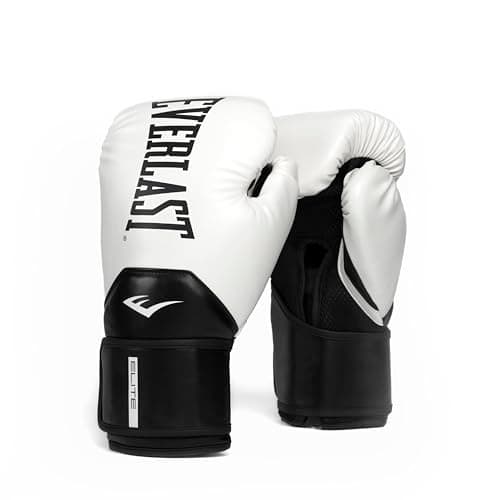
Everlast Elite Boxing Gloves
Everlast
The safe default first pair: a full-length hook-and-loop strap with a splint-style wrist, triple-layer foam, and a published weight chart to size it by.
Best for
A first pair for bag work, sized by body weight
Pros
- Everlast publishes a weight-to-ounce chart for this glove (12–14 oz at 101–150 lb, 14–16 oz at 151–175 lb, 16–18 oz over 175 lb)
- EverShield wedge-shaped strap runs the full length of the wrist — easy to close one-handed
- Mesh palm and soft lining make it comfortable for the 30-minute sessions a beginner actually does
- Attached thumb and a foam grip bar encourage a correct fist
Cons
- PVC outer shell rather than leather — expect it to show wear sooner than a leather pair
- No 10 oz option; the jump from 8 oz to 12 oz skips the size some smaller adults want
Specs from Everlast — Elite Boxing Gloves (specs and size chart).
Key specs
- Length
- 180 in (4.5 m)
- Fabric
- Stretch cotton-polyester blend
- Closure
- Hook-and-loop, wide-mouth thumb loop
Scores · editorial, out of 10
- Support & elasticity
- 9
- Length options
- 7
- Thumb loop & closure
- 9
- Wash durability
- 8
- Value
- 9
Pick 02 · Hand wraps
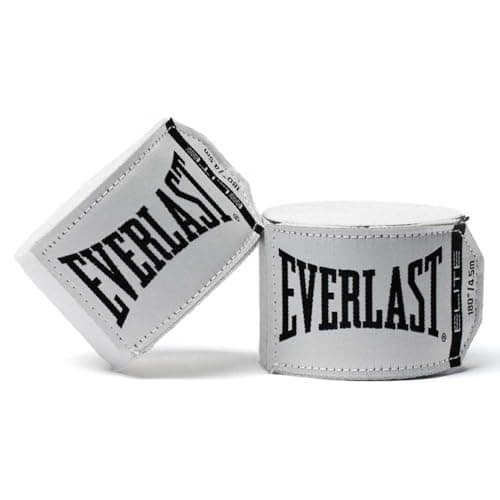
Everlast Elite Hand Wraps (180 in)
Everlast
The default adult wrap: 180 inches of stretchy cotton-poly, a wide-mouth thumb loop, hook-and-loop, machine washable.
Best for
Every adult's first wraps
Pros
- 180 in covers Mexican-style wrapping with knuckle padding for adult hands
- Wide-mouth thumb loop is easier to start than a narrow one
- Machine washable — you will wash these every week
Cons
- Only 180 in; buy the Core 120 in for small hands or kids
- Stretch wraps loosen slightly as they age
Specs from Everlast — Elite Hand Wraps 180 in (specs).
Key specs
- Length
- 120 in × 2 in
- Fabric
- Polyester-cotton blend
- Closure
- Thumb strap, hook-and-loop
Scores · editorial, out of 10
- Support & elasticity
- 6
- Length options
- 6
- Thumb loop & closure
- 8
- Wash durability
- 8
- Value
- 10
Pick 03 · Hand wraps
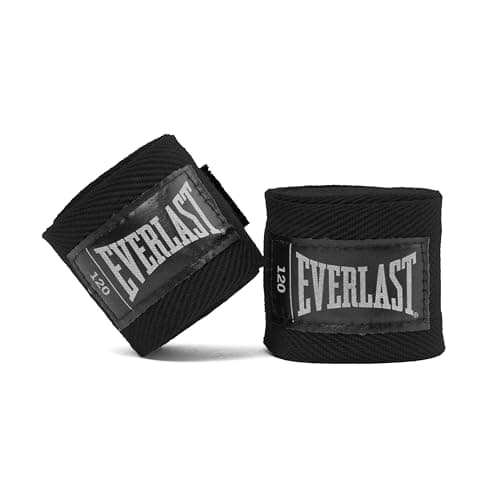
Everlast Core Hand Wraps (120 in)
Everlast
A 120 in, 2 in wide poly-cotton wrap — the right length for small hands, kids, and anyone who finds 180 in bulky.
Best for
Small hands, kids, and slim gloves
Pros
- 120 in fits under an 8–10 oz glove without crowding the compartment
- Machine washable
- Cheapest wrap on this list
Cons
- Not enough length for a padded Mexican-style adult wrap
- Less stretch than the Elite
Specs from Everlast — Core Hand Wraps 120 in (specs).
FAQ
Frequently asked questions
How tight should boxing gloves be?
Snug with a closed fist and your usual wraps on. The glove should move as one piece with your hand, your knuckles should land on the thickest part of the padding, and the strap should fasten around the middle of its travel — with no numbness and no sliding.
Should boxing gloves be tight or loose?
Err tight. A slightly snug glove is uncomfortable and you will know about it. A loose glove feels fine while removing most of the protection, because the knuckles sit off the padding and the strap cannot brace the wrist.
Should my fingers touch the end of my boxing gloves?
No. You want a small gap between your fingertips and the end of the compartment with the fist closed. Fingertips pressing the end means the glove is too short for your hand.
Why do my hands go numb in boxing gloves?
Almost always the hand wrap, pulled too tight across the back of the hand or the wrist, rather than the glove itself. Take the glove off and re-wrap with even, firm tension. If it still happens, the glove is too small.
Do boxing gloves loosen up over time?
Yes. The foam compresses and the shell moulds to your hand, leather more than synthetic. A new glove that is tight across the knuckles will settle in two to four weeks; a glove that presses your fingertips into the end will not.
Does the hand wrap change what size glove I need?
It can change the fit by a full size. Always test with the wraps you train in, and remember that moving between a 180 in and a 120 in wrap is the cheapest way to adjust the fit of a glove you already own.
Next in your kit
How to wrap your hands for boxing →Keep reading
Related guides
- Boxing glove size chart →
Body weight to ounces, before you worry about fit.
- How to choose boxing gloves →
The full decision, from use to closure.
- Best boxing gloves for small hands →
When the glove is simply too big for you.
- 180 vs 120 in hand wraps →
The cheapest way to change a glove's fit.
Sources
- —Everlast — Elite Boxing Gloves (specs and size chart) · everlast.com
- —Everlast — Elite Hand Wraps 180 in (specs) · everlast.com
- —Everlast — Core Hand Wraps 120 in (specs) · everlast.com