Guide · Heavy Bags
How to Stop a Freestanding Bag From Moving
A freestanding bag that walks across the garage after every combination is almost always under-filled, standing on the wrong surface, or set too tall for its base. All three are fixable in an afternoon, and none of them requires drilling anything. Here is the order to fix them in.
Written by Mike M. · Owner, Iron Mako Media
Published
Bag & Bell is reader-supported. Product links go through our affiliate resolver and we may earn a commission from qualifying purchases at no cost to you. Prices are the retailer's, come from Amazon's own product data on the date shown, and change — the button always opens the live listing.
Part of the Heavy Bags hub.
How to stop a freestanding punching bag from sliding · 6 steps
Step 01
Check what is actually in the base
Open the cap and look. A base filled with water is at roughly the lightest weight that base can be. Most freestanding bases hold substantially more weight in sand than in water — the Century Original Wavemaster, for example, is rated around 250 lb filled with water, and sand is denser still.
Step 02
Drain it and refill with sand
This is the single biggest improvement available and it costs the price of a few bags of play sand. Use dry, clean sand, funnel it in slowly, and tap the base as you go so it settles without voids. Keep the cap and the seal — you will want to move the bag one day.
Step 03
Put grip under the base
A rubber mat, interlocking foam tiles or a piece of stair tread under the base stops it sliding on sealed concrete, tile or laminate. This is the cheapest fix and often the only one you need on a smooth floor.
Step 04
Lower the bag if it is adjustable
Most freestanding bags adjust for height. Every inch you raise the striking surface increases the leverage your punches apply to the base. Set it to the lowest height that still has the target at your head and chest.
Step 05
Change where you stand
Hitting the bag square pushes it straight back and it returns. Hitting across it rotates the base and walks it. If the bag migrates in one direction, you are consistently striking it off-centre.
Step 06
Add weight on top of the base, carefully
A sandbag or a weight plate laid flat on the base ring adds ballast where it helps. Do not stack plates against the pole, do not strap anything to the bag body, and do not add so much that the base cannot be moved safely.
Why freestanding bags move
A freestanding bag is a tall mass on a short base. Every punch applies a force high up and the base has to resist the turning moment that creates. Two things decide whether it does: how much the base weighs, and how much friction there is between the base and the floor. That is the entire problem, and every fix below is one or the other.
There is a third factor people miss: height. Raising the bag by six inches increases the leverage your punches have over the base, so the same bag at the same fill weight becomes noticeably less stable. If you raised it when you bought it because it looked better, that may be your whole issue.
Fix one: fill it with sand, not water
Nearly every freestanding bag ships empty and tells you to fill the base with water or sand. Water is easier — a hose, ten minutes, done — and it is what most people use. It is also the lighter option for the same volume, which means you are running the bag at close to its lightest possible setting.
Manufacturers publish the difference. Century rates the Original Wavemaster at around 250 lb filled with water and the XXL at up to 270 lb; a sand fill in the same base is heavier again. The Ringside Cobra Fitness reflex base, to take another example, is published at up to 125 lb with water and up to 240 lb with sand. That is close to double, from the same base, for the price of a few bags of sand.
The trade is honest: a sand-filled base is a serious job to move and a nuisance to empty. If you expect to relocate the bag often, water plus a grip mat may be the better compromise. If the bag lives in one corner of a garage, fill it with sand and stop thinking about it.
| Fix | Cost | Effort | How much it helps |
|---|---|---|---|
| Refill the base with sand | Low — a few bags of play sand | An afternoon | The biggest single improvement available |
| Grip mat or floor tiles underneath | Low | Minutes | Large on smooth floors; little on carpet |
| Lower the bag's height setting | Free | Minutes | Moderate, and immediate |
| Weight plate or sandbag on the base ring | Low if you own plates | Minutes | Moderate; do not overdo it |
| Change your striking angle | Free | Ongoing | Moderate — stops the bag walking in one direction |
| Buy a bag with a bigger base | High | A purchase | Large, if the current base is genuinely undersized |
Fix two: grip under the base
On sealed concrete, tile, laminate or vinyl, the base does not slide because it is light — it slides because there is nothing to hold it. A rubber mat, a square of interlocking EVA floor tiles or a section of heavy stair tread underneath changes that immediately, and it is the cheapest thing on this page.
Some freestanding bags use a suction-cup base designed for exactly this, which works well on a smooth, clean, flat floor and does nothing at all on rough concrete or carpet. Check which kind of base you have before you buy a mat for it. If you are also skipping rope in the same spot, a mat does double duty — see our jump rope mat roundup.
On carpet, the opposite problem applies: there is plenty of friction but the base rocks on a soft surface. A rigid board under the base, with a mat on top of it, is the usual answer.
Fix three: height, and how you are hitting it
Most freestanding bags adjust through several height settings — the Original Wavemaster has seven between 47 and 68 in, the XXL stands 69 in overall. Set it to the lowest height at which the striking surface still covers head and body height for you. Every extra inch is leverage against the base.
Then watch which way the bag travels. A bag that slides straight back and returns is being hit square, and that is mostly a ballast problem. A bag that rotates and walks sideways across the floor is being hit consistently off-centre — usually by hooks thrown across the bag rather than into it. That is worth knowing because it is a technique signal as much as an equipment one.
When the bag is simply too small for you
There is a limit to what ballast can do. A 190 lb-filled base under a heavier adult throwing hard combinations will move no matter what you put under it, and the honest answer is that the bag is under-specified rather than badly set up. Base capacity is the spec to compare: the Century XXL fills to around 270 lb with a 28 in base, which is a different category from a 170 lb youth base.
If you are at that point, read best freestanding punching bag for the heavier-based options, and freestanding vs hanging for the bigger question — because a hanging bag solves the movement problem completely if your building allows one.
What not to do
- Do not fill the base with water and then add antifreeze or salt. It does not meaningfully change the weight and it makes the base a disposal problem.
- Do not stack loose weight plates against the pole. They slide, they chip the base, and they are an ankle injury waiting to happen.
- Do not strap the bag body to a wall. The bag is supposed to absorb and return force; tying the top of it transfers that force into your wall instead.
- Do not overfill past the manufacturer's line. The base is a pressure vessel of sorts and the seam will tell you about it eventually.
- Do not ignore a base that has started to leak. A slow leak is why a bag that was stable last year is not stable now.
Noise, while you are down there
The same mat that stops the base sliding also cuts a surprising amount of the thud transmitted into the floor, which matters if there is a room underneath. It will not make a freestanding bag quiet — nothing will — but foam tiles under a base are the single most effective noise measure available for this kind of bag. Our apartment page goes further on that, and how to stop a heavy bag from swinging covers the equivalent problem for hanging bags.
Picks
If the bag itself is the problem
Sometimes the base is simply too small for how hard you hit. A heavier-based bag, a suction-cup base for a smooth floor, and interlocking floor tiles that give the base something to grip.
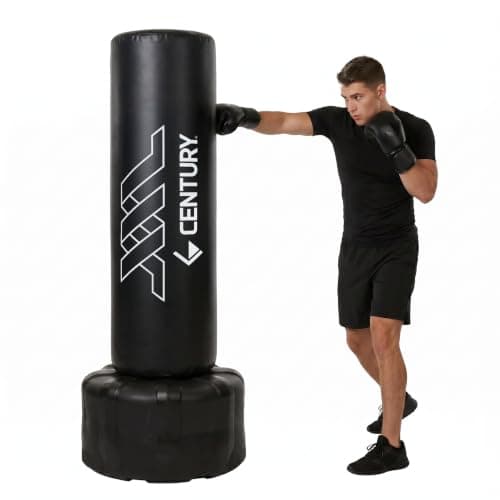
Key specs
- Height
- 69 in total · 52 × 18 in bag
- Base
- 28 in, up to 270 lb filled
- Shell
- 18 oz vinyl over high-density foam
Scores · editorial, out of 10
- Base stability when filled
- 9
- Footprint
- 6
- Rebound & feel
- 9
- Height adjustability
- 3
- Value
- 7
Pick 01 · Freestanding bags
Century XXL Wavemaster
Century
The freestanding bag that behaves most like a hanging one: 52 in of 18 in-wide striking surface on a 28 in base that holds up to 270 lb.
Best for
A no-drill setup that still takes full-power punches and kicks
Pros
- Over twice the striking area of the original Wavemaster — you can hit it anywhere
- 270 lb base weight is why it walks less than the small freestanding bags
- Rolls on its grooved base for storage
Cons
- Fixed height — no adjustment
- You need a 28 in circle of floor plus room to move around it
Specs from Century — XXL Wavemaster (specs).
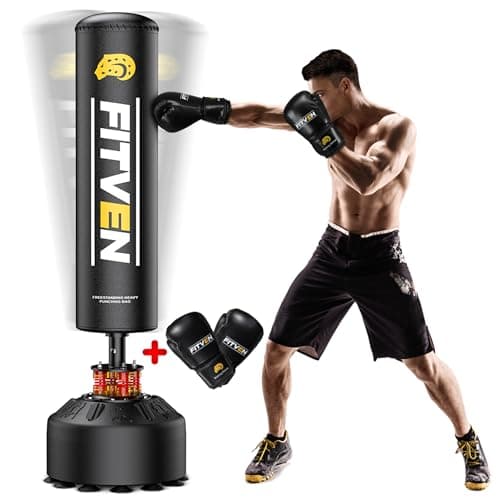
Key specs
- Height
- 70 in
- Base
- Fills to approx. 190 lb
- Grip
- Suction-cup base
Scores · editorial, out of 10
- Base stability when filled
- 3
- Footprint
- 9
- Rebound & feel
- 6
- Height adjustability
- 2
- Value
- 8
Pick 02 · Freestanding bags
FITVEN Freestanding Punching Bag (70 in)
FITVEN
A 70 in bag on a suction-cup base that fills to about 190 lb — the cheapest way to get an adult-height freestanding bag that will not walk across the floor.
Best for
A room where nothing can be drilled and the floor is smooth enough for suction cups
Pros
- 190 lb of ballast is far more than the water-base bags at this price, so it stays where you put it
- 70 in is adult height, so head-level punches land on bag rather than air
- Suction cups add grip on a smooth floor — the usual failure mode of a freestanding bag is sliding, not tipping
- Boxing gloves are included in the box
Cons
- Suction cups need a smooth, hard floor — on carpet or rough concrete you are relying on ballast alone
- An Amazon-native brand, so there is no manufacturer spec sheet to check
- A freestanding bag always absorbs less than a hanging bag of the same weight
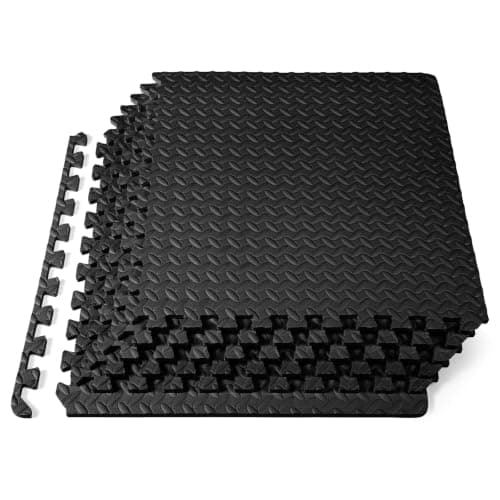
Key specs
- Tile
- 24 × 24 × 1/2 in, high-density EVA
- Coverage
- 24 · 48 · 144 sq ft sets
- Included
- End border pieces for a finished edge
Scores · editorial, out of 10
- Cushion for repeated impact
- 10
- Grip on a hard floor
- 7
- Size for a rope arc
- 10
- Durability under a cable
- 5
- Value
- 10
Pick 03 · Jump rope mats
ProsourceFit Exercise Puzzle Mat (½ in)
ProsourceFit
Interlocking ½ in EVA tiles — twice the cushion of any rolled mat here, at the lowest cost per square foot, and you choose the shape.
Best for
A garage or basement floor where you want to cover the whole training area, cheaply
Pros
- ½ in of EVA is the thickest cushion on this page — the kindest option on a concrete garage slab
- Cheapest per square foot by a long way, and you can lay it to fit the room
- ProsourceFit states it is water- and noise-resistant, which suits a garage
- Border pieces included so the edge does not curl and trip you
Cons
- Tile seams can creep apart under repeated jumping and need nudging back
- EVA foam scuffs and dents under a bare steel cable more than vinyl does
- ProsourceFit describes it as suited to lighter-use home setups
Specs from ProsourceFit — Exercise Puzzle Mat 1/2-in (tile size, coverage, material, borders).
FAQ
Frequently asked questions
How do you stop a freestanding punching bag from sliding?
Refill the base with sand instead of water, put a rubber mat or interlocking floor tiles underneath for grip, and lower the bag to its lowest usable height. Those three changes solve it for most home setups.
Should I fill my punching bag base with sand or water?
Sand, if the bag will stay in one place. Manufacturers publish noticeably higher filled weights for sand than water in the same base. Water is the right choice only if you expect to move the bag often.
Can you bolt a freestanding punching bag to the floor?
No. The base is a moulded plastic container for water or sand, and putting fixings through it will crack and leak it. Freestanding bags are held down by ballast and friction by design.
What do you put under a freestanding punching bag?
A rubber mat, interlocking EVA floor tiles or heavy stair tread. On a smooth floor this is the cheapest and often the only fix needed, and it cuts floor noise at the same time.
Why does my freestanding bag move in one direction?
You are hitting it off-centre — usually hooks thrown across the bag rather than into it — which rotates the base and walks it. Square strikes push it back and it returns; angled ones make it travel.
Does adding weight on top of the base help?
A sandbag or a plate laid flat on the base ring adds useful ballast. Do not stack loose plates against the pole, where they slide and chip the base, and do not add so much that the bag cannot be moved safely.
Next in your kit
Best mouthguard for boxing →Keep reading
Related guides
- Best freestanding punching bag →
Base capacities compared, if yours is undersized.
- Freestanding vs hanging punching bag →
The decision that removes the problem entirely.
- How to stop a heavy bag from swinging →
The same problem for a hanging bag.
- Best punching bag for an apartment →
If floor noise is the real constraint.
Sources
- —Century — XXL Wavemaster (height, base diameter, filled weight) · centurymartialarts.com
- —Century — Original Wavemaster (height settings, filled weight) · centurymartialarts.com
- —Amazon listing — FITVEN Freestanding Punching Bag 70 in (base fill weight, suction-cup base) · amazon.com
- —ProsourceFit — Exercise Puzzle Mat 1/2-in (tile size, coverage, material) · prosourcefit.com
- —Amazon listing — Ringside Cobra Fitness Reflex Bag (base fill: water and sand capacities) · amazon.com