Guide · Heavy Bags
How to Stop a Heavy Bag From Swinging
A bag that swings away from you after every punch is telling you something: either you are pushing instead of punching, or the bag is too light for you, or the chain is too long. Fix it in that order. Only then reach for hardware — a shorter drop, a heavier fill, a floor tether, and the one thing that actually quiets a bag in a house.
Written by Mike M. · Owner, Iron Mako Media
Published
Bag & Bell is reader-supported. Product links go through our affiliate resolver and we may earn a commission from qualifying purchases at no cost to you. Prices are the retailer's, come from Amazon's own product data on the date shown, and change — the button always opens the live listing.
Part of the Heavy Bags hub.
How to stop a heavy bag from swinging · 6 steps
Step 01
Check your punch before you change the bag
Film thirty seconds on your phone. If the bag travels away in a long arc and keeps going, you are pushing through it rather than snapping the punch back. A correctly thrown punch makes the bag jolt and fold, not sail. This is the cause about half the time, and no hardware fixes it.
Step 02
Shorten the drop
The bag is a pendulum, and a shorter pendulum swings less and comes back faster. Remove chain links so the bag hangs with its centre at your chest and its top near your head. Most home bags hang too low on too much chain.
Step 03
Check the bag's weight against yours
The rule of thumb is a bag around half your body weight. A 70 lb bag under a 200 lb person will swing no matter what you do to the hardware. Our bag weight guide has the table.
Step 04
Top up the fill
Bags settle: the fill compacts downward, the top third goes soft and light, and a light top swings. Open the bag and re-pack it with fibre fill, keeping sand to a minimum and only at the bottom. A properly packed bag of the same nominal weight swings less than a settled one.
Step 05
Add a floor tether
The real fix for a hanging bag that still moves too much: a strap or bungee from the loop at the bottom of the bag to a floor anchor, a loaded weight plate, or the foot of a rack. Tension it just enough to damp the swing, not so tight that the bag is rigid - a rigid bag is harder on your hands and your wrists.
Step 06
Fix the mount, not the bag
If the whole ceiling or the mount flexes when the bag moves, you are feeling structure, not swing. Move to a rigid joist mount bolted to the side and bottom of a joist, or move the bag to a stand. Never add a floor tether to a mount you are not confident about: it adds a sideways pull the fixing was not designed for.
Why your bag swings
A heavy bag is a pendulum on a hinge. How far it travels depends on four things, and they are not all about the bag:
| Cause | What you see | Fix |
|---|---|---|
| Pushing instead of punching | Long, smooth arc that keeps going | Technique - snap the punch back |
| Bag too light for you | Jumps on every solid shot | Heavier bag, or top up the fill |
| Chain too long | Big slow swing, bag hangs low | Remove links; centre at chest height |
| Settled fill | Soft, light top third; bag kicks out | Re-pack with fibre fill |
| Flexing mount or ceiling | The room moves with the bag | Rigid joist mount, or a stand |
| Twisting rather than swinging | Bag spins up the chain | A proper swivel |
Start at the top of that table. Changing hardware to compensate for a pushing punch means you will push harder against a bag that moves less, which is how wrists get hurt. Our beginner heavy bag workout covers the snap-and-return mechanic that stops a bag sailing in the first place.
Weight is the one thing you cannot talk your way around
The standard guidance is a bag about half your body weight: roughly 70 lb for a 140 lb person, 100 lb for a 200 lb person. Under-buy and the bag will swing however you hang it, because physics is not negotiable. The full table, including what to do if you are between sizes, is on what weight heavy bag should I get, and 70 lb vs 100 lb covers the most common decision.
If you already own a bag that is too light, re-packing it is cheaper than replacing it. Shredded fibre fill with minimal sand at the bottom gives you a denser, more evenly weighted bag — see best punching bag filler. Do not simply pour sand in: a sand-heavy bag goes rock hard at the bottom and becomes an injury risk.
The floor tether, done properly
Most heavy bags have a D-ring or loop at the bottom precisely for this. What you attach it to matters more than what you attach it with:
- Concrete floor: a rated eye bolt or anchor is the proper solution and it is cheap.
- Loaded weight plates or a rack foot: works well, needs real mass — a 10 lb plate will simply slide.
- A sandbag with a D-ring: the renter's option; the heavier the better.
- A bungee rather than a static strap: gives the bag a little travel, which is kinder on your hands than a dead-rigid target.
Tension it so the bag still moves an inch or two. The goal is damping, not immobilising — a bag with no give transmits far more impact back into your wrists.
"It shakes the whole house"
This is a different problem from swinging, and the swing fixes often make it worse. Vibration travels through the mount into the structure, so a rigidly bolted bag in a bedroom above a living room is the worst case. What helps:
- Move it to a ground floor or a garage slab. The most effective change by a wide margin.
- Mount into a joist near a wall or a load-bearing point rather than mid-span, where the joist flexes most.
- Put rubber matting under the bag area to absorb footwork noise, which is often most of what the household is hearing — see mats.
- Consider a freestanding bag instead. Nothing transmits into the ceiling because nothing is attached to it: freestanding vs hanging and bags for an apartment.
Freestanding bags: sliding, not swinging
A freestanding bag has the opposite problem. It does not swing, it walks across the floor. Three fixes, in order of effect: fill the base completely with sand rather than water (sand is denser, so the same base is heavier), put a rubber mat or interlocking tiles underneath for friction, and stack a weight plate or two over the base lip if the design allows it. If it is still moving, the base is simply too small for how hard you hit, and the answer is a heavier base or a hanging bag on a stand.
Swivels: what they do and do not do
A swivel stops the bag twisting up the chain — it is a rotation fix, not a swing fix. It is still worth having, because a twisting bag puts torsion into the mount and wears the chain, and most bags ship with hardware rated well below what a swinging bag actually loads it with. A 200 lb-rated chain and swivel set is cheap insurance on a 70-100 lb bag.
Picks
The hardware that actually helps
A rated chain and swivel so the bag rotates instead of twisting, a rigid joist mount that does not amplify the swing, and the stand to buy if the real problem is that your fixing is flexing.
Key specs
- Rated
- Up to 200 lb
- Parts
- Hanger chain + swivel
- Use
- Any hanger, mount or beam bracket
Scores · editorial, out of 10
- Rated load
- 6
- Joist / beam / wall compatibility
- 9
- Hardware included
- 9
- Swivel & noise
- 4
- Value
- 10
Pick 01 · Mounts & hangers
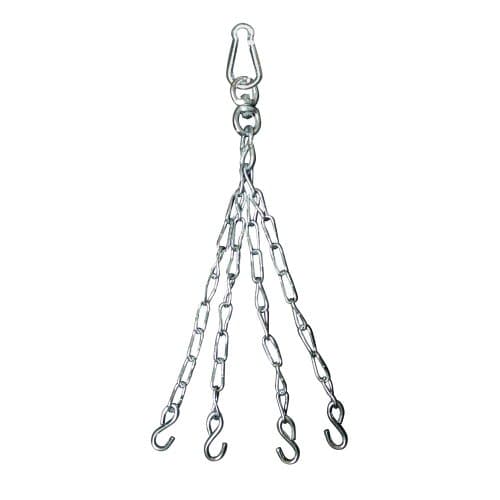
Ringside Heavy Bag Hanger Chain and Swivel
Ringside
The 200 lb-rated chain-and-swivel set that turns any hanger into a hanging bag — double the rating of the hardware most bags ship with.
Best for
Anyone whose bag or mount didn't come with chain and a swivel
Pros
- 200 lb rating covers every bag on this site, including the 130 lb Muay Thai bags
- The swivel lets the bag rotate instead of twisting the mount and the straps
- Costs less than a pair of wraps
Cons
- Chain is loud — a strap system or spring mount is quieter
- Ringside publishes no chain length on the listing, so check your drop before ordering
Specs from Amazon listing — Ringside Heavy Bag Hanger Chain and Swivel, 200 lb (rating, parts; checked 2026-10-03).
Key specs
- Rated
- 120–200 lb bags
- Attaches to
- Side and bottom of an open floor joist
- Swivel
- Compression spring, 360°
Scores · editorial, out of 10
- Rated load
- 9
- Joist / beam / wall compatibility
- 8
- Hardware included
- 7
- Swivel & noise
- 9
- Value
- 8
Pick 02 · Mounts & hangers
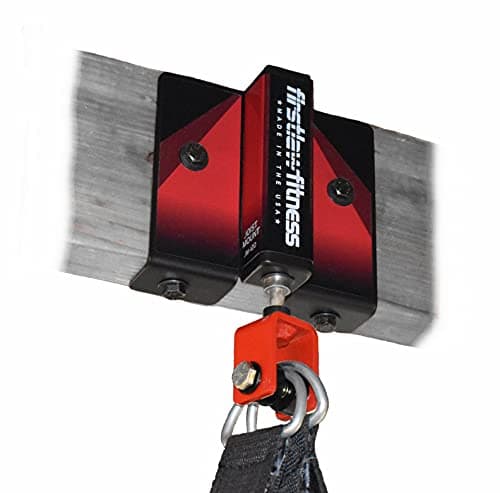
Firstlaw Fitness Joist Mount 200
Firstlaw Fitness
A US-made mount that clamps to the side and bottom of an open joist, with a compression spring and 360° swivel — rated for bags from 120 lb to 200 lb.
Best for
An unfinished garage or basement ceiling with exposed joists and a heavy bag
Pros
- Rated to 200 lb, so it covers the 130 lb Muay Thai bags no stand here will take
- A lighter Joist Mount 120 is sold alongside it, so you buy the rating that matches your bag
- Spring dampens the jerk and the noise
- Lifetime warranty, made in the USA
Cons
- Only for exposed joists — nothing to grab on a drywall ceiling
- Overkill, and overpriced, for a 70 lb bag — buy the 120 model instead
Specs from Amazon listing — Firstlaw Fitness Joist Mount 200, bags 120–200 lb (rating, fitment; checked 2026-10-03).
Key specs
- Capacity
- Bags up to 100 lb
- Footprint
- 66.5 × 47.6 in · 86.2 in tall
- Ballast
- 3 weight-plate pegs
Scores · editorial, out of 10
- Rated capacity
- 7
- Footprint
- 6
- Stability
- 7
- Assembly
- 8
- Value
- 9
Pick 03 · Heavy bag stands
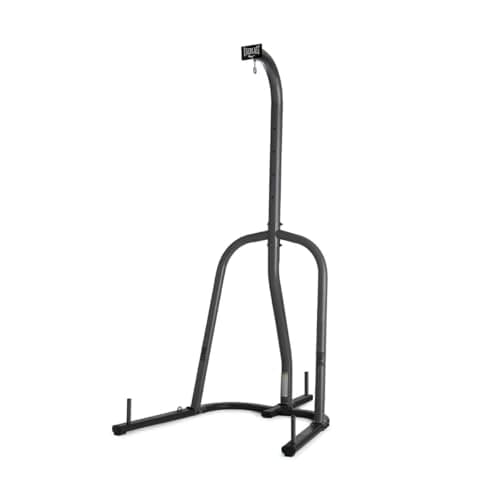
Everlast Heavy Punching Bag Stand
Everlast
A powder-coated steel stand rated to 100 lb with three plate pegs — the standard no-drill answer for a garage.
Best for
Hanging a 70–100 lb bag without touching the ceiling
Pros
- Rated for the exact bag weights a beginner buys
- Three plate pegs — load them and it stops walking
- Two-person assembly, no tools beyond the basics
Cons
- Needs a 5.5 × 4 ft footprint plus swing room
- Not rated for outdoor use; a stand always sways more than a joist mount
Specs from Everlast — Heavy Punching Bag Stand (specs).
FAQ
Frequently asked questions
How do I stop my heavy bag from swinging so much?
In order: snap your punches back instead of pushing through the bag, shorten the chain so the bag hangs higher, make sure the bag is roughly half your body weight, top up a settled fill, and then add a bungee tether from the bottom of the bag to a floor anchor or loaded plate.
Should a heavy bag swing when you hit it?
A little, yes. A correctly thrown punch makes the bag jolt and fold rather than sail away in a long arc. A bag that travels a long way is usually being pushed, not punched — or it is too light for you.
Does a shorter chain stop a heavy bag swinging?
Yes. The bag is a pendulum, and a shorter pendulum has a smaller, faster swing. Hang it so the centre of the bag is around your chest and the top near head height.
Can you anchor a heavy bag to the floor?
Yes, and it is the most effective single fix — a strap or bungee from the bag's bottom loop to a floor eye bolt, a loaded rack foot or heavy plates. Only do it if you are confident in the ceiling mount, because it adds a sideways load the fixing may not be rated for.
How do I stop a heavy bag shaking the house?
That is vibration through the structure, not swing. Move the bag to a ground floor or garage slab, mount near a load-bearing point rather than mid-span, put matting down for footwork noise, or switch to a freestanding bag that touches nothing but the floor.
How do I stop a freestanding punching bag from sliding?
Fill the base with sand rather than water, put a rubber mat or interlocking tiles underneath for friction, and add weight plates over the base if the design allows. If it still walks, the base is too light for how hard you hit.
Next in your kit
Best heavy bag stand →Keep reading
Related guides
- How to hang a heavy bag in a garage →
Getting the mount right first.
- What weight heavy bag should I get? →
The half-body-weight rule.
- Best punching bag filler →
Re-packing a settled bag.
- Best heavy bag mounts and hangers →
Rigid mounts, rated hardware.
- Best punching bag for an apartment →
If noise is the real problem.
Sources