Guide · Protection
Do You Need Shin Guards for Kickboxing?
For kicking a bag in your garage: no. For anything involving another person's body — sparring, partner drills, clinch work, even light technical rounds — yes, and they are not optional. Here is the honest line between the two, what a shin guard is actually protecting, and how to size a pair.
Written by Mike M. · Owner, Iron Mako Media
Published
Bag & Bell is reader-supported. Product links go through our affiliate resolver and we may earn a commission from qualifying purchases at no cost to you. Prices are the retailer's, come from Amazon's own product data on the date shown, and change — the button always opens the live listing.
Part of the Protection hub.
The honest answer, split in two
| What you are doing | Shin guards? | Why |
|---|---|---|
| Kicking a heavy bag at home | No | A bag is a controlled surface. Technique and conditioning are the protection |
| Kicking a freestanding bag | No | Same, though mind the hard base and the pole |
| Pad work with a partner holding Thai pads | Usually not | You are striking a pad, not a person - but guards are kinder on a long session |
| Partner drills with leg checks | Yes | Shin on shin is the specific collision guards exist for |
| Light technical sparring | Yes | Non-negotiable, however light it is meant to be |
| Clinch and knee work | Yes | Plus a mouthguard and headgear |
If you are setting up at home to kick a bag — which is what most people buying their first kickboxing kit are doing — you do not need shin guards yet. You need gloves that suit kicking, wraps, and a bag that can take a kick: see best kickboxing gloves and heavy bags for Muay Thai. Buy the shin guards when a second person enters the room.
What a shin guard is actually for
Two jobs, and the second one is the one people underrate.
- It spreads the impact of a shin-on-shin collision. When your partner checks a kick, two bony surfaces meet with no soft tissue between them. That is the collision a shin guard exists for, and it is why guards are standard kit in every kickboxing and Muay Thai gym for anything above pad work.
- It protects your partner. A bare shin landing on someone's arm, ribs or thigh is a harder, more concentrated impact than a padded one. Wearing guards is partly a courtesy, which is exactly why gyms insist on them rather than leaving it to individual judgment.
Note what is not on that list: shin guards do not condition your shins, they do not make a kick safe to throw badly, and they do not protect your knee. They cover the shin and, on most models, the instep — the part of the foot that takes the impact on a round kick and the part people break.
What to look for when you do buy
Four things, in order of how much they matter:
- Instep coverage. A guard that covers the shin and stops at the ankle leaves out the bones people actually break. Both picks below are shin-and-instep designs.
- Retention. A guard that rotates around the leg mid-round is protecting the air beside your shin. Wide straps behind the calf plus a foot elastic or stirrup is the standard answer; two straps is better than one.
- Size band, and whether yours exists. Guards are sold in letter sizes based on height and calf. Small and tall people both struggle here, and the available range is a real buying constraint — one reason the budget pick below earns its place.
- Padding type. Foam density is the trade between protection and how much the guard slows your kick. Any reputable first pair is adequate; this is the last thing to worry about.
How to size shin guards
Manufacturers size by a combination of height and calf circumference, so use the chart for the exact model rather than a general rule. Then fit-test them:
- The pad should start just below the knee and reach the top of the foot, covering the instep.
- Straps should land in the middle of their travel, not at the end.
- Walk, then throw a few slow kicks. If the guard rotates around the leg, it is too big or too loose.
- Check it with the shoes or bare feet you will actually train in — most kickboxing is barefoot.
- If you are between sizes, go down for a stretchy sleeve-style guard and up for a rigid strapped one.
Do shin guards go over or under anything?
Over bare skin, or over thin socks if you prefer. Hand wraps have no equivalent for the leg, and shin wraps are not a substitute for a guard — they are a thin compression layer, not impact protection. If you are wondering about the hand side of a kickboxing kit, that is hand wraps for kickboxing and MMA.
Where shin guards sit in a kickboxing kit
In buying order for someone starting kickboxing at home: wraps, gloves, something to kick, then — the moment partner work starts — mouthguard, shin guards, headgear. The mouthguard comes before the shin guards because teeth do not heal, and both come before headgear in our view. The full sequence is in the first sparring kit checklist, and kickboxing at home equipment covers the whole setup from zero.
Picks
The two pairs we would buy
A first pair for pad work and light sparring, and the budget pair that also comes in the extra-small size the premium brands skip.
Key specs
- Sizes
- M · L · XL
- Coverage
- Shin + instep, anatomical
- Closure
- 2 wide straps + foot elastics
Scores · editorial, out of 10
- Shin & instep coverage
- 9
- Strap security & fit
- 9
- Padding for a first pair
- 8
- Materials & durability
- 8
- Value
- 7
Pick 01 · Shin guards
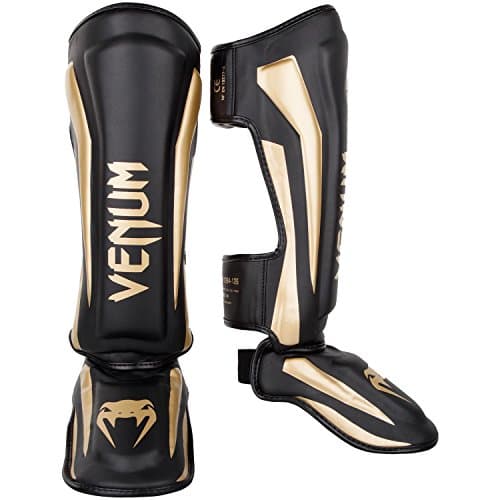
Venum Elite Standup Shin Guards
Venum
The standard kickboxing shin guard: Skintex leather over high-density foam with extra padding on the shin and instep, two wide hook-and-loop straps and under-foot elastics — sized M to XL.
Best for
A first pair of shin guards for kickboxing or Muay Thai pad work and light sparring
Pros
- High-density foam with additional padding on the shinbone and instep, per Venum
- Two large hook-and-loop straps plus elastic bands under the foot and heel keep it from rotating on a kick
- 100% Skintex synthetic leather — wipes clean; handmade in Thailand
Cons
- No small size listed on the product page
- Venum sizes by shin length (below the knee to the ankle) — measure before ordering
Specs from Venum — Elite Standup Shin Guards (features, sizes).
Key specs
- Sizes
- XS · S/M · L/XL
- Padding
- Durasoft impact foam
- Closure
- Double hook-and-loop straps
Scores · editorial, out of 10
- Shin & instep coverage
- 7
- Strap security & fit
- 8
- Padding for a first pair
- 7
- Materials & durability
- 7
- Value
- 9
Pick 02 · Shin guards
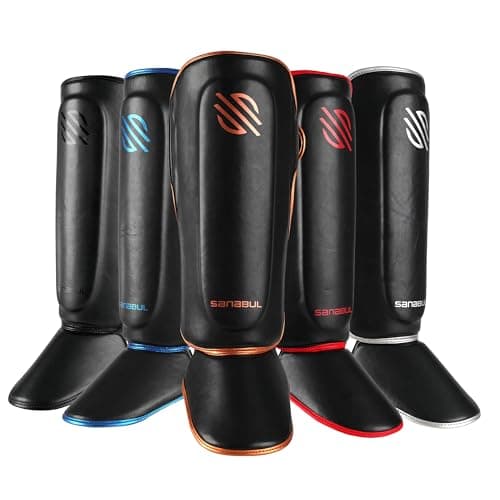
Sanabul Essential Hook & Loop Shin Guards
Sanabul
The value pair with a small size: engineered leather, Durasoft foam, double straps and triple stitching, in XS through L/XL — the pick for a smaller adult or a teen.
Best for
A budget first pair, especially in the extra-small size the premium pairs skip
Pros
- Extra-small through L/XL — the only pair here that fits a smaller frame
- Triple-stitched throughout, per Sanabul; engineered-leather shell
- Double hook-and-loop strap fasteners and a contoured fit
Cons
- Sanabul's page doesn't detail instep coverage — check the size guide and photos for the foot section
- Thinner build than the Venum Elite; fine for pad work, less so for hard sparring
Specs from Sanabul — Essential Hook & Loop Shin Guards (features, sizes).
FAQ
Frequently asked questions
Do you need shin guards for kickboxing?
For kicking a bag or pads at home, no. For anything involving another person — partner drills with leg checks, light sparring, clinch work — yes, every time. They protect your shin in a shin-on-shin collision and they protect your partner from a bare shin.
Do you need shin guards to kick a heavy bag?
No. A bag is a controlled surface and guards are not standard for bag work. Build kicking volume gradually and kick with the shin rather than the top of the foot.
Do shin guards protect your feet?
Most kickboxing guards are shin-and-instep designs, so they cover the top of the foot — which is where the impact lands on a round kick and where people break bones. A shin-only guard leaves that exposed.
How do you size shin guards?
By the manufacturer's chart, which combines height and calf circumference. Then fit-test: the pad should run from just below the knee to the top of the foot, the straps should close in the middle of their travel, and the guard should not rotate when you throw a slow kick.
Do shin guards help condition your shins?
No. Conditioning comes from progressive bag work over months, and nothing you wear speeds it up. Guards reduce the impact of collisions; they do not toughen bone.
Can you use shin guards instead of shin wraps?
Shin wraps are a thin compression layer, not impact protection, so they are not an alternative. If contact is involved, you want a padded shin-and-instep guard.
Next in your kit
Best mouthguard for boxing →Keep reading
Related guides
- Best kickboxing gloves →
The glove that goes with the kicks.
- Kickboxing at home equipment →
The whole setup from zero.
- First sparring kit checklist →
What to buy, in what order.
- Hand wraps for kickboxing and MMA →
The hand side of the same kit.
- Best heavy bags for Muay Thai →
A bag that takes kicks.
Sources
- —Venum — Elite Standup Shin Guards (features, sizes) · venum.com
- —Sanabul — Essential Hook & Loop Shin Guards (features, sizes) · sanabulsports.com