Comparison · Heavy Bags
Focus Mitts vs Thai Pads: Which Should You Buy?
If the training is boxing, buy focus mitts — they are cheaper, lighter, easier to hold and they are what a punching combination needs. Thai pads are a different tool for a different sport: strapped to the forearm, deep enough to take a shin, and a serious job to hold. Here is the decision, and the one case where you end up with both.
Written by Mike M. · Owner, Iron Mako Media
Published
Bag & Bell is reader-supported. Product links go through our affiliate resolver and we may earn a commission from qualifying purchases at no cost to you. Prices are the retailer's, come from Amazon's own product data on the date shown, and change — the button always opens the live listing.
Part of the Heavy Bags hub.
The decision table
| Focus mitts | Thai pads | |
|---|---|---|
| What it takes | Punches — jab, cross, hook, uppercut | Kicks, knees, and punches if you angle them |
| How it is held | On the hand, like a thick glove | Strapped to the forearm, held with a handle |
| Typical padding | Around 2 in across a small face | Several inches across a long face |
| Typical weight | Light — ounces per mitt | Heavy — a pair is a real load to hold |
| Sold as | Always a pair | Often singly; check before you buy |
| Holder skill needed | Low, if you hold still | High — a badly held pad hurts the holder |
| Holder fatigue | Shoulders, after a few rounds | Arms, back and legs, from round one |
| Cost to start | The cheaper option by a clear margin | Roughly double for a usable pair |
| Storage | A drawer | A corner of the room |
| Sport | Boxing — and the hand part of everything else | Muay Thai, kickboxing, MMA |
They are not the same product in two sizes
A focus mitt is a target on a hand. It is small on purpose: you can move it to where a punch should land, snap it into a hook, pull it away to make someone miss. The holder's hand is inside it and the whole design question is how to get padding between the punch and that hand without making the mitt so heavy that nobody can hold it for three rounds.
A Thai pad is a shield on a forearm. It is long, thick and heavy because the thing landing on it is a shin swinging at full body rotation, and the force has to be spread across the holder's whole forearm rather than concentrated on a hand. That shape makes it clumsy for hand work — you can angle a pad for punches and plenty of gyms do, but it is a compromise, and it is why a Muay Thai coach holds pads on the arms and mitts in the hands in the same round.
What each one trains
Focus mitts train accuracy, combination timing and reaction. The holder calls a combination and presents a target that is not where it was two seconds ago, which forces you to aim at something real rather than at an imaginary head on a heavy bag. They also expose what a bag hides: punches that land with the wrong knuckles, a hook thrown too wide, a cross that arrives late. Nothing in a home setup gives feedback that fast, which is why the focus mitt roundup treats them as the best value in this hub once there are two people.
Thai pads train the kick itself — the turn, the shin connection, the recovery back to stance — plus knees in the clinch and the timing of a kick after a hand combination. They also condition the shin, slowly and honestly, in a way a heavy bag does more bluntly. What they do not do is teach hand accuracy: the target is large and the punch does not have to be precise to connect.
Holding is the real difference
Mitts are easy to hold badly and still survive. Stand still, elbow soft, mitt at the height you want the punch, and a beginner can hold a usable round in their first session. The common injuries — jammed fingers, a bent-back wrist — come from meeting the punch instead of absorbing it, and they are fixable with a sentence of coaching.
Thai pads are not like that. Holding a round kick means bracing your whole body behind the pad, with the arm in front of the ribs and elbows together, stepping into the kick rather than away from it — and a holder who gets that wrong takes a shin in the forearm or has the pad driven into their own face. It is a skill, it is tiring, and it is the main reason we would not put Thai pads in a first home kit unless somebody in the house has held them before.
What they cost to get started
We do not print prices — they move, and each card's button opens the live listing — but the shape of it is consistent. Focus mitts are always sold in pairs and the entry tier is genuinely usable, so the cost of starting is one purchase at the bottom of this hub's range. Thai pads cost roughly double for a comparable tier, and the trap is that many are sold singly: the cheap listing you found is one pad, and pad work needs two. Check the quantity before you check the price.
There is a real reason for the gap. A Thai pad contains several times the foam and leather of a mitt, and the good ones are hand-built. Our premium pick below is the gym standard for exactly that reason, and it costs what a decent heavy bag does.
The case for mitts first
Even in kickboxing. Mitts cost less, they are easier to hold, they store in a drawer, and they train the half of your striking you will use most often as a beginner — the hands. Add Thai pads when kicks are actually part of what you practice weekly and somebody is willing to learn to hold them properly. If you are still deciding which sport your home setup is for, boxing vs kickboxing at home is the page that makes that choice, and kickboxing at home equipment lays out the kit in buying order.
The case for pads first
One scenario only: you train Muay Thai or kickboxing at a gym, your partner already knows how to hold, and kicks are the thing you want to drill between classes. In that case a pair of pads does what mitts cannot, and you will want shin protection on the kicking side before you throw hard — the shin guard roundup covers that, and do you need shin guards answers the question underneath it.
What about a kick shield?
A third option worth knowing. A kick shield is a big rectangular body pad held against the chest with two handles — cheaper than a pair of Thai pads, much easier to hold safely, and the right choice if you only want somewhere to put heavy kicks and knees without the pad holder learning a skill. It cannot be used for hand work at all, and it does nothing for timing, because it does not move. Several of the curved single pads sold as Thai pads, including our entry pick below, sit on the line between the two shapes.
How we compared these
From the manufacturers' own product pages where they publish one, and the live listings where they do not, checked on 28 October 2026 and cited under each card. The comparison is our reading of published construction and published dimensions against what pad work in a home setup actually involves. We have not lab tested foam in either product, and nothing here claims a protection level the maker does not state.
Picks
One of each, at two tiers
The focus mitts to start pad work with and the pair to upgrade to, then the Thai pad that is worth buying once and the cheap single pad that tells you whether anyone in the house will hold kicks.
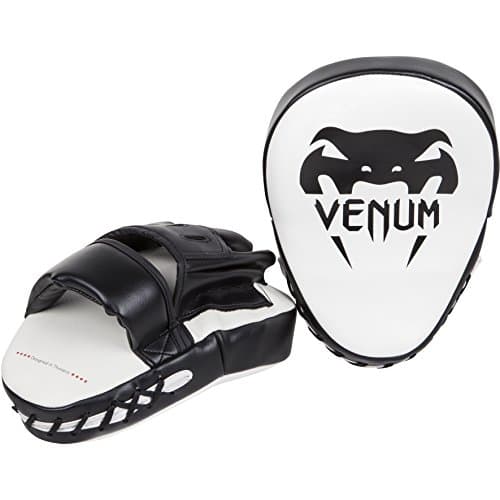
Key specs
- Size
- 19.5 x 25 x 4 cm (W x H x D)
- Shell
- Semi leather
- Padding
- Compact multi-density foam
Scores · editorial, out of 10
- Impact absorption for the holder
- 8
- Hand fit & strap security
- 9
- Target size & shape for a beginner pair
- 8
- Materials & durability
- 7
- Value
- 9
Pick 01 · Focus mitts
Venum Light Focus Mitts
Venum
The pair to hand a partner who has never held pads: ultra-light semi-leather with a pro-concave face, a curved shape and a multi-density foam system, at a mid-tier price and a published size.
Best for
A first pair for two people taking turns, where whoever holds is a beginner too
Pros
- Venum publishes actual dimensions — 19.5 x 25 x 4 cm — which most mitt makers do not
- Pro-concave face: a flat striking surface on the puncher's side, a softer shape against the holder's hand
- Ultra-light build, so the holder's shoulders last longer than the puncher's arms on a first session
- Curved shape plus a multi-density foam system, the two features that decide whether pad work hurts the holder
Cons
- 4 cm of depth is thinner than the coach mitts here, so a heavy puncher will be felt through them
- Semi leather rather than full leather — fine for a garage, not for a gym's daily pad rounds
- Venum states no weight figure, so you cannot compare it to the Hayabusa on grams
Specs from Venum — Light Focus Mitts (dimensions, semi leather, multi-density foam, pro-concave design).
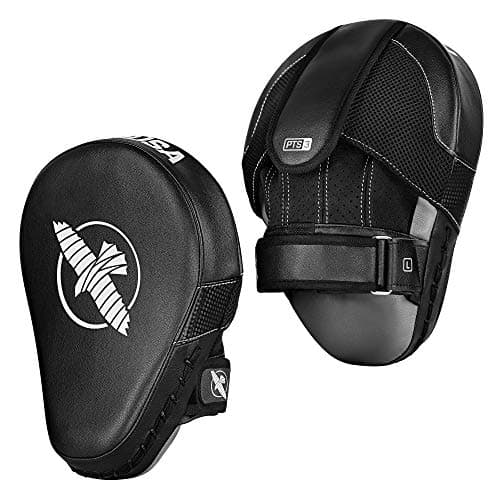
Key specs
- Size
- 10 in H x 7.5 in W x 2 in deep
- Weight
- 12 oz
- Build
- Teardrop shape, reinforced spine
Scores · editorial, out of 10
- Impact absorption for the holder
- 9
- Hand fit & strap security
- 9
- Target size & shape for a beginner pair
- 9
- Materials & durability
- 9
- Value
- 7
Pick 02 · Focus mitts
Hayabusa PTS 3 Focus Mitts (Standard)
Hayabusa
The best-documented mitt on this page: a teardrop target 10 in tall, 7.5 in wide and 2 in deep at 12 oz, with a reinforced spine Hayabusa says holds the curve and stops the foam breaking down.
Best for
The pair you keep — regular pad rounds with a partner who punches hard
Pros
- Hayabusa publishes height, width, depth and weight — the fullest spec sheet of any mitt here
- A reinforced spine whose stated job is to hold the curve, which is exactly how cheap mitts die
- Teardrop shape, which Hayabusa says helps avoid wrist torque when a punch lands off-center
- 12 oz per mitt is light for the size, so the holder's arms are not the limit on a long round
Cons
- Near the top of this page on price, and a beginner pair will not use the build up
- Hayabusa does not publish the shell material or the foam layup on the product page
- One size only — smaller hands get a loose fit and there is no alternative
Specs from Hayabusa — PTS3 Focus Mitts (dimensions, weight, teardrop shape, reinforced spine).
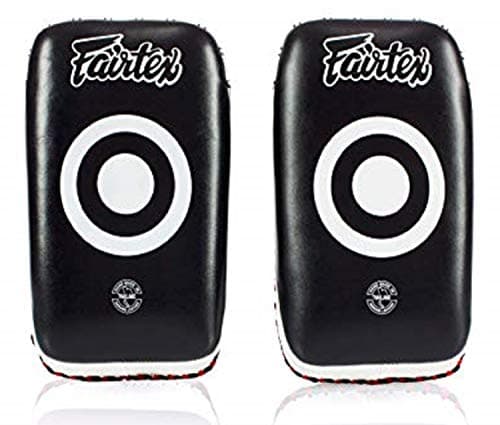
Key specs
- Material
- Premium genuine leather
- Padding
- Multi-layer foam
- Shape
- Curved, adjustable straps
Scores · editorial, out of 10
- Padding depth & impact absorption
- 10
- Forearm strap security
- 9
- Size & curve for kicks and knees
- 9
- Materials & durability
- 10
- Value
- 4
Pick 03 · Thai pads
Fairtex KPLC2 Curved Kick Pads
Fairtex
The gym-standard Thai pad: genuine leather over multi-layer foam, curved to take load off the holder's arms and shoulders, with adjustable straps — handmade in Thailand and priced like it.
Best for
A pair you buy once, if someone in the house is going to hold kicks regularly
Pros
- Genuine leather rather than synthetic — the shell most likely to still be here in five years
- Multi-layer foam, which is what keeps a kick from arriving in the holder's forearm
- The curve is the point: Fairtex states it reduces strain on the holder's arms and shoulders
- Adjustable straps, so one pair fits two people with different forearms
Cons
- By far the most expensive item on either side of this comparison
- Fairtex publishes no dimensions or weight for the KPLC2
- Leather wants wiping and airing; left damp in a bag it will mildew where a vinyl pad would not
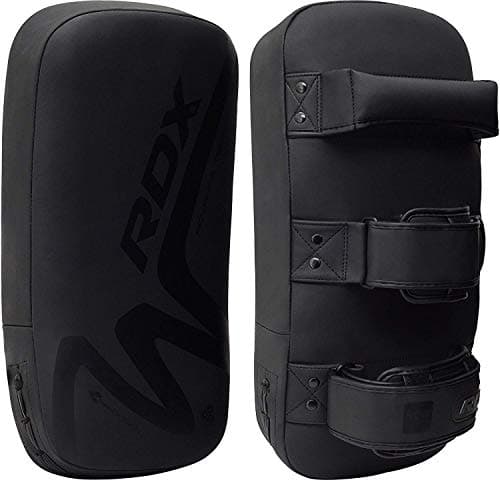
Key specs
- Shape
- Curved strike shield
- Shell
- Convex Skin leather
- Sold as
- A single pad
Scores · editorial, out of 10
- Padding depth & impact absorption
- 7
- Forearm strap security
- 7
- Size & curve for kicks and knees
- 8
- Materials & durability
- 6
- Value
- 9
Pick 04 · Thai pads
RDX Curved Muay Thai Pad
RDX Sports
The entry-tier curved strike shield: a single Convex Skin leather pad for kicks, knees and punches — the cheapest honest way to find out whether anyone in the house will actually hold pads.
Best for
Testing kick pad work before spending Fairtex money on it
Pros
- A fraction of the price of a leather Thai pad, which makes it a low-risk way to try pad work
- Curved rather than flat, so it sits on the forearm the way a Thai pad should
- Listed for kicks, knees and punching rather than one discipline only
- RDX is already in our glove, head guard and shin guard roundups, so the brand is a known quantity here
Cons
- Listed as a single pad — a matching pair costs two, and holding one pad limits most Thai pad drills
- We could not find an RDX spec page for this model, so the shell and shape come from the live Amazon listing
- No published foam depth, and at this tier the padding is the thing being saved on
FAQ
Frequently asked questions
What is the difference between focus mitts and Thai pads?
Focus mitts are small targets worn on the hands for punches. Thai pads are long, thick pads strapped to the forearms that absorb kicks and knees as well as punches. Mitts are lighter, cheaper and far easier to hold; Thai pads are the only one of the two that can safely take a round kick.
Can you kick a focus mitt?
No. A mitt does not cover enough of the forearm or carry enough foam to spread the force of a kick, so it goes through the holder's wrist and hand. Kicks need a Thai pad or a kick shield.
Can you punch Thai pads?
Yes — angle them and they work for straight punches and hooks, and most Muay Thai pad rounds include hands. They are a compromise for hand work, though: the target is large, so a punch does not have to be accurate to connect, which is exactly the feedback mitts give you.
Which should a beginner buy first?
Focus mitts, in almost every case. They cost less, the entry tier is usable, and a beginner can hold a safe round in their first session. See the focus mitt roundup for the picks.
Are Thai pads sold in pairs?
Sometimes. Many listings are for a single pad, which is why a Thai pad can look cheaper than a pair of mitts until you read the quantity. Check it before you buy — pad work with one pad is limited.
Do I need both?
Only if you train Muay Thai or kickboxing with a regular partner. In that case holders switch between pads for kicks and mitts for hands within the same round. For boxing, mitts alone are the whole answer.
Can I use pads or mitts instead of a heavy bag?
No. Both need a partner and neither builds the kind of repetition and power a bag does. They are supplements to a heavy bag, not substitutes for one.
Next in your kit
Best focus mitts →Keep reading
Related guides
- Best focus mitts →
Six pairs ranked, and what to buy first.
- Kickboxing at home equipment →
The whole kit, in buying order.
- Best shin guards for kickboxing →
Before you kick anything hard.
- Best heavy bags for Muay Thai →
The partner-free way to drill kicks.
- Best kickboxing gloves →
A more open palm, for catching kicks.
- Boxing vs kickboxing at home →
The choice underneath this one.
Sources
- —Fairtex — Curved Kick Pads KPLC2 (genuine leather, multi-layer foam, curved shape, adjustable straps, handmade in Thailand) · fairtex.com
- —Venum — Light Focus Mitts (19.5 x 25 x 4 cm, semi leather, compact multi-density foam, pro-concave design) · row.venum.com
- —Hayabusa — PTS3 Focus Mitts (dimensions 10 x 7.5 x 2 in, 12 oz, teardrop shape, reinforced spine) · hayabusafight.com
- —Amazon listing — RDX MMA Thai Pad, Convex Skin Leather Curved Kickboxing Strike Shield (shell, shape, single pad; checked 2026-10-28) · amazon.com