Comparison · Heavy Bags
Reflex Bag vs Double End Bag
Both are small, fast targets that punish a lazy guard. The difference is how they are held: a reflex bag stands on a weighted base, so it needs no anchors at all; a double end bag is tethered between the ceiling and the floor, which is cheaper, quieter and smaller — if you can fix both ends. For most home setups, that single fact decides it.
Written by Mike M. · Owner, Iron Mako Media
Published
Bag & Bell is reader-supported. Product links go through our affiliate resolver and we may earn a commission from qualifying purchases at no cost to you. Prices are the retailer's, come from Amazon's own product data on the date shown, and change — the button always opens the live listing.
Part of the Heavy Bags hub.
The difference table
| Reflex bag | Double end bag | |
|---|---|---|
| How it is held | Steel pole on a fillable base | Elastic cables to ceiling and floor |
| Needs drilling | No | Usually yes, at both ends |
| Floor space | A base roughly 12-20 in across, plus clearance | None - it hangs in the air |
| Setup | Assemble and fill the base with water or sand | Two fixings, then clip the cables |
| Rebound | Spring-driven, returns to centre | Cable tension, moves on both axes |
| Height | Adjustable, typically 48-84 in | Set by where you fix the cables |
| Portability | Drain it and move it | Unclip it and the bag is in a drawer |
| Noise | Base can transmit into the floor | Quietest target in boxing |
| Cost tier | Several times a double end bag | The cheapest bag you can buy |
What each one actually trains
Honestly: nearly the same thing, with a different feel. Both are small targets that move when hit and come back, so both train timing, distance and accuracy, and both punish you for dropping your hands — the target comes back to roughly where your face is.
The differences are real but secondary. A reflex bag on a spring returns to the centre on a fairly predictable arc, which makes it the easier of the two to start with and the better one for building a rhythm of jab-and-slip. A double end bag is tethered at both ends, so it moves on more axes and the rebound depends on exactly where and how you hit it — less predictable, more useful once you can already hit a moving target. If you want the slower, steadier version of the same lesson, a reflex bag is the gentler introduction.
The anchoring question, which is the real decision
A double end bag needs two fixings, and the lower one is what catches people out. Options that work: an eye bolt into a concrete floor, a heavy weight plate with a loop, the foot of a loaded squat rack, or a sandbag with a D-ring. Options that do not: anything light enough to slide, and anything screwed into a floating floor. If none of those exist in your room, you are buying a reflex bag, and the price difference stops mattering.
The upper fixing is the same problem as hanging a heavy bag, minus the load — a double end bag pulls with the tension of its cables rather than the weight of a bag, so a far lighter fixing is adequate. That is the one structural advantage it has: you can put one in a room that will not take a heavy bag.
Space, noise and neighbours
A double end bag takes no floor space and transmits almost nothing into the building, which makes it the quietest piece of boxing equipment you can own and the right choice in an apartment where even a freestanding base thumps the floor. A reflex bag needs a footprint plus clearance all round, and the base sits on the floor, which means impact travels into it. If noise is your constraint, read bags for an apartment before buying either.
If you already own a heavy bag, which do you add?
Add a double end bag. It is the cheaper purchase, it costs you no floor space next to the heavy bag, and its less predictable rebound complements the heavy bag's dead target well. Add a reflex bag instead if the heavy bag is on a stand and there is no ceiling fixing anywhere in the room, or if a teenager and an adult are sharing the setup and you want the adjustable height. Our double end bag roundup and reflex bag roundup have the full lists; the comparison with the third small target, the speed bag, is on speed bag vs double end bag.
Picks
Two reflex bags, two double end bags
The two reflex bags first, because that is the answer for most rooms. Then the two double end bags to buy if you have a ceiling point and a floor point and want the cheaper, quieter target.
Key specs
- Height
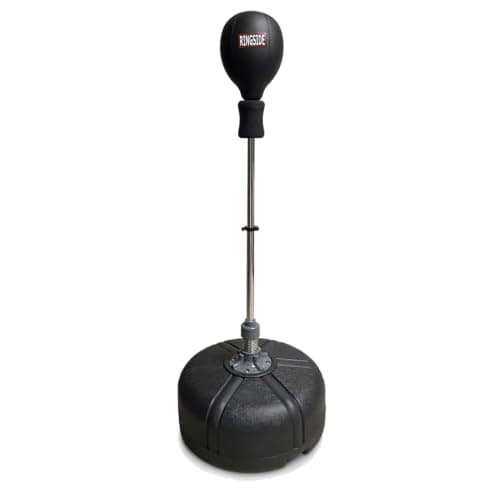
- 49–69 in, steel pole
- Base fill
- Up to 125 lb water · 240 lb sand
- Spring
- Chrome, mounted at the base of the pole
Scores · editorial, out of 10
- Rebound control for a beginner
- 10
- Base stability when filled
- 10
- Height range
- 8
- Target size & feel
- 6
- Value
- 9
Pick 01 · Reflex bags
Ringside Cobra Fitness Reflex Bag
Ringside
The only reflex bag here whose maker says out loud that it is tuned for beginners: a base-mounted spring with higher tension and a slower, steadier return, over the biggest fillable base on the page.
Best for
A first reflex bag, and a household where an adult and a teen share it
Pros
- Ringside put the spring at the bottom of the pole, which raises tension and gives a smooth, steady rebound instead of a whip
- 240 lb of sand is the largest published fill capacity of any bag on this page
- 49 in low setting is the only one here that drops far enough for a teen or a youth athlete
- 25 in square footprint, so it sits in a corner rather than owning the room
Cons
- Ringside's own listing says it is not intended for heavy power-punching or advanced agility striking — it is a rhythm and cardio tool
- 22 lb empty, so every bit of the stability comes from what you put in the base
- No target-ball diameter published, so you cannot compare the striking face against the TITLE bags
Key specs
- Height
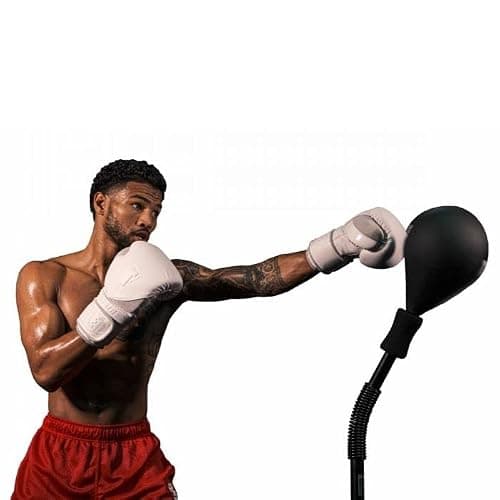
- 48–72 in, turn-knob adjust
- Target
- 9 in sponge rubber, 869 g, mid-density
- Spring
- 7.5 in high-tension steel
Scores · editorial, out of 10
- Rebound control for a beginner
- 8
- Base stability when filled
- 6
- Height range
- 10
- Target size & feel
- 9
- Value
- 7
Pick 02 · Reflex bags
TITLE Boxing Lightning Strike Pro Reflex Bag
TITLE Boxing
The widest published height band on the page and a solid sponge-rubber target with no bladder to maintain — the reflex bag to buy if more than one height of person will use it.
Best for
A shared garage setup, from a youth athlete to a tall adult
Pros
- 48 to 72 in is a full two-foot range — TITLE say youth to super heavyweight, and the numbers back it
- Solid sponge-rubber target: no inner bladder, no air pump, nothing to re-inflate
- TITLE publish the target weight (869 g) as well as its diameter, which almost nobody does
- Turn-knob height change, so you can reset it between users without tools
Cons
- The base is 12 × 12 in and TITLE publish no fill capacity for it — this is a bag you weight down or anchor, not one you fill with water
- 22 lb shipped, so out of the box it is light for the height it reaches
- No slow or low-tension setting: the spring is one speed
Key specs
- Sizes
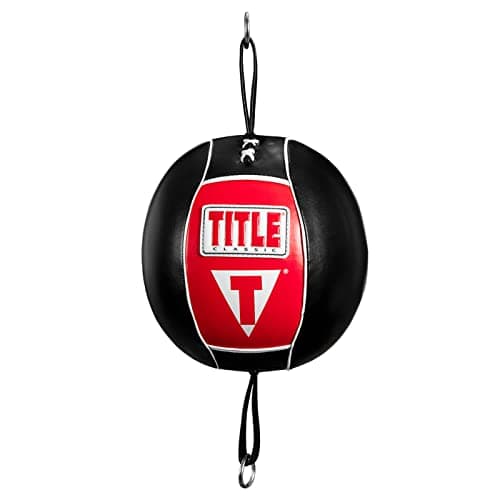
- 5 in · 8 in diameter
- Shell
- Engineered leather, welted reinforced seams
- Included
- Two industrial rubber cables with S-hooks
Scores · editorial, out of 10
- Rebound speed for beginners
- 8
- Cords & anchoring included
- 9
- Size options
- 7
- Shell & bladder durability
- 7
- Value
- 10
Pick 03 · Double end bags
TITLE Classic Double End Bag 3.0
TITLE Boxing
Two cords in the box, twin steel O-rings, a choice of 5 in or 8 in, and the lowest price of any double end bag with published sizes.
Best for
A first double end bag — buy the 8 in and learn the timing before you go small
Pros
- Both cables are included — a bag without cords is useless and many are sold that way
- Multi-layer top and bottom loops with twin steel O-rings
- Two sizes, so you can buy the forgiving 8 in first and the 5 in later
- Nylon-stitched welted seams rather than a glued edge
Cons
- Engineered leather, not hide
- You still need a floor anchor or something heavy to tie the bottom cord to
- TITLE warns you must lubricate the needle before inflating or you tear the valve
Specs from TITLE Boxing — Classic Double End Bag 3.0 (sizes, shell, included cables).
Key specs
- Core
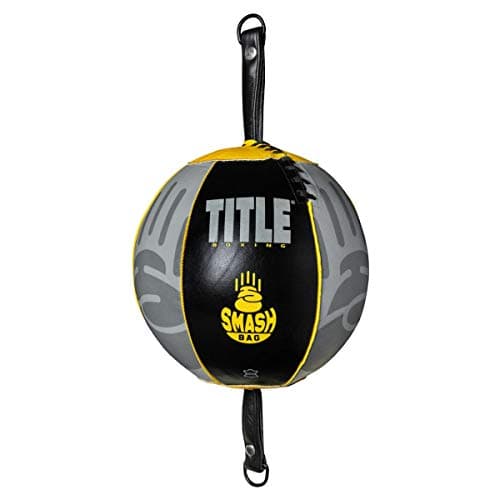
- Open-cell foam — no air bladder
- Shell
- 100% genuine leather
- Sizes
- 7 · 9 · 11 in (7 in in stock 2026-09-26)
Scores · editorial, out of 10
- Rebound speed for beginners
- 6
- Cords & anchoring included
- 9
- Size options
- 5
- Shell & bladder durability
- 9
- Value
- 9
Pick 04 · Double end bags
TITLE Boxing Double End Smash Bag
TITLE Boxing
A foam-core double end bag in genuine leather — no bladder to puncture, and a deliberately slower, more rhythmic rebound.
Best for
Accuracy and timing work, and anyone tired of re-inflating a bag
Pros
- A foam core cannot leak — nothing to inflate and no needle to lubricate
- TITLE designs it to move slower and more rhythmically, which suits accuracy drills
- Genuine leather shell at an engineered-leather price
Cons
- Only the 7 in was in stock when we checked on 2026-09-26
- Foam cannot be firmed up or softened the way air pressure can
- A slower bag does less for reaction speed
Specs from TITLE Boxing — Double End Smash Bag (foam core, shell, sizes).
FAQ
Frequently asked questions
What is the difference between a reflex bag and a double end bag?
How they are held. A reflex bag is a ball on a spring at the top of a steel pole standing on a weighted base, so it needs no fixings. A double end bag is a small ball tethered by elastic cables to a ceiling point above and a floor point below.
Which is better for a beginner?
A reflex bag, slightly — the spring returns the target on a more predictable arc, and there is nothing to drill. A double end bag is cheaper and takes no floor space, so it wins if you have both anchor points available.
Do you need to drill for a double end bag?
Usually at both ends. The upper fixing can be light because the load is cable tension rather than bag weight, but the lower anchor has to be genuinely immovable — a floor eye bolt, a loaded rack foot or a heavy plate with a loop.
Can a reflex bag replace a heavy bag?
No. Neither of these is a power target. They train timing, accuracy and keeping your hands up. If you can only own one bag, own a heavy bag.
Which is quieter for an apartment?
The double end bag, by a long way — it hangs in the air and transmits almost nothing into the floor. A reflex bag base sits on the floor and sends impact into it.
Next in your kit
Best boxing round timer →Keep reading
Related guides
- Best reflex bag →
The reflex bags, ranked.
- Best double end bags →
The double end bags, ranked.
- Speed bag vs double end bag →
The third small target.
- Best punching bag for an apartment →
If noise is the constraint.
- Best heavy bag for beginners →
The bag to own before either of these.
Sources
- —Ringside listing — Cobra Fitness Reflex Bag (49–69 in height, 125 lb water / 240 lb sand base, base-mounted spring; checked 2026-10-07) · amazon.com
- —TITLE Boxing listing — Lightning Strike Pro Reflex Bag (48–72 in, 9 in / 869 g target, 7.5 in spring, 12 × 12 in base; checked 2026-10-07) · amazon.com
- —TITLE Boxing — Classic Double End Bag 3.0 (sizes, shell, included cables) · titleboxing.com
- —TITLE Boxing — Double End Smash Bag (foam core, shell, sizes) · titleboxing.com