Beginner picks · Heavy Bags
Best Reflex Bags for a Home Setup
A reflex bag — the ball on a spring, often sold as a cobra bag — is the cheapest way to train head movement and hand speed without a partner. It is also the easiest piece of home gear to buy wrong, because the spec that decides whether you enjoy it is the one nobody puts in the headline. Seven bags ranked on spring, base, height and target, with the four criteria first.
Written by Mike M. · Owner, Iron Mako Media
Published
Bag & Bell is reader-supported. Product links go through our affiliate resolver and we may earn a commission from qualifying purchases at no cost to you. Prices are the retailer's, come from Amazon's own product data on the date shown, and change — the button always opens the live listing.
Part of the Heavy Bags hub.
Quick picks
| # | Product | Best for | Score | Price |
|---|---|---|---|---|
| 01 | 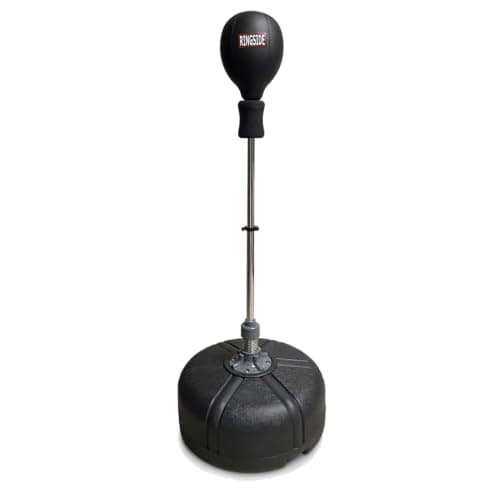 Ringside Cobra Fitness Reflex Bag The only reflex bag here whose maker says out loud that it is tuned for beginners: a base-mounted spring with higher tension and a slower, steadier return, over the biggest fillable base on the page. | A first reflex bag, and a household where an adult and a teen share it | 8.9 | |
| 02 | 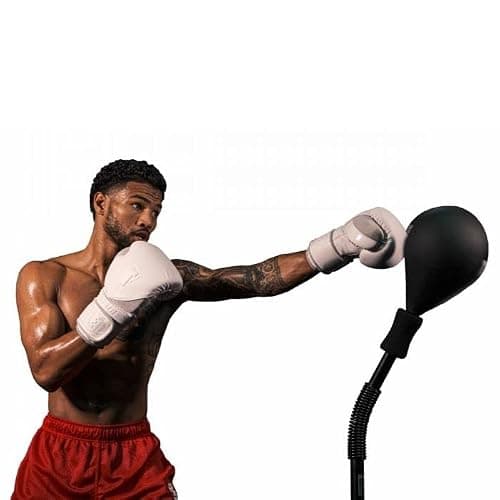 TITLE Boxing Lightning Strike Pro Reflex Bag The widest published height band on the page and a solid sponge-rubber target with no bladder to maintain — the reflex bag to buy if more than one height of person will use it. | A shared garage setup, from a youth athlete to a tall adult | 7.9 | |
| 03 | 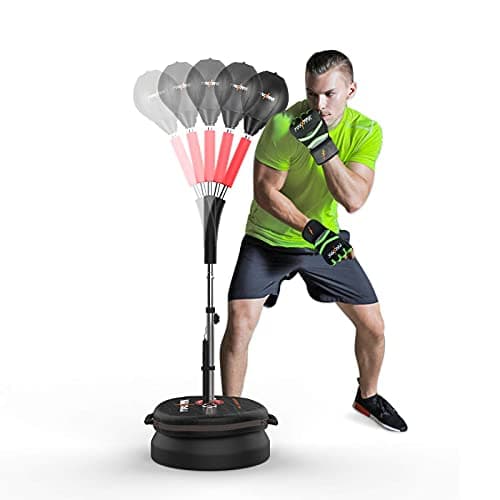 MaxxMMA Advanced Cobra Reflex Bag Kit 2.0 The only bag here that ships two target sizes and two tension settings, so the difficulty can follow you from week one to month six instead of being fixed at purchase. | Someone who wants the bag to get harder as they get better | 7.1 | |
| 04 | 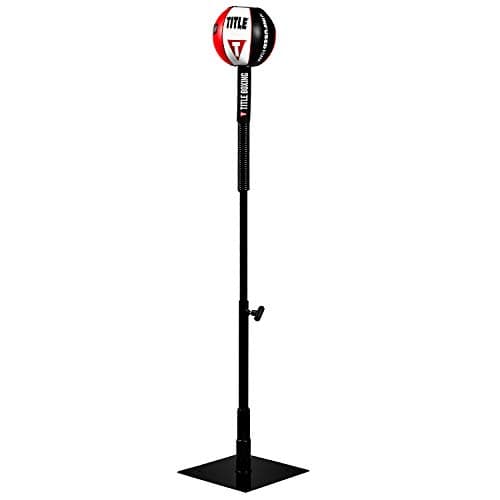 TITLE Boxing Deluxe King Cobra Reflex Bag The permanent-installation option: four masonry floor anchors in the box, a 9 in automotive-grade spring, and an infused-foam target that never needs air. | A dedicated garage or basement corner you are willing to drill | 7.5 | |
| 05 | 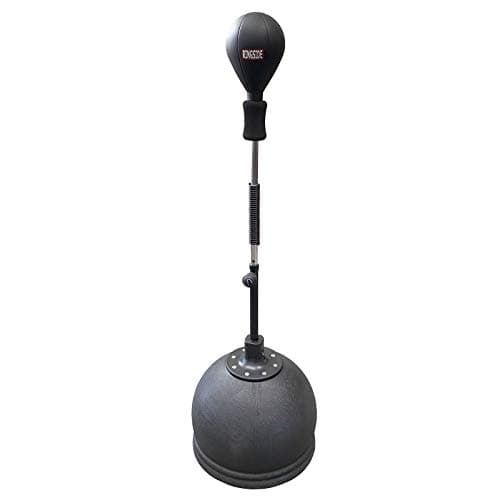 Ringside Elite Cobra Reflex Bag The tall one: 84 in at the top setting over a 140 lb fillable base, with a fast rapid-rebound spring that suits someone who already has head movement. | A tall adult, or simulating a taller opponent | 7.4 | |
| 06 | 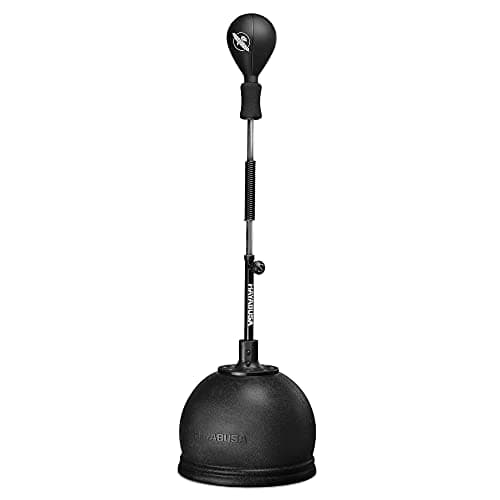 Hayabusa Cobra Reflex Bag The best-feeling target of the group — Hayabusa tune the ball density to work gloved or bare-handed — bought at the cost of the thinnest published spec sheet here. | Someone who cares how the ball feels more than what the spec sheet says | 6.6 | |
| 07 | 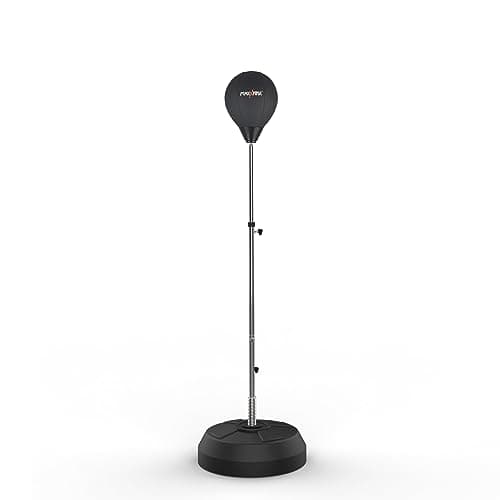 MaxxMMA Speed-Adjustable Freestanding Reflex Bag Kit The cheapest real reflex bag on the page, and the only one with a published slow mode — which is genuinely the setting a first week needs. | Finding out whether you like reflex work before spending premium money | 6.5 |
Scores are our editorial judgment from each model's published specs, size charts and manuals, weighted for what a first home setup needs.
What a reflex bag actually trains
A reflex bag is a foam or air-filled ball on top of a sprung steel post, standing in a weighted base. You hit it, it travels, and it comes back at you on the spring. That return is the whole product: it forces you to move your head, reset your guard and time the next punch against something that is already moving. No other piece of home equipment does that without a training partner.
What it does not do is build punching power, and this is where most disappointment comes from. There is no mass behind the ball — you are not driving your weight through anything, and a reflex bag will punish you for trying. Power, mechanics and conditioning come from a hanging heavy bag, which is why a reflex bag is never the first bag anyone should buy. It is the piece you add once you can already punch straight and want something that punches back.
It also sits in a slightly different place than the two other small bags. A speed bag trains rhythm and shoulder endurance and needs a rigid wall-mounted platform. A double end bag trains timing and defense but has to be anchored to both the ceiling and the floor. A reflex bag needs neither: it is freestanding, it moves, and that is the reason it is the realistic choice for a garage, a basement or a rented room where nothing can be drilled.
The four specs that decide this purchase
Every bag below gets ranked on these four things, in this order, because they are what the published spec sheets actually let you compare. Everything else — frame color, the words “pro” and “elite” in the model name, who the brand sponsors — is noise.
- Spring tension and spring position. The single most important spec, and the one nobody headlines. A long spring high on the post whips the ball back fast; a shorter, higher-tension spring mounted at the base of the post returns it slower and straighter. Fast is what an experienced fighter wants. Slow is what makes the first two weeks enjoyable rather than humiliating. Only two bags here publish a beginner-appropriate setting, and one of them is the cheapest on the page.
- Base fill capacity. Every one of these bags weighs around 22 lb empty. All of the stability is whatever you pour in. Published capacities on this page run from 55 lb of sand to 240 lb of sand — a four-fold difference in how firmly the thing stays planted. Two of the picks publish no capacity at all because they are designed to be anchored or plated instead, which is a different trade entirely.
- Height range. Not just the top number. The target should sit around your own chin or nose height, so a bag that only drops to 60 in is unusable for a shorter adult or a child no matter how high it goes. If more than one person will use it, the span is the spec — and the spans here vary from 13.5 in to a full two feet.
- Target construction. Solid or infused foam needs nothing from you, ever. An inflatable ball with an inner bladder needs a pump, loses pressure, and is the component that eventually fails. Two picks here use bladders; both are honest about it, and both are cheaper for that reason.
| Pick | Height range | Base fill published | Target | Spring |
|---|---|---|---|---|
| Ringside Cobra Fitness | 49–69 in | 125 lb water · 240 lb sand | Not stated | Chrome, base-mounted |
| TITLE Lightning Strike Pro | 48–72 in | No — weight or anchor it | 9 in sponge rubber, 869 g | 7.5 in high-tension steel |
| MaxxMMA Advanced Cobra 2.0 | 52–65 in | No — core weight bag | Two sizes, PU + bladder | Two tension settings |
| TITLE Deluxe King Cobra | 48–66 in | No — four masonry anchors | 8 in infused foam | 9 in automotive grade |
| Ringside Elite Cobra | 60–84 in | 140 lb water or sand | Foam-filled | Rapid-rebound steel alloy |
| Hayabusa Cobra | Not stated (70.9 in assembled) | Not stated | Rebound ball, density not stated | High-tension, length not stated |
| MaxxMMA Speed-Adjustable | 48–61.5 in | 30 lb water · 55 lb sand | Inflatable, pump included | Slow + fast modes |
Where a reflex bag belongs in the buying order
Fourth or fifth, honestly. The order that works for a home setup has not changed: gloves and wraps first, then a heavy bag and a rated way to hang it, then a jump rope and a round timer, because those two do more for your conditioning than any second bag. A reflex bag comes after that — and it comes before a speed bag for most people, because it needs no platform and no drilling. The setup cost breakdown puts the whole sequence in order with the arithmetic.
There is a cheaper way to find out whether you like reflex work at all, and it is worth saying before anyone spends three figures: a head-mounted reflex ball on an elastic cord. It is a different tool — a ball at your own head height rather than a weighted post that stands on its own — and it teaches nothing about distance. But it costs a tiny fraction of any bag on this page and it answers the question. The headband reflex ball set we cover on the double end bag roundup ships four balls and needs no anchor, no ceiling hook and no floor space at all. If you enjoy it, buy a real bag. If you do not, you have saved yourself a large object in the corner of the garage.
How this list is ordered
By our published reflex bag rubric: rebound control for a beginner (25), base stability when filled (25), height range (20), target size and feel (15) and value (15). The weighting is deliberate and it is written for this site's reader — someone building a first home setup, not a coach restocking a gym. That is why the cheapest Ringside beats both premium cobra bags, and why a fast, aggressive spring counts against a bag rather than for it. Every number comes from the maker's own published listing, cited under each card; where a maker does not publish a figure we write “not stated” rather than estimate it. Scores are our editorial reading of those published specs, not lab measurements.
The picks in detail
Every pick, reviewed
Key specs
- Height
- 49–69 in, steel pole
- Base fill
- Up to 125 lb water · 240 lb sand
- Spring
- Chrome, mounted at the base of the pole
Scores · editorial, out of 10
- Rebound control for a beginner
- 10
- Base stability when filled
- 10
- Height range
- 8
- Target size & feel
- 6
- Value
- 9
Pick 01 · Reflex bags · REF HEA-01
Ringside Cobra Fitness Reflex Bag
Ringside
The only reflex bag here whose maker says out loud that it is tuned for beginners: a base-mounted spring with higher tension and a slower, steadier return, over the biggest fillable base on the page.
Best for
A first reflex bag, and a household where an adult and a teen share it
Why it is #1. Ringside did two things here that no other maker on the page did. They put the spring at the bottom of the pole, which raises tension and turns the return into a steady push rather than a whip — and then they said in plain language that the bag is for light-contact rhythm work and not for heavy power-punching. That honesty is why it wins a beginner-weighted rubric: it is the one bag here tuned for the first two months rather than the second year. The base takes up to 240 lb of sand, the most on this page, and the 49 in floor setting is the only one low enough for a teen. The limits are real: it is 22 lb empty, Ringside publish no target diameter, and if you want to load up and hit it hard, this is the wrong bag and they tell you so.
Pros
- Ringside put the spring at the bottom of the pole, which raises tension and gives a smooth, steady rebound instead of a whip
- 240 lb of sand is the largest published fill capacity of any bag on this page
- 49 in low setting is the only one here that drops far enough for a teen or a youth athlete
- 25 in square footprint, so it sits in a corner rather than owning the room
Cons
- Ringside's own listing says it is not intended for heavy power-punching or advanced agility striking — it is a rhythm and cardio tool
- 22 lb empty, so every bit of the stability comes from what you put in the base
- No target-ball diameter published, so you cannot compare the striking face against the TITLE bags
Key specs
- Height
- 48–72 in, turn-knob adjust
- Target
- 9 in sponge rubber, 869 g, mid-density
- Spring
- 7.5 in high-tension steel
Scores · editorial, out of 10
- Rebound control for a beginner
- 8
- Base stability when filled
- 6
- Height range
- 10
- Target size & feel
- 9
- Value
- 7
Pick 02 · Reflex bags · REF HEA-02
TITLE Boxing Lightning Strike Pro Reflex Bag
TITLE Boxing
The widest published height band on the page and a solid sponge-rubber target with no bladder to maintain — the reflex bag to buy if more than one height of person will use it.
Best for
A shared garage setup, from a youth athlete to a tall adult
Best for a shared setup. 48 to 72 in is a full two-foot height span adjusted with a turn knob, which in practice means a 5 ft 2 teenager and a 6 ft 3 adult can use the same bag without tools. The target is the best-documented on the page — 9 in across, 869 g, mid-density sponge rubber, no bladder and no pump — and the spring is a 7.5 in high-tension steel unit. The catch is the base: 12 × 12 in with no published fill capacity, because this is a bag you weight down or anchor rather than fill. Budget for plates or anchors in the same order, or you will have a 22 lb object reaching 6 ft and nothing holding it there. There is also no low-tension setting; the spring is one speed.
Pros
- 48 to 72 in is a full two-foot range — TITLE say youth to super heavyweight, and the numbers back it
- Solid sponge-rubber target: no inner bladder, no air pump, nothing to re-inflate
- TITLE publish the target weight (869 g) as well as its diameter, which almost nobody does
- Turn-knob height change, so you can reset it between users without tools
Cons
- The base is 12 × 12 in and TITLE publish no fill capacity for it — this is a bag you weight down or anchor, not one you fill with water
- 22 lb shipped, so out of the box it is light for the height it reaches
- No slow or low-tension setting: the spring is one speed
Key specs
- Height
- 52–65 in
- Included
- Two bag sizes + tension settings
- Base
- 17.7 in diameter + core weight bag
Scores · editorial, out of 10
- Rebound control for a beginner
- 9
- Base stability when filled
- 6
- Height range
- 6
- Target size & feel
- 7
- Value
- 7
Pick 03 · Reflex bags · REF HEA-03
MaxxMMA Advanced Cobra Reflex Bag Kit 2.0
MaxxMMA
The only bag here that ships two target sizes and two tension settings, so the difficulty can follow you from week one to month six instead of being fixed at purchase.
Best for
Someone who wants the bag to get harder as they get better
The one that gets harder as you do. Two different target sizes and two tension settings in one box, which is genuinely unusual — every other bag here has the difficulty fixed at purchase. Start slow and large, move to fast and small when the slow setting stops catching you out. The core weight bag adds base mass and doubles as a workout bag. Third rather than higher because of the bladders: these are PU covers over inner-bladder balls, so a pump is part of ownership and the bladder is what eventually goes. MaxxMMA also publish no water or sand capacity for the base, the 52 in floor is too high for a young child, and stock was thin when we checked.
Pros
- Two different bag sizes with different tension settings in one box — adjustable difficulty, which no other pick here offers
- The core weight bag adds base mass and doubles as a workout bag
- Steel rod construction with high-grade PU covers over the bags
- A genuine middle bracket: more adjustable than the budget kits, well under the premium cobra bags
Cons
- The bags use an inner-bladder design, so re-inflating is part of ownership and the bladder is the part that eventually fails
- MaxxMMA publish no water or sand capacity for the base — the core weight bag is the stability story
- 52 in is the lowest setting, which is too tall for a young child
- Stock was thin when we checked (listed as a limited number left)
Key specs
- Height
- 48–66 in
- Target
- 8 in infused foam, no bladder
- Base
- 12 in diameter · four masonry anchors
Scores · editorial, out of 10
- Rebound control for a beginner
- 7
- Base stability when filled
- 8
- Height range
- 8
- Target size & feel
- 9
- Value
- 5
Pick 04 · Reflex bags · REF HEA-04
TITLE Boxing Deluxe King Cobra Reflex Bag
TITLE Boxing
The permanent-installation option: four masonry floor anchors in the box, a 9 in automotive-grade spring, and an infused-foam target that never needs air.
Best for
A dedicated garage or basement corner you are willing to drill
Best if you will drill. The only pick here that ships floor anchors — four masonry anchors in the box — and a bolted-down cobra bag is a different machine from a free-standing one: nothing shifts, nothing walks, and the spring does all of the moving. The 9 in automotive-grade spring is the longest on the page, the 8 in infused-foam ball never needs air, and the 48 in floor setting covers a youth athlete. The reasons it is not higher are all about commitment. The base is only 12 in across, so anchoring or 45 lb Olympic plates are not optional, the plates are not included, and four holes in a concrete floor is not a decision you take back in a rental. Stock was limited when we checked.
Pros
- The only pick here that ships floor anchors for a permanent install — bolted down, a cobra bag behaves completely differently
- Can be weighted with two to four 45 lb Olympic plates instead of anchoring, if you already own plates
- 9 in automotive-grade high-tension steel spring — the longest spring on this page
- 48 in floor setting works for a youth athlete, and the infused-foam ball needs no pump
Cons
- A 12 in diameter base genuinely has to be anchored or plated; unweighted it will not stay put
- Four masonry anchors is a decision you cannot undo in a rental or on a finished floor
- Olympic plates are not included, so the 'no drilling' route is an extra purchase if you do not own any
- Stock was limited when we checked
Key specs
- Height
- 60–84 in
- Base fill
- Up to 140 lb water or sand
- Head
- Foam-filled, rapid-rebound steel alloy spring
Scores · editorial, out of 10
- Rebound control for a beginner
- 6
- Base stability when filled
- 10
- Height range
- 7
- Target size & feel
- 8
- Value
- 5
Pick 05 · Reflex bags · REF HEA-05
Ringside Elite Cobra Reflex Bag
Ringside
The tall one: 84 in at the top setting over a 140 lb fillable base, with a fast rapid-rebound spring that suits someone who already has head movement.
Best for
A tall adult, or simulating a taller opponent
Best for a tall adult. 84 in at the top setting is the highest published figure here by a foot, and it is the only bag on this page that can put the target above the head of someone over 6 ft — which is the point if you want to practice slipping a taller opponent's jab. The base takes 140 lb of water or sand and is a fill-and-drain design rather than an anchored one, so it can move rooms. Mid-table because of who it is wrong for: 60 in is as low as it goes, which rules out children and is awkward for a short adult, and the rapid-rebound spring returns fast — exactly what a first-week beginner does not want. It is also the most expensive bracket on the page.
Pros
- 84 in is the highest published setting of any bag here — the only one that puts the target above a tall adult's head
- 140 lb of water or sand in the base, and it is a fill-and-drain base rather than an anchored one
- Foam-filled top: no bladder, no pump
- Steel frame, and Ringside publish the full height range rather than a single assembled number
Cons
- 60 in is as low as it goes, which rules it out for a child and is awkward for a short adult
- A rapid-rebound spring is the opposite of what a first-week beginner wants — it returns fast and punishes a slow guard
- The most expensive bracket on this page by a clear margin
Key specs
- Assembled height
- 70.9 in
- Base footprint
- 19.7 × 19.7 in
- Shipped weight
- 23.5 lb
Scores · editorial, out of 10
- Rebound control for a beginner
- 6
- Base stability when filled
- 7
- Height range
- 6
- Target size & feel
- 9
- Value
- 5
Pick 06 · Reflex bags · REF HEA-06
Hayabusa Cobra Reflex Bag
Hayabusa
The best-feeling target of the group — Hayabusa tune the ball density to work gloved or bare-handed — bought at the cost of the thinnest published spec sheet here.
Best for
Someone who cares how the ball feels more than what the spec sheet says
Best feel, thinnest spec sheet. Hayabusa are the only maker here who address the density of the ball itself — they tune it to give distinct feedback gloved or bare-handed — and that is a real thing to buy, because the pop on impact is most of why people keep using a reflex bag. The height adjusts specifically to simulate different opponent heights, and the assembled dimensions (70.9 in tall, 19.7 in base, 23.5 lb) are published. Sixth because it is the one bag here you cannot compare: no published adjustment range, no published base capacity, no spring length. That is premium money for specs you have to take on trust, and the fast recoil is still a poor match for a first week.
Pros
- Hayabusa say the ball density is chosen to give distinct feedback with or without gloves — the only maker here that addresses bare-handed work
- Height is adjustable specifically to simulate different opponent heights
- High-tension spring built for head-movement and defensive-footwork drills, not just hand speed
- Heavyweight base design, and the assembled dimensions are published
Cons
- Hayabusa publish no height adjustment range and no base fill capacity — the only hard numbers are the assembled dimensions
- The fast recoil is a poor match for a first week on a reflex bag
- Premium pricing for a spec sheet you cannot compare line-by-line against the TITLE or Ringside bags
Key specs
- Height
- 48–61.5 in
- Modes
- Slow + fast spring settings
- Base fill
- Up to 30 lb water · 55 lb sand
Scores · editorial, out of 10
- Rebound control for a beginner
- 10
- Base stability when filled
- 3
- Height range
- 5
- Target size & feel
- 5
- Value
- 10
Pick 07 · Reflex bags · REF HEA-07
MaxxMMA Speed-Adjustable Freestanding Reflex Bag Kit
MaxxMMA
The cheapest real reflex bag on the page, and the only one with a published slow mode — which is genuinely the setting a first week needs.
Best for
Finding out whether you like reflex work before spending premium money
The cheap way in. Last on the rubric and still the pick we would suggest to a lot of readers, because it is the only bag here at a genuinely low bracket and it has the beginner setting the expensive bags lack: a patented slow mode alongside a fast one. Pump, base and spring-loaded shaft are all in the box, the 48 in floor setting suits a teen, and MaxxMMA publish a 120,000-cycle bend test on the spring, which is more durability data than most. It scores last for one honest reason — a 55 lb sand capacity is a quarter of what the Ringside Cobra Fitness holds, and under a bag you are striking that is the difference between planted and wandering. The 61.5 in ceiling is also short for a tall adult, and the inflatable ball carries a one-year replacement guarantee, which tells you what wears out.
Pros
- A patented slow mode MaxxMMA describe as the beginner setting, plus a fast mode — adjustable difficulty at the bottom of the market
- Pump, base and spring-loaded shaft all in the box, so nothing else is needed on day one
- 48 in low setting works for a teen as well as an adult
- MaxxMMA publish a 120,000-cycle bend test on the spring, which is more durability data than most makers give
Cons
- 55 lb of sand is by far the smallest base capacity here — under a bag you are actually striking, that is the real limit of this pick
- Inflatable ball with a one-year replacement guarantee, which tells you plainly what wears out
- 61.5 in ceiling is short for a tall adult, and there is no way to go higher
Buying guide
Setting the height: the step everyone skips
Put the top of the ball somewhere between your chin and the bridge of your nose. That is the range where the bag does what you bought it for — you have to move your head to avoid the return, and the punches you throw are the ones you would throw at a person. Set it too low and you spend the round reaching down, which teaches a dropped guard. Set it too high and you are punching upward on your toes, which teaches nothing useful and is hard on the shoulders.
If two people share the bag, write both settings on the post with a marker. It sounds trivial; it is the difference between resetting the height every session and not bothering, and not bothering is how a reflex bag ends up unused in a corner.
Why cheap reflex bags walk across the floor
Because the base is empty, or filled with water when the listing allowed sand. Every bag on this page is roughly 22 lb of steel and plastic — the stability is entirely what you add. Sand is about 1.6 times as dense as water, which is why the listings that quote both give a much higher sand number: the Ringside Cobra Fitness takes 125 lb of water or 240 lb of sand in the same tank. Fill with sand if the listing permits it and you do not need to move the bag often; fill with water if you do, and accept the lower figure.
A rubber mat under the base stops the remaining creep and takes some of the noise out of the floor, which matters more than you would think in a garage above a living space. The same mats we use under a jump rope work fine for this.
Reflex bag, double end bag or speed bag?
All three are small bags that teach timing, and they are not interchangeable. A reflex bag is freestanding and needs no fixings, which makes it the only one of the three that works in a rental. A double end bag is quieter and better for defensive timing but has to be anchored to both ceiling and floor. A speed bag is the best rhythm trainer and the worst neighbor, and needs a rigid platform bolted into a stud wall. If you are weighing the two mounted options against each other, that comparison is here; if you are deciding whether you need a small bag at all before the heavy bag, start here instead.
What a reflex bag will not fix
Punching power, cardio and technique under load. A reflex bag rewards fast, light, accurate hands, so it will happily let you build a habit of slapping at a target with no weight behind it. Keep it as a round or two inside a session that still includes heavy bag work — three minutes of reflex bag between heavy bag rounds is the way most gyms use one. If the reflex bag has become your whole session, your punches are getting faster and weaker at the same time.
Mistakes to avoid
- Buying one as your first bag. It builds no power and no conditioning — the heavy bag comes first.
- Not reading the base capacity before ordering. It is the difference between a planted bag and a tipping one.
- Buying a 60 in-minimum bag for a household that includes a child or a shorter adult.
- Picking the fastest spring available because it sounds better. A fast rebound in week one is discouraging, not useful.
- Hitting it bare-knuckle because the ball is soft. Wrist injuries come from fast off-balance punches, not hard ones.
- Choosing an anchored-base model in a rental, then discovering the plates are a separate purchase.
- Letting it become the whole workout.
FAQ
Frequently asked questions
What does a reflex bag actually train?
Head movement, hand speed, accuracy and timing against a moving target — the things a training partner normally provides. It builds no punching power and very little conditioning, because there is no mass behind the ball. Use it alongside a heavy bag, not instead of one.
Are reflex bags worth it for beginners?
Yes, as a fourth or fifth purchase and provided you pick a slow or base-mounted spring. The common disappointment comes from buying a fast rapid-rebound bag in week one: the ball returns before a beginner has reset their guard, and the bag gets abandoned. Start with a bag that publishes a beginner setting, or try a cheap headband reflex ball first to see whether you enjoy reaction work at all.
Do you need gloves for a reflex bag?
Yes — gloves and wraps, every session. The ball is soft, so the risk is not your knuckles, it is your wrist: you are throwing fast repeated punches at a target that keeps moving, and that is how a wrist rolls. One maker tunes their ball for bare-handed work, but it is still not what we would do.
How much weight should I put in a reflex bag base?
As much as the maker publishes, and use sand rather than water where the listing allows both — sand is denser, so the same tank holds the bag down harder. The capacities on this page run from 55 lb of sand up to 240 lb. Two picks publish no capacity because they are designed to be anchored to the floor or weighted with Olympic plates instead.
What height should a reflex bag be set to?
Top of the ball between your chin and the bridge of your nose. Too low teaches a dropped guard; too high puts you on your toes punching upward. If two people share the bag, check the span of the height range rather than the maximum — some bags here only drop to 60 in, which is unusable for a shorter adult or a child.
Reflex bag or double end bag?
A reflex bag if you cannot drill — it is freestanding, which is why it is the realistic choice for a rented room. A double end bag if you can anchor to both ceiling and floor: it is quieter, cheaper and slightly better for defensive timing, but the anchoring is not optional.
Why don't you list prices?
Reflex bag prices move constantly and the same model is often listed at different numbers by color. Each button opens Amazon's own current price, stamped with the date it was checked, so you never act on a figure we typed weeks ago. See the affiliate disclosure.
Next in your kit
Best double end bags →Keep reading
Related guides
- Best double end bags →
The anchored alternative, and the cheap reflex ball.
- Best speed bags for home →
The rhythm trainer, and the platform it needs.
- Best heavy bag for beginners →
Buy this before any small bag.
- Punching bag vs speed bag →
Which bag to buy first, and why.
- Garage boxing gym setup →
Where a freestanding bag fits in the layout.
Sources
- —Ringside — Cobra Fitness Reflex Bag listing (height range, base fill, base-mounted spring) · amazon.com
- —TITLE Boxing — Lightning Strike Pro Reflex Bag listing (48–72 in, 9 in / 869 g target, 7.5 in spring, 12 × 12 in base) · amazon.com
- —TITLE Boxing — Deluxe King Cobra Reflex Bag listing (48–66 in, 8 in infused-foam target, 9 in spring, four masonry anchors) · amazon.com
- —Ringside — Elite Cobra Reflex Bag listing (60–84 in, 140 lb water/sand base, rapid-rebound spring) · amazon.com
- —Hayabusa — Cobra Reflex Bag listing (assembled dimensions, rebound-ball density, adjustable height) · amazon.com
- —MaxxMMA — Advanced Cobra Reflex Bag Kit 2.0 listing (52–65 in, two bags and tension settings, core weight bag) · amazon.com
- —MaxxMMA — Speed-Adjustable Freestanding Reflex Bag Kit listing (48–61.5 in, slow/fast modes, 30 lb water / 55 lb sand base) · amazon.com