Guide · Protection
How to Clean a Mouthguard
A mouthguard spends an hour in your mouth and then, usually, the rest of the week in a damp box. The fix takes about forty seconds a session and costs nothing: rinse it, brush it, dry it, and keep it out of heat. Here is the routine, the weekly clean for a guard that already smells, and the things that quietly ruin one.
Written by Mike M. · Owner, Iron Mako Media
Published
Bag & Bell is reader-supported. Product links go through our affiliate resolver and we may earn a commission from qualifying purchases at no cost to you. Prices are the retailer's, come from Amazon's own product data on the date shown, and change — the button always opens the live listing.
Part of the Protection hub.
How to clean a mouthguard · 7 steps
Step 01
Rinse it before you put it in
Rinse the guard under cool running water before use as well as after. The ADA's guidance is to rinse before and after each use, or brush it with a toothbrush and toothpaste. The before-rinse is the step everyone skips and it takes five seconds.
Step 02
Brush it as soon as you finish
Brush the guard with a soft toothbrush, inside and out, straight after the session. Toothpaste is fine per the ADA; a non-abrasive paste is kinder to the surface. Rinse it thoroughly afterward so no paste is left in the tooth channels.
Step 03
Wash it in cool, soapy water regularly
The ADA recommends cleaning the mouthguard regularly in cool, soapy water and then rinsing it thoroughly. Cool is the operative word — see the heat warning below. Plain mild soap and a soft brush is the whole method; nothing stronger is needed.
Step 04
Dry it before it goes away
Shake the water off and let the guard air-dry before it goes in its case. A guard put away wet sits in its own moisture all week, which is where the smell and the film come from.
Step 05
Store it in a vented case
Store and transport it in a sturdy container with vents so it can dry and bacteria are less able to grow, per the ADA. A sealed plastic box, a gym bag pocket or a glove is the wrong home for it. Keep it somewhere the dog cannot reach — the ADA specifically warns that pets treat mouthguards as chew toys.
Step 06
Keep it away from heat and sun
Never leave the guard in hot water, in direct sun, on a radiator or in a car. Heat is what deforms a boil-and-bite guard that you have already fitted to your teeth, and a deformed guard no longer protects properly.
Step 07
Check the fit and the wear, and take it to the dentist
Inspect the guard regularly for wear, tears and thin spots, and check that it still seats on your teeth. Replace it when either has gone. The ADA also suggests bringing the mouthguard to regular dental checkups so your dentist can evaluate it, and they may be able to give it a thorough clean.
Why a mouthguard goes bad
The same three conditions that ruin boxing gloves: moisture, no airflow and time. A guard comes out of your mouth coated in saliva, goes into a closed case while still wet, and then sits in a warm gym bag for a week. What you notice first is the smell and a cloudy film on the surface; what you do not notice is that the routine which produced that is also the one slowly degrading the material.
None of this needs a product. The American Dental Association's published care guidance for mouthguards is four lines long — rinse before and after each use or brush with a toothbrush and toothpaste, clean regularly in cool soapy water and rinse thoroughly, store and transport it in a sturdy vented container, and never leave it in the sun or in hot water. That is the entire method, and it works.
The forty-second routine
The numbered steps above are the full version. In practice, the habit that does nearly all the work is this: the moment the session ends, rinse the guard, brush it, shake it off, and leave the case open while you change. By the time you are ready to leave, it is dry enough to put away. The guards that go bad are almost always the ones that went from a mouth into a sealed box inside ten seconds.
The weekly clean, for a guard that already smells
Cool, soapy water and a soft brush, worked into every channel, then rinsed until no soap taste is left. Let it air-dry fully before it goes away. If your guard has a case with a vented lid, leave the case open in a dry room rather than in the bag.
You will find plenty of soak recipes online — vinegar, hydrogen peroxide, denture tablets, mouthwash. We are not going to publish measurements for any of them, because the ADA's own guidance does not, and the one thing all of them have in common is that they are solving a problem that drying the guard properly would have prevented. If a guard has gone genuinely foul, the honest options are a dental cleaning at your next checkup — which the ADA suggests, and dentists can do thoroughly — or a replacement, which on a boil-and-bite guard costs less than most people think.
What ruins a mouthguard
| What | What it does | What to do instead |
|---|---|---|
| Hot water or a dishwasher | Softens the thermoplastic and deforms a guard you have already fitted | Cool, soapy water and a soft brush, every time |
| A sealed case, put away wet | Traps moisture against the guard all week — the smell and the film | Dry it first, then a sturdy container with vents |
| A sunlit car or a radiator | Same deformation as hot water, slower and easier to miss | Store it indoors, out of direct sun |
| Chewing it between rounds | Thins the bite surface where the protection is, and loosens the fit | Take it out between rounds if you must, and keep it clean |
| Leaving it loose in a gym bag | Picks up everything in the bag, and gets crushed | Case, every time — it is the cheapest thing in your kit |
| The dog | Ends the guard entirely; the ADA warns about this explicitly | Store the case somewhere a pet cannot reach |
Boil-and-bite, custom and remoldable guards
The cleaning routine is the same for all of them; the heat warning is not. A standard boil-and-bite guard is a one-shot fit — heat it once, bite it, and from then on heat is the enemy. A remoldable guard is designed to be refitted multiple times, so a distortion is recoverable by refitting it to the manufacturer's instructions rather than binning it. A custom guard from a dentist is the most expensive thing in your kit and the one most worth taking to a checkup for professional cleaning.
If you are not sure which you have, the fitting instructions that came with it tell you, and how to fit a boil-and-bite mouthguard walks through the process — including what a correct fit feels like, which is the thing you are checking for when you inspect a guard that has been through a hot wash.
When to replace it instead
The ADA's position is the sensible one: check the fit and check for wear and tear, and replace the guard when either has gone — and replace it immediately if it is damaged or no longer fits. Children and teenagers need replacements more often because their mouths are still growing, which is worth knowing if you are the parent buying.
In practice, for an adult boxing once or twice a week, the signs are: visible thinning or tooth marks chewed through the bite surface, a tear anywhere, a guard that no longer clicks onto the upper teeth and stays there without being held, or a smell that survives a proper clean. None of those are cleaning problems. Our best mouthguard for boxing roundup ranks the replacements, and if there are braces involved, the braces roundup is the right list — a guard fitted over braces is replaced on a different schedule entirely.
Do you even need one yet?
If you are hitting a bag in a garage, no — a mouthguard is sparring equipment, and it is the first thing you buy when sparring starts, before headgear. When do you need boxing headgear covers that order, and the first sparring kit checklist is the whole list. The reason it matters here is simple: a guard you bought two years ago for a class you took twice is exactly the guard that needs replacing rather than cleaning.
Picks
When cleaning is not the answer any more
No routine saves a guard that has been chewed flat or no longer seats properly. The ADA's advice is to check the fit and the wear and replace it when either has gone — these are the three we would replace it with, and all three are ranked in full in our mouthguard roundup.
Key specs
- Sizes
- Youth (10 & under) · Adult (11+)
- Fit
- Boil-and-bite
- Build
- Triple layer, gel-fit liner
Scores · editorial, out of 10
- Fit & retention
- 8
- Breathing & speech
- 6
- Protection thickness
- 9
- Ease of molding
- 8
- Value
- 9
Pick 01 · Mouthguards
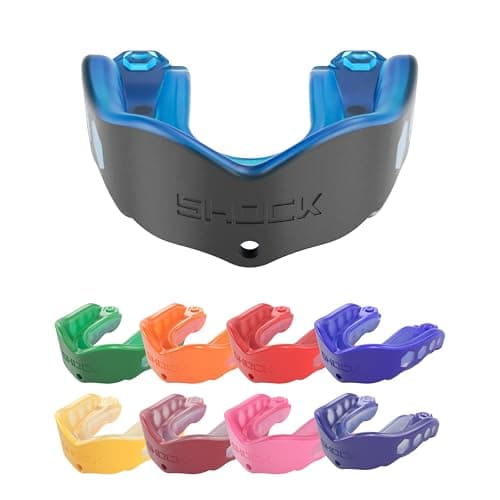
Shock Doctor Gel Max Mouthguard
Shock Doctor
The safe default boil-and-bite: a triple-layer guard with a gel-fit liner and an exoskeletal frame, in youth and adult sizes, with a convertible strap you can leave off for boxing.
Best for
A first mouthguard for an adult or a child over 10 who wants a full-thickness guard
Pros
- Triple-layer design with Shock Doctor's gel-fit liner and a heavy-duty exoskeletal frame
- Two age-based sizes
- Convertible tether — strapped for helmet sports, strapless for boxing
- Shock Doctor lists a limited dental warranty; HSA/FSA eligible per the product page
Cons
- Not compatible with braces — Shock Doctor points braces wearers to its dedicated models
- Thicker than a SISU; breathing and speaking take a session to get used to
Specs from Shock Doctor — Gel Max Mouthguard (features, sizing, fitting).
Key specs
- Thickness
- 1.6 mm
- Sizes
- Medium/Large adult · Small junior
- Braces
- Adult: compatible
Scores · editorial, out of 10
- Fit & retention
- 8
- Breathing & speech
- 10
- Protection thickness
- 5
- Ease of molding
- 6
- Value
- 7
Pick 02 · Mouthguards
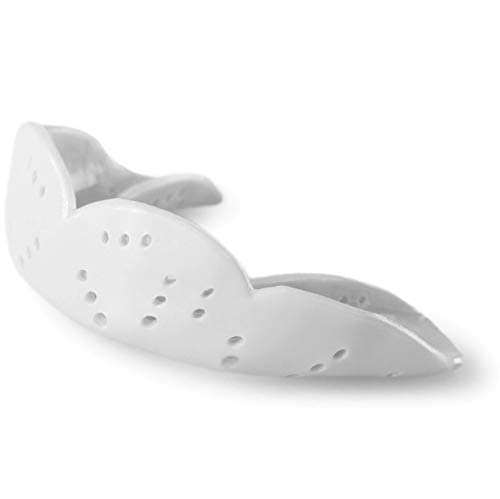
SISU Aero 1.6 mm Mouthguard
SISU
The thinnest SISU at 1.6 mm — easiest to talk and breathe through, but SISU itself lists it for lower-contact sports, so for boxing it is the light-sparring and bag-work option.
Best for
Bag work and very light drilling where you want to forget the guard is in
Pros
- 1.6 mm profile — talking, breathing and drinking with it in is the whole point
- Adult sizes are braces compatible, per SISU
- Remoldable in hot water; dental warranty listed
Cons
- SISU's own chart recommends it for lacrosse, soccer and basketball — the Max is its pick for high-impact sports
- The junior Aero Small is not braces compatible
Specs from SISU — product comparison chart (Aero, Max, Go, Junior).
Key specs
- Sizes
- Adult (10+) · Youth (under 10)
- Fit
- Self-fit, fin technology
- Braces
- Separate Gold Level Braces model
Scores · editorial, out of 10
- Fit & retention
- 9
- Breathing & speech
- 8
- Protection thickness
- 9
- Ease of molding
- 7
- Value
- 7
Pick 03 · Mouthguards
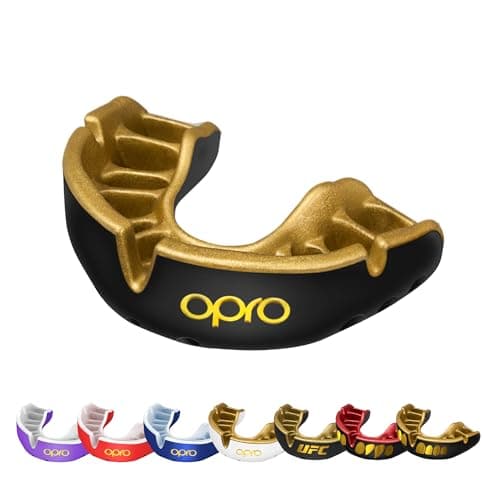
OPRO Gold Level Mouthguard
OPRO
The self-fit guard with fins: OPRO's dual-layer Gold Level molds with a single compression cage and fin technology drawn from its custom-impression data — in adult and youth sizes, with a braces version.
Best for
A beginner who wants the closest thing to a custom fit without a dentist visit
Pros
- Patented fins placed from OPRO's custom-fit impression data, molded with a single compression cage
- Dual-layer, ultra-impact-resistant construction — Level 4 in OPRO's self-fit range
- Adult and youth sizes, plus a dedicated Gold Level Braces variant
- Dental warranty listed on every guard
Cons
- Pricier than a basic boil-and-bite
- The fitting cage adds a step; read the instructions before the water is hot
Specs from OPRO — Gold Level mouthguards (sizes, fit, braces variant).
FAQ
Frequently asked questions
How do you clean a mouthguard?
Rinse it before and after each use, or brush it with a toothbrush and toothpaste, and clean it regularly in cool, soapy water before rinsing it thoroughly — that is the American Dental Association's published guidance. Let it dry, then store it in a sturdy vented container away from heat and sun.
Can you put a mouthguard in boiling water to clean it?
No. Heat is how a boil-and-bite guard was molded to your teeth, so hot water un-molds it. The ADA's own advice is never to leave a mouthguard in hot water or in the sun. Cool, soapy water only.
Can a mouthguard go in the dishwasher?
No — a dishwasher combines heat and detergent, and the heat alone is enough to deform a fitted guard. Clean it by hand with a soft brush.
How do you get the smell out of a mouthguard?
Brush it properly with cool soapy water and, more importantly, dry it before it goes into its case — the smell is moisture trapped against the guard all week. If it survives a proper clean, take it to your next dental checkup for a thorough cleaning or replace it.
How often should you clean a mouthguard?
Rinse or brush it every single session, and give it a soapy-water clean regularly — weekly is a sensible habit for a guard used once or twice a week.
How long does a mouthguard last?
Until the fit or the material goes. Inspect it for wear and check it still seats on your teeth; replace it immediately if it is damaged or no longer fits. Children and teenagers need replacing more often because their mouths are still growing.
Should you store a mouthguard wet or dry?
Dry, in a vented case. A wet guard in a sealed box is the single most common reason a guard smells, and the vents in a proper case exist precisely so it can dry.
Next in your kit
Best boxing headgear →Keep reading
Related guides
- Best mouthguard for boxing →
The replacements, ranked.
- How to fit a boil-and-bite mouthguard →
The fit you are checking for.
- Boil-and-bite vs custom mouthguard →
What a dentist-made guard buys.
- Best mouthguard with braces →
A different guard and a different schedule.
- First sparring kit checklist →
Where a mouthguard sits in the order.
- How to clean boxing gloves →
The same problem, bigger gear.
Sources
- —American Dental Association, MouthHealthy — Mouthguards (care: rinse before and after use or brush with toothpaste; clean in cool soapy water and rinse; vented storage container; never in sun or hot water; check fit and wear and replace; bring it to dental checkups) · mouthhealthy.org
- —Shock Doctor — Gel Max Mouthguard (features, sizing, fitting) · shockdoctor.com
- —SISU — product comparison chart (Aero, Max, Go, Junior) · sisuguard.com
- —OPRO — Gold Level mouthguards (sizes, fit, braces variant) · opro.com