Beginner picks · Heavy Bags
Best Thai Pads: 6 Ranked for Kicks at Home
A Thai pad is the only piece of gear on this site whose whole job is protecting the person who is not training. Everything below is weighted toward padding depth and strap security rather than how a kick sounds landing, because the holder's forearm is what fails first. Six currently-sold options on one published rubric, with the quantity trap spelled out before the prices.
Written by Mike M. · Owner, Iron Mako Media
Published
Bag & Bell is reader-supported. Product links go through our affiliate resolver and we may earn a commission from qualifying purchases at no cost to you. Prices are the retailer's, come from Amazon's own product data on the date shown, and change — the button always opens the live listing.
Part of the Heavy Bags hub.
Quick picks
| # | Product | Best for | Score | Price |
|---|---|---|---|---|
| 01 | 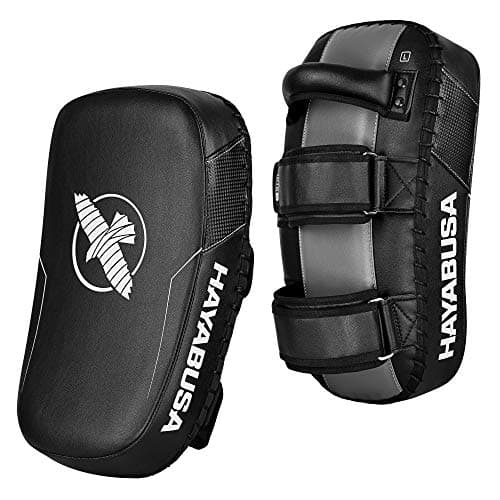 Hayabusa PTS3 Thai Pads The only Thai pad here that publishes every number: 14 x 8 x 3.5 in and 2.7 lb per pad, five foam layers, reinforced handles and dual straps under a non-absorbent shell you can wipe down. | A first real pair of Thai pads, when you want the specification rather than the reputation | 9.1 | |
| 02 | 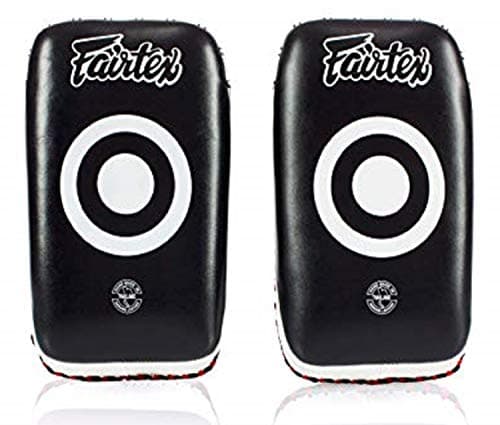 Fairtex KPLC2 Curved Kick Pads The gym-standard Thai pad: genuine leather over multi-layer foam, curved to take load off the holder's arms and shoulders, with adjustable straps — handmade in Thailand and priced like it. | A pair you buy once, if someone in the house is going to hold kicks regularly | 9.0 | |
| 03 | 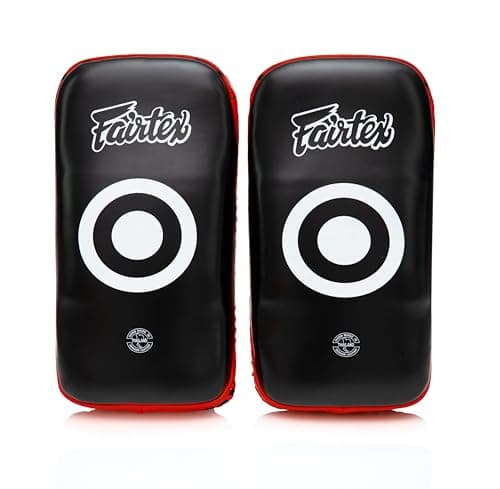 Fairtex KPLC3 Extra Thick Muay Thai Pads The deepest-padded pair on this page: Fairtex's extra-thick build, still curved to the forearm, with two straps per pad — the pad to buy when the person kicking is already strong. | A holder who takes full-power kicks from a heavier or more experienced striker | 8.6 | |
| 04 | 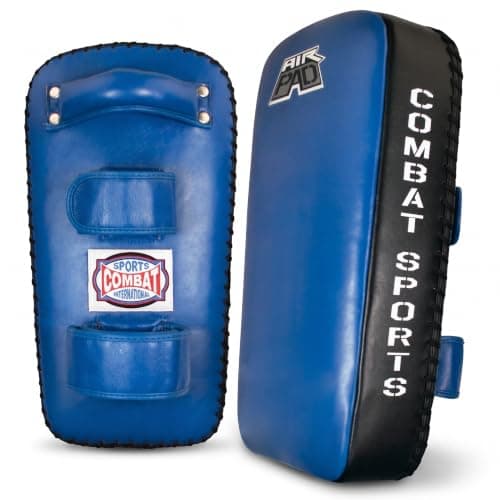 Combat Sports Leather Muay Thai Pads A leather pair at a mid-tier price, listed at 16 x 8 x 4 in with a vented foam construction the maker calls Dome Air Technology — the sensible middle of this page. | A home setup that will use pads weekly but is not buying a gym's worth of them | 8.0 | |
| 05 | 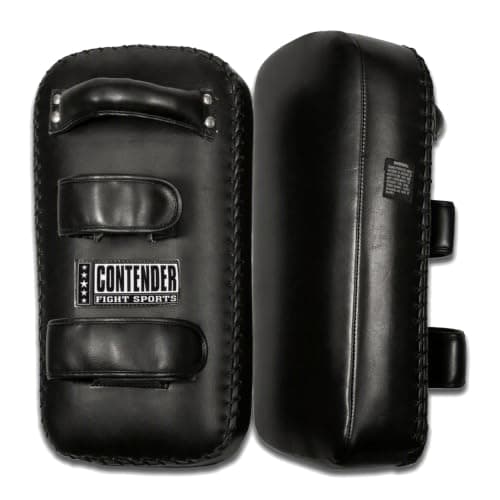 Contender Fight Sports Muay Thai Pads The cheapest honest pair here: vinyl rather than leather, 16 x 8 x 3.5 in, riveted handles and dual hook-and-loop straps — the pad to find out on before spending Fairtex money. | Testing whether anyone in the house will hold kicks, with a real pair rather than one pad | 7.5 | |
| 06 | 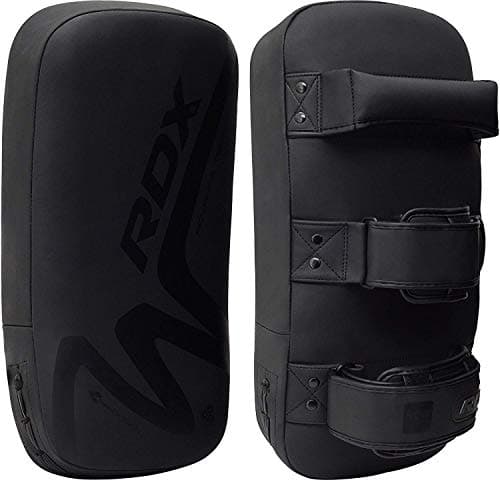 RDX Curved Muay Thai Pad The entry-tier curved strike shield: a single Convex Skin leather pad for kicks, knees and punches — the cheapest honest way to find out whether anyone in the house will actually hold pads. | Testing kick pad work before spending Fairtex money on it | 7.3 |
Scores are our editorial judgment from each model's published specs, size charts and manuals, weighted for what a first home setup needs.
The short answer
Read this before you compare prices: most Thai pads are sold singly
This is the single most common buying mistake in the category, and it is not the buyer's fault. A Thai pad listing that looks half the price of another one is very often one pad, not two — and pad work with one pad is a drill, not a round. Of the six below, three are explicitly sold as pairs, two are the Fairtex standard pair listings, and one is a single pad we have included on purpose as the cheap way to find out whether pads get used at all.
So the first rule of this page: check the quantity before you check the price. We do not print prices here — they move, and each card's button opens the live listing — but the shape of the market is consistent. A usable pair starts at roughly what a mid-range pair of beginner gloves costs, the leather pairs cost about as much as a decent heavy bag, and the Thai-made pads cost more than either.
What a Thai pad is, and what it is not
A Thai pad is a long, thick pad strapped to the holder's forearm with a handle to grip. Its job is to absorb a round kick — a shin swinging at full body rotation — and spread that force across the whole forearm rather than concentrating it in a hand. That is why pads are deep, why they are long, and why they are heavy enough that holding two of them is a workout.
It is not a focus mitt in a bigger size. Mitts are hand-held targets for punches; they are lighter, cheaper and easier to learn to hold, and they cannot take a kick at any price. Focus mitts vs Thai pads is the decision page under this one, and if you are buying your first partner equipment, read it first — for most home setups the honest answer is mitts, and the focus mitt roundup is where that money should go.
It is also not a kick shield. A shield is a big rectangular or curved body pad held against the chest with handles: cheaper, far easier to hold safely, and the right call if all you want is somewhere to put heavy kicks without the holder learning a skill. If nobody in your house has held pads before, the kick shield roundup is the safer first purchase and we say so there too.
How we ranked these
One rubric, published in full on our methodology page, weighted for a home setup rather than a gym: padding depth and impact absorption 30%, forearm strap security 25%, size and curve for kicks and knees 20%, materials and durability 15%, value 10%.
Padding depth carries the most weight because it is the only spec that decides whether the holder can keep holding. Strap security is next because a pad that rotates mid-kick stops protecting the forearm it is strapped to — two straps per pad beats one, every time. Size and curve matter third: a curved pad sits on the arm, a flat one is held against it, and a long face means a mis-aimed kick still lands on the pad.
Every score is an editorial judgment read off published specs, manufacturer pages and the live listings cited under each card. We have not lab tested foam, and nothing here claims a protection level the maker does not state. Where a maker publishes nothing, we say so on the card and it costs them points — which is why two of the picks below are ranked lower than their reputation suggests.
The four specs that actually matter
| Spec | Why it decides the purchase | What good looks like |
|---|---|---|
| Depth of foam | The only number standing between a shin and the holder's forearm | 3.5 in is workable, 4 in is comfortable, extra-thick is for hard kickers |
| Straps per pad | A pad that rotates on impact leaves the arm exposed mid-round | Two adjustable straps plus a gripped handle |
| Curve | A curved pad transfers load into the forearm and shoulder; a flat one into the hand | Pre-curved, with the maker stating it reduces strain |
| Weight per pad | Holder fatigue, which ends pad rounds long before the kicker tires | Under 3 lb per pad for a home setup, if published at all |
| Shell | Leather lasts and wants care; vinyl and microfiber survive a cold garage | Leather for a gym, synthetic for a garage |
| Quantity | Half the listings in this category are one pad | The listing says pair, in words |
What actually fails on a Thai pad
Three things, in this order. The foam goes dead — it compresses, stops rebounding, and the holder starts to feel every kick through it. The straps or their stitching let go, usually at the rivet where the strap meets the body, after which the pad is a cushion you hold rather than a pad you wear. And the shell splits at a corner, which on a cheap vinyl pad can happen in the first cold winter in an unheated garage.
None of those are fixable at home in a way we would recommend. What extends a pad's life is unremarkable: do not leave them in a sealed bag, do not dry them on a radiator, wipe leather down after sessions, and do not let a beginner throw full-power kicks into the same spot of the same pad for an hour. Rotate which pad takes the left and the right.
Who should not buy Thai pads yet
Three groups. If there is no second person who will hold twice a week, pads are a purchase that sits in a corner — the money belongs in a long heavy bag, which drills kicks with nobody else in the room. If you do not yet own gloves, wraps and something to hit, pads are a fourth purchase, not a first one; the kickboxing at home equipment page lays the kit out in buying order. And if the training is boxing with no kicks in it, you want mitts: lighter, cheaper, and built for the hands.
If you are still deciding which sport your home setup is for, boxing vs kickboxing at home is the page that makes that choice, and it changes almost everything else you buy.
Pads and protection go together
One more thing before the picks. Pad work means someone is kicking a dense object with their shin, repeatedly, and the shin is where kickboxing beginners get hurt first — not on the pad side, on the kicking side. Shin guards for pad rounds are a judgment call rather than a rule, and do you need shin guards for kickboxing answers it honestly; the shin guard roundup is the kit page if the answer is yes. A pair of kickboxing gloves with a more open palm also makes catching and checking easier than a tight boxing glove does.
The picks in detail
Every pick, reviewed
Key specs
- Size
- 14 x 8 x 3.5 in
- Weight
- 2.7 lb per pad
- Padding
- 5 foam layers
Scores · editorial, out of 10
- Padding depth & impact absorption
- 9
- Forearm strap security
- 10
- Size & curve for kicks and knees
- 9
- Materials & durability
- 9
- Value
- 7
Pick 01 · Thai pads · REF HEA-01
Hayabusa PTS3 Thai Pads
Hayabusa
The only Thai pad here that publishes every number: 14 x 8 x 3.5 in and 2.7 lb per pad, five foam layers, reinforced handles and dual straps under a non-absorbent shell you can wipe down.
Best for
A first real pair of Thai pads, when you want the specification rather than the reputation
Why it is #1. It publishes everything: 14 in tall, 8 in wide, 3.5 in deep, 2.7 lb per pad, five foam layers, reinforced handles and dual expanded straps under a non-absorbent shell. Those numbers answer the three questions that decide a pad purchase — is there enough foam between the kick and the arm, can my partner hold this braced for three rounds, and will the pad stay where I strapped it. 2.7 lb is genuinely light for a full-size pad, which is why the holder lasts longer on these than on the thicker pads here, and Hayabusa states no recycled foam in the composition, which is the usual reason a cheap pad goes dead in a season. The wipe-clean shell matters more on a pad than on a bag, because pads live against sweaty forearms. The honest cons: it is near the top of the page on price and a beginner pair will not use up the build; Hayabusa does not publish foam densities or the shell material grade, so the five-layer claim is a count rather than a specification; 3.5 in is less depth than the extra-thick pads here, so a heavy kicker gets felt through it sooner; and it is one size only, which is a lot of pad for a smaller holder.
Pros
- Hayabusa publishes height, width, depth and weight — the four numbers that decide whether your partner can hold these for three rounds
- Five foam layers, and Hayabusa states no recycled foam in the composition
- Reinforced handles plus dual expanded straps, so the pad is held by the hand and anchored on the forearm
- Non-absorbent shell that wipes clean, which matters more on a pad sweated into than on a bag
- 2.7 lb per pad is genuinely light for a full-size Thai pad
Cons
- Near the top of the range on price, and a beginner pair will not use up the build
- Hayabusa does not publish the foam densities or the shell material grade, so you are trusting the layer count
- One size only — a smaller holder gets a pad that covers more of the forearm than they can control
- 3.5 in of depth is less than the extra-thick pads here, so a heavy kicker is felt through it sooner
Key specs
- Material
- Premium genuine leather
- Padding
- Multi-layer foam
- Shape
- Curved, adjustable straps
Scores · editorial, out of 10
- Padding depth & impact absorption
- 10
- Forearm strap security
- 9
- Size & curve for kicks and knees
- 9
- Materials & durability
- 10
- Value
- 4
Pick 02 · Thai pads · REF HEA-02
Fairtex KPLC2 Curved Kick Pads
Fairtex
The gym-standard Thai pad: genuine leather over multi-layer foam, curved to take load off the holder's arms and shoulders, with adjustable straps — handmade in Thailand and priced like it.
Best for
A pair you buy once, if someone in the house is going to hold kicks regularly
The pair you buy once. This is the pad most gyms we researched are holding, and the reasons are boring and good: genuine leather over multi-layer foam, a curve Fairtex states reduces strain on the holder's arms and shoulders, adjustable straps so one pair fits two different forearms, and handmade construction in Thailand. If you are going to hold pads for years, the leather shell is the part that is still here at the end — synthetic shells crack first, usually at a corner. The honest cons: it is the most expensive non-specialist pad on this page; Fairtex publishes no dimensions and no weight for the KPLC2, so the spec card is construction rather than measurement and you cannot compare it with the Hayabusa on the one number both would be judged by; and leather wants wiping and airing — a damp leather pad in a sealed bag will mildew where vinyl simply would not.
Pros
- Genuine leather rather than synthetic — the shell most likely to still be here in five years
- Multi-layer foam, which is what keeps a kick from arriving in the holder's forearm
- The curve is the point: Fairtex states it reduces strain on the holder's arms and shoulders
- Adjustable straps, so one pair fits two people with different forearms
Cons
- By far the most expensive item on either side of this comparison
- Fairtex publishes no dimensions or weight for the KPLC2
- Leather wants wiping and airing; left damp in a bag it will mildew where a vinyl pad would not
Key specs
- Padding
- Extra-thick foam
- Shape
- Curved to the forearm
- Closure
- Two straps per pad
Scores · editorial, out of 10
- Padding depth & impact absorption
- 10
- Forearm strap security
- 9
- Size & curve for kicks and knees
- 8
- Materials & durability
- 9
- Value
- 4
Pick 03 · Thai pads · REF HEA-03
Fairtex KPLC3 Extra Thick Muay Thai Pads
Fairtex
The deepest-padded pair on this page: Fairtex's extra-thick build, still curved to the forearm, with two straps per pad — the pad to buy when the person kicking is already strong.
Best for
A holder who takes full-power kicks from a heavier or more experienced striker
The one for a hard kicker. The KPLC3 is Fairtex's extra-thick build: the same curve and the same two-strap hold as the KPLC2, with more foam between the kick and the forearm. That is the correct purchase in exactly one situation, which is common enough to earn the pad a place here — the person kicking is heavier, stronger or more experienced than the person holding. Extra depth is the only thing that fixes that mismatch, and no amount of holding technique substitutes for it. The honest cons: it is the most expensive pair on the page; Fairtex publishes no dimensions, no weight and no foam layup for the KPLC3, so our card is features from the live listing rather than a spec sheet; the extra thickness is extra weight and bulk, which the holder feels in the shoulders within a round; and for a beginner kicking at half power — most first-year pad work — it is simply overkill you carry.
Pros
- Extra-thick foam is the one spec that protects a holder from a hard kicker, and this is the thickest pad here
- Still curved rather than flat, so the pad sits on the forearm instead of being gripped flat against it
- Two straps per pad, which is what stops a pad rotating when a kick lands off-center
- Fairtex is the maker whose pads most gyms we researched use, and the KPLC line is the reason
Cons
- The most expensive pair on this page
- Fairtex publishes no dimensions, no weight and no foam layup for the KPLC3, so the spec card is features rather than numbers
- Extra thickness means extra weight and bulk — the holder feels it in the shoulders long before the kicker runs out
- Overkill for a beginner kicking at half power, which is most first-year pad work
Key specs
- Size
- 16 x 8 x 4 in
- Shell
- Leather
- Sold as
- A pair
Scores · editorial, out of 10
- Padding depth & impact absorption
- 8
- Forearm strap security
- 8
- Size & curve for kicks and knees
- 8
- Materials & durability
- 8
- Value
- 8
Pick 04 · Thai pads · REF HEA-04
Combat Sports Leather Muay Thai Pads
Combat Sports (Ringside)
A leather pair at a mid-tier price, listed at 16 x 8 x 4 in with a vented foam construction the maker calls Dome Air Technology — the sensible middle of this page.
Best for
A home setup that will use pads weekly but is not buying a gym's worth of them
The sensible middle. A leather pair, listed at 16 x 8 x 4 in, with a vented foam construction the maker calls Dome Air Technology, at a price between the budget vinyl pair and the Thai-made pads. The numbers are the argument: 4 in of depth is more than the Hayabusa and the budget pair, and a 16 in face is a longer target than either, which is forgiving for a kicker who has not learned to aim yet. A leather shell at this price is the trade most home buyers should take. The honest cons: we could not find a manufacturer spec page for this model, so the size, shell and construction all come from the live Amazon listing rather than a maker's sheet; there is no published weight, so you cannot compare holder fatigue against the Hayabusa's 2.7 lb; nothing is published about strap count or handle design, which is a real gap in a category where straps are the second-most-important spec; and leather in a cold damp garage wants more care than a synthetic pad.
Pros
- 4 in of depth on a 16 in face — more padding than the budget pair here and a longer target than the Hayabusa
- Leather shell at well under the Thai-made price, which is the trade most home buyers should take
- Sold as a pair, so the listing price is the whole purchase
- The maker's vented Dome Air construction is aimed at shock absorption rather than looks
Cons
- We could not find a manufacturer spec page for this model, so size, shell and construction come from the live Amazon listing
- No published weight, so you cannot compare holder fatigue against the Hayabusa's 2.7 lb
- Leather wants airing and wiping; sealed in a bag damp it will mildew where vinyl would not
- No stated strap count or handle design — you are buying on the dimensions and the shell
Key specs
- Size
- 16 x 8 x 3.5 in
- Shell
- Vinyl
- Closure
- Riveted handles, dual straps
Scores · editorial, out of 10
- Padding depth & impact absorption
- 7
- Forearm strap security
- 8
- Size & curve for kicks and knees
- 8
- Materials & durability
- 6
- Value
- 9
Pick 05 · Thai pads · REF HEA-05
Contender Fight Sports Muay Thai Pads
Contender Fight Sports
The cheapest honest pair here: vinyl rather than leather, 16 x 8 x 3.5 in, riveted handles and dual hook-and-loop straps — the pad to find out on before spending Fairtex money.
Best for
Testing whether anyone in the house will hold kicks, with a real pair rather than one pad
The cheapest real pair. Vinyl rather than leather, 16 x 8 x 3.5 in, riveted handles and two hook-and-loop straps per pad — a genuine pair at about the price many single pads sell for. The hardware is what earns it the spot: riveted handles and dual straps are exactly what cheap pads usually drop, and without them a pad rotates on impact. Vinyl also does not care about a garage, which leather does. The honest cons: 3.5 in of foam over a vinyl shell is the least protection on this page and a hard kicker will be felt through it; no manufacturer spec page exists that we could find, so every figure comes from the live listing; vinyl stiffens in cold storage and will crack years before leather does; and there is no published weight or foam layup at all.
Pros
- A genuine pair at the price most single pads sell for, which is the whole argument for it
- Riveted handles and two hook-and-loop straps per pad — the hardware a cheap pad usually skips
- Vinyl wipes clean and does not care about being left in a garage, unlike leather
- 16 x 8 in is a full-size target, not a cut-down one
Cons
- 3.5 in of foam over a vinyl shell is the least protection on this page — a hard kicker is felt through it
- No manufacturer spec page we could find, so every figure here comes from the live Amazon listing
- Vinyl stiffens in cold storage and will crack years before leather does
- No published weight or foam layup
Key specs
- Shape
- Curved strike shield
- Shell
- Convex Skin leather
- Sold as
- A single pad
Scores · editorial, out of 10
- Padding depth & impact absorption
- 7
- Forearm strap security
- 7
- Size & curve for kicks and knees
- 8
- Materials & durability
- 6
- Value
- 9
Pick 06 · Thai pads · REF HEA-06
RDX Curved Muay Thai Pad
RDX Sports
The entry-tier curved strike shield: a single Convex Skin leather pad for kicks, knees and punches — the cheapest honest way to find out whether anyone in the house will actually hold pads.
Best for
Testing kick pad work before spending Fairtex money on it
The test purchase. One curved Convex Skin leather pad for kicks, knees and punches, at the bottom of the range. It is last on the rubric and we would still buy it in one specific case: you do not yet know whether anybody in the house will hold pads, and a single cheap pad answers that question for a fraction of the money. Curved rather than flat, so it sits on the forearm the way a Thai pad should, and RDX is a brand already in our glove, head guard and shin guard roundups. The honest cons: it is listed as a single pad, so a matching pair costs two and most real pad drills need both; we could not find an RDX spec page for this model, so the shell and shape come from the live Amazon listing; there is no published foam depth, and at this tier padding is the thing being saved on; and an entry-tier pad transmits what it does not absorb, straight into the holder's arm.
Pros
- A fraction of the price of a leather Thai pad, which makes it a low-risk way to try pad work
- Curved rather than flat, so it sits on the forearm the way a Thai pad should
- Listed for kicks, knees and punching rather than one discipline only
- RDX is already in our glove, head guard and shin guard roundups, so the brand is a known quantity here
Cons
- Listed as a single pad — a matching pair costs two, and holding one pad limits most Thai pad drills
- We could not find an RDX spec page for this model, so the shell and shape come from the live Amazon listing
- No published foam depth, and at this tier the padding is the thing being saved on
Buying guide
Pairs, singles and what you actually need
Two pads, if there is any choice. A holder with one pad can feed a single kick and nothing else: no left-right combinations, no knee-then-kick, no punching into the pads and finishing with a round kick. Two pads is what makes a pad round a round. The single-pad listings exist for coaches who already own three pairs and want a spare, and for buyers like the test case above — not as a cheaper version of a pair.
How thick is thick enough
For a beginner kicking at half to three-quarter power onto a braced holder, 3.5 in of foam is workable and 4 in is comfortable. The jump to an extra-thick pad is worth it when there is a weight or experience mismatch — a 180 lb kicker with two years of training and a 130 lb holder who has never held before is the case the extra-thick pads exist for. Depth is not a substitute for technique on either side, but it buys the holder time to learn.
Leather, vinyl or microfiber
Leather lasts longest and needs the most care: wipe it after sessions, air it, never seal it damp in a bag. Vinyl and synthetic shells survive neglect and cold far better and will crack sooner — for an unheated garage that is often the right trade. Microfiber shells, which Fairtex uses on some of its lighter pads, sit between the two and are the lightest option; the retail descriptions we found for those models were inconsistent enough that we have not ranked one here.
Holding pads without hurting anyone
The short version, and it is worth reading twice if you are the holder. Stand with the pad in front of your ribs, not out at arm's length. Keep both elbows together and the pad angled slightly into the incoming kick. Step into the kick as it lands rather than giving ground — bracing is what absorbs force, and turning away is what transfers it into your arm. Keep your head behind the pad and your chin tucked, because a hard kick drives a pad backward. And call the combination, so the kicker is not improvising at a holder who is not ready.
If that reads like a skill rather than a purchase, it is — which is exactly why we keep pointing beginners at kick shields and focus mitts first. A shield is held against the chest with two handles and is close to foolproof. A Thai pad is not.
What we did not rank, and why
We left out the budget two-packs from brands with no published specs and no spec page, because at that tier the only thing distinguishing them is a photograph. We also left out the specialist trainer gear — belly pads, leg kick pads, body shields — which are coach equipment rather than home equipment, and the Fairtex microfiber models, where we could not establish from any source we trust whether a given listing is a pair or a single pad. Nothing on this page is here on brand reputation alone; every entry is a currently-sold listing we confirmed was buyable while writing.
FAQ
Frequently asked questions
Are Thai pads sold in pairs?
Sometimes, and it is the trap in this category. Many listings are for a single pad, which makes them look far cheaper than a pair until you read the quantity. Three of the six picks above are explicitly pairs and one is explicitly a single. Always check the quantity before the price.
How thick should a Thai pad be?
For a beginner kicking a braced holder, 3.5 in of foam is workable and 4 in is comfortable. Go to an extra-thick pad when the kicker is substantially heavier, stronger or more experienced than the holder — depth is the only thing that fixes that mismatch.
Can you punch Thai pads?
Yes. Angle them and they work for straight punches and hooks, and most Muay Thai pad rounds include hands. They are a compromise for hand work though: the target is large, so a punch does not need to be accurate to connect, which is exactly the feedback focus mitts give you and pads do not.
Thai pads or a kick shield for a home setup?
A kick shield, if nobody in the house has held pads before. It is cheaper, held against the chest with two handles, and close to impossible to hold dangerously. Thai pads are the better tool once there is a holder who knows what they are doing — the kick shield roundup covers the other side of that choice.
Do I need shin guards to kick Thai pads?
Not strictly, and most pad rounds in Muay Thai gyms are done bare-shinned. But a beginner whose shins are not conditioned, kicking a dense pad repeatedly, will feel it — do you need shin guards for kickboxing is the honest answer, and the short version is that they are worth it early and optional later.
Can one person use Thai pads alone?
No. They need a holder, and that is the whole qualification for buying them. For solo kick work you want a long bag — the Muay Thai bag roundup picks by length rather than weight, because a low kick needs something to land on.
How long do Thai pads last?
A leather pair used a few times a week at home should outlast your interest in holding them; the foam going dead is what ends a pad, not the shell. Cheap vinyl pads in an unheated garage can split at a corner within a couple of winters. Do not store them sealed in a bag, do not dry them near heat, and rotate which pad takes the harder side.
Are expensive Thai pads worth it for a beginner?
Only if you already know pad work will happen weekly. The leather Thai-made pairs are built for a volume of holding a home setup will not reach for years. Start with the mid-tier leather pair or the budget vinyl pair, and buy the gym-standard pads when the cheap ones wear out and you are still at it.
Next in your kit
Best kick shields →Keep reading
Related guides
- Focus mitts vs Thai pads →
The decision underneath this page.
- Best kick shields →
Easier to hold, cheaper, and safer for a new holder.
- Best focus mitts →
For the hands, and the better first partner buy.
- Best heavy bags for Muay Thai →
Drilling kicks with nobody else in the room.
- Best shin guards for kickboxing →
Before you kick anything dense, hard.
- Kickboxing at home equipment →
The whole kit, in buying order.
Sources
- —Hayabusa — PTS3 Thai Pads (14 x 8 x 3.5 in, 2.7 lb, 5-layer foam, reinforced handles, dual expanded straps, non-absorbent shell) · hayabusafight.com
- —Fairtex — Curved Kick Pads KPLC2 (genuine leather, multi-layer foam, curved shape, adjustable straps, handmade in Thailand) · fairtex.com
- —Amazon listing — Fairtex KPLC3 Extra Thick Muay Thai Pads (extra-thick foam, curved shape, two straps; checked 2026-11-04) · amazon.com
- —Amazon listing — Combat Sports Leather Muay Thai Pads (16 x 8 x 4 in, leather, Dome Air construction, sold in pairs; checked 2026-11-04) · amazon.com
- —Amazon listing — Contender Fight Sports Muay Thai Pads (16 x 8 x 3.5 in, vinyl, riveted handles, dual hook-and-loop straps, pair; checked 2026-11-04) · amazon.com
- —Amazon listing — RDX MMA Thai Pad, Convex Skin Leather Curved Kickboxing Strike Shield (shell, shape, single pad; checked 2026-11-04) · amazon.com