Guide · Heavy Bags
How to Use a Double End Bag
A double end bag is the only thing in a home gym that punches back, which is exactly why it is worth owning and exactly why the first session is humbling. Get the height and the cord tension right and it becomes a timing tool. Get them wrong and it is a small leather ball that keeps hitting you in the nose.
Written by Mike M. · Owner, Iron Mako Media
Published
Bag & Bell is reader-supported. Product links go through our affiliate resolver and we may earn a commission from qualifying purchases at no cost to you. Prices are the retailer's, come from Amazon's own product data on the date shown, and change — the button always opens the live listing.
Part of the Heavy Bags hub.
How to use a double end bag · 7 steps
Step 01
Hang it at your own head height
The centre of the bag should sit between your chin and your eyes when you stand in your stance. This is a head-level target; hanging it lower turns every punch into a downward swing and teaches a bad habit.
Step 02
Set the cord tension loose to start
Loose cords mean a slow, wide, predictable rebound. Tight cords mean a fast, short, snapping one. Start loose enough that the bag takes a full beat to come back, and tighten it only when you can control it.
Step 03
Stand at jab range and stay there
Set your feet so a straight lead hand just reaches the bag with your shoulder extended. Most beginners stand too close, which is why the bag catches them on the return.
Step 04
Throw single jabs and let it settle
One jab, hands back to your guard, let the bag come to rest or nearly rest, then jab again. Do a full minute of this before you throw anything else. You are learning the return arc, not getting a workout.
Step 05
Add the return slip
Jab, then move your head one inch off the centre line as the bag comes back. Not a duck, not a lean — a small lateral move. This is the whole reason the bag exists: it punishes a head that stays still.
Step 06
Add a second punch on the rebound
Jab, let the bag come back, and time a second jab to meet it as it arrives. This is the timing drill. When you can hit it twice cleanly, start adding the cross.
Step 07
Work in rounds, not sets
Three minutes on, one minute off, with a timer. A double end bag punishes fatigue immediately, which is the point — accuracy under tiredness is the skill you are building.
What a double end bag actually trains
Timing, accuracy, distance and the habit of moving your head after you punch. It is the only piece of equipment in a normal home gym that gives you a moving target returning along an unpredictable line, which is why it transfers to sparring better than almost anything else you can hang in a garage.
What it does not train is power. You cannot hit a double end bag hard without losing all control of it, and trying to is the most common beginner mistake. Power work belongs on the heavy bag; this is the precision tool. If you are still deciding between them, our speed bag vs double end bag and reflex bag vs double end bag pages set out the trade-offs.
Setup: the two settings that decide everything
Height. The centre of the bag should sit somewhere between your chin and your eyes when you are in your stance. It is a head, and you should be punching at head height. People hang them low because it is easier to anchor to a convenient point, and then spend months practising a downward jab they will never use.
Cord tension. This is the dial that controls difficulty, and nearly everyone sets it too tight on day one. Slack cords give a slow, wide, readable rebound — the bag floats back and you have time to see it. Tight cords give a fast, short snap that comes straight back at your face. Start slack. Tighten by a few inches at a time as your timing improves, and never tighten it to the point where you are flinching rather than reacting.
| Setting | Looser cords | Tighter cords |
|---|---|---|
| Rebound speed | Slow and wide | Fast and short |
| Predictability | High — you can read the arc | Low — it snaps back on a tight line |
| Best for | Learning the timing; longer combinations | Sharp single shots and reaction work |
| Risk to the face | Low | High until your timing is reliable |
| Who it suits | Every beginner, for at least a month | Once you can hit it twice in a row cleanly |
Why it keeps hitting you in the face
Three causes, in order of likelihood. You are standing too close — if you have to shorten your jab to reach the bag, the rebound arrives before your hand is back. Your cords are too tight, so the return is quicker than your guard. Or you are dropping your hands after you punch, which is a habit the bag is correctly punishing.
The fix for all three is the same drill: single jabs, full reset, hands back to the guard every time, from a distance where your arm extends fully. Boring for ten minutes, and it fixes the problem permanently.
Four drills, in order
- Single jab, full reset. One jab, hands back, let the bag settle. A full round. This is the foundation and most people skip it.
- Jab and slip. Jab, then move your head one inch off the centre line as the bag returns. Small movement. You are building the reflex of not standing where you just were.
- Double jab on the rebound. Jab, then time a second jab to meet the bag as it comes back. This is the timing drill, and the first time it lands cleanly is when the bag starts to make sense.
- One-two with a reset. Jab, cross, hands back, let it settle. Add the cross only once the double jab is reliable; the cross is slower to recover from and the bag will punish it.
Three-minute rounds with a minute of rest, same as everything else. A timer on the wall is what turns this from messing about into training — see round timer settings for beginners.
Anchoring it at home
A double end bag needs two fixing points, one above and one below, roughly in line. That is the awkward part of owning one at home: the floor anchor. Common solutions are an eye bolt into a joist above and one into a floor joist or a concrete slab below, a weighted base, or a stand that carries both points on one frame.
The loads are small compared with a heavy bag — nobody is hanging 70 lb — but the top anchor still needs to go into structure rather than drywall, and the bottom anchor takes a surprising amount of repeated pull. If you cannot anchor a floor point at all, a freestanding reflex bag on a weighted base does a related job with no fixings; our reflex bag roundup covers those.
Which size and cord to buy
Buy the bigger bag. An 8 in or 9 in bag is a wide, slow, forgiving target; a 5 in bag is a specialist tool for people who already have the timing and want to be humbled. The same logic applies to the cords that come in the box: use the longer, slacker setting first.
On construction, the practical choice is between an air bladder and a foam core. A bladder bag can be tuned by inflation and replaced cheaply when it fails; a foam core never needs pumping up and never goes soft mid-session, which is the whole appeal. Both are listed in our double end bag roundup, with the cord and anchor details for each.
How often to use it
It is a low-impact piece of equipment, so it can go into most sessions without adding much fatigue — two or three rounds after your heavy bag work, while you are already warm but starting to tire, is where it does the most good. Accuracy when you are tired is the thing it teaches, and it cannot teach that if you only ever use it fresh.
Picks
What to practise on
Buy the larger size first — an 8 in bag is a far more forgiving target than a 5 in. A classic bladder bag, a slower-rebounding option, and a foam-cored bag with nothing to re-inflate.
Key specs
- Sizes
- 5 in · 8 in diameter
- Shell
- Engineered leather, welted reinforced seams
- Included
- Two industrial rubber cables with S-hooks
Scores · editorial, out of 10
- Rebound speed for beginners
- 8
- Cords & anchoring included
- 9
- Size options
- 7
- Shell & bladder durability
- 7
- Value
- 10
Pick 01 · Double end bags
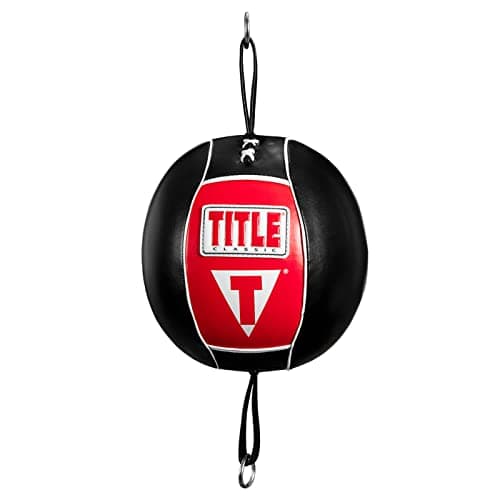
TITLE Classic Double End Bag 3.0
TITLE Boxing
Two cords in the box, twin steel O-rings, a choice of 5 in or 8 in, and the lowest price of any double end bag with published sizes.
Best for
A first double end bag — buy the 8 in and learn the timing before you go small
Pros
- Both cables are included — a bag without cords is useless and many are sold that way
- Multi-layer top and bottom loops with twin steel O-rings
- Two sizes, so you can buy the forgiving 8 in first and the 5 in later
- Nylon-stitched welted seams rather than a glued edge
Cons
- Engineered leather, not hide
- You still need a floor anchor or something heavy to tie the bottom cord to
- TITLE warns you must lubricate the needle before inflating or you tear the valve
Specs from TITLE Boxing — Classic Double End Bag 3.0 (sizes, shell, included cables).
Key specs
- Size
- Larger body (Everlast does not publish inches)
- Straps
- Rivet-reinforced hanging straps
- Access
- Zipper closure to a replaceable latex bladder
Scores · editorial, out of 10
- Rebound speed for beginners
- 9
- Cords & anchoring included
- 5
- Size options
- 3
- Shell & bladder durability
- 7
- Value
- 10
Pick 02 · Double end bags
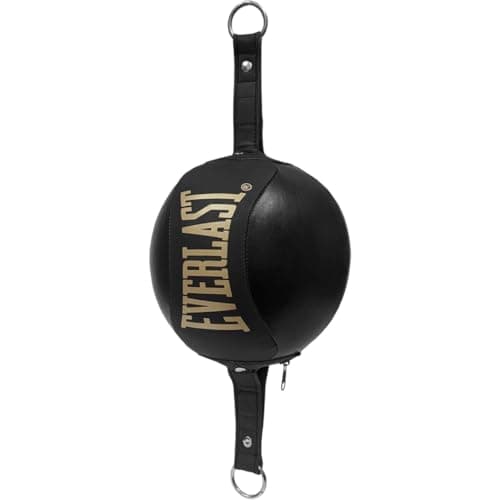
Everlast Elite Double End Bag
Everlast
A larger, slower bag with rivet-reinforced straps and a zipper to the latex bladder — the most forgiving rebound here for a beginner.
Best for
A first double end bag when you want a slow, readable rebound
Pros
- Everlast calls it a larger bag for beginner to mid-level training — a bigger body moves slower and is easier to read
- Rivet-reinforced straps at the two points that take all the load
- Zipper access to a replaceable latex bladder
Cons
- Everlast publishes no diameter, so you cannot compare it to a 7 in or 9 in bag on paper
- Cables are not named in the listing — check before you order
- Latex holds pressure less well than butyl
Specs from Everlast — Elite Double Ended Punching Bag (straps, bladder access, level).
Key specs
- Core
- Open-cell foam — no air bladder
- Shell
- 100% genuine leather
- Sizes
- 7 · 9 · 11 in (7 in in stock 2026-09-26)
Scores · editorial, out of 10
- Rebound speed for beginners
- 6
- Cords & anchoring included
- 9
- Size options
- 5
- Shell & bladder durability
- 9
- Value
- 9
Pick 03 · Double end bags
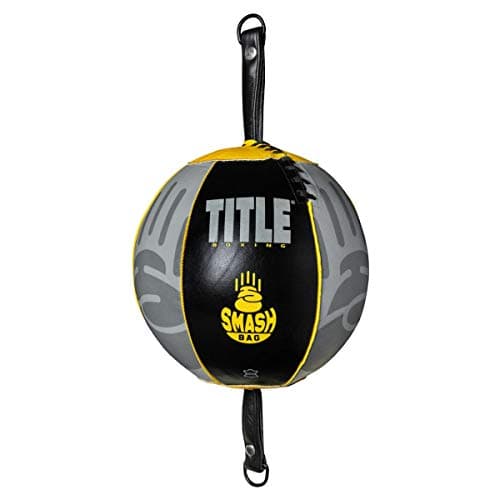
TITLE Boxing Double End Smash Bag
TITLE Boxing
A foam-core double end bag in genuine leather — no bladder to puncture, and a deliberately slower, more rhythmic rebound.
Best for
Accuracy and timing work, and anyone tired of re-inflating a bag
Pros
- A foam core cannot leak — nothing to inflate and no needle to lubricate
- TITLE designs it to move slower and more rhythmically, which suits accuracy drills
- Genuine leather shell at an engineered-leather price
Cons
- Only the 7 in was in stock when we checked on 2026-09-26
- Foam cannot be firmed up or softened the way air pressure can
- A slower bag does less for reaction speed
Specs from TITLE Boxing — Double End Smash Bag (foam core, shell, sizes).
FAQ
Frequently asked questions
How do you use a double end bag for beginners?
Hang it at head height, set the cords slack, stand at full jab range, and throw single jabs with a full reset between each one for the first few sessions. Add head movement, then a second punch on the rebound, then combinations.
How tight should double end bag cords be?
Loose to start. Slack cords give a slow, wide, readable rebound that you can time. Tight cords snap the bag straight back at your face and are only worth using once you can hit it cleanly twice in a row.
How high should a double end bag hang?
With the centre of the bag between your chin and your eyes in your stance. It represents a head, so it should be at head height — hanging it low teaches a downward jab you will never use.
Why does the double end bag keep hitting me?
Usually distance: standing too close so the bag returns before your hand does. After that, cords set too tight, or dropping your hands after punching. Single jabs with a full reset at full arm's length fixes all three.
What size double end bag should a beginner buy?
The larger one — 8 or 9 in. It is a wider, slower target and far easier to time. Smaller bags around 5 in are faster and are better treated as an upgrade once your timing is established.
Do you need gloves for a double end bag?
Yes, and wraps. The target is small and hard and you will catch it off-centre often. Bag gloves are ideal; a bulky 16 oz sparring glove is too big for precision work.
Next in your kit
Best boxing round timer →Keep reading
Related guides
- Best double end bags →
Sizes, cords and anchors, compared.
- Speed bag vs double end bag →
Which trains what, if you can only buy one.
- Reflex bag vs double end bag →
If you cannot anchor a floor point.
- How to use a speed bag →
The other rhythm tool, and its three-beat count.
Sources
- —TITLE Boxing — Classic Double End Bag 3.0 (sizes, shell, cables) · titleboxing.com
- —Everlast — Elite Double Ended Punching Bag (straps, bladder, access) · everlast.com
- —TITLE Boxing — Double End Smash Bag (foam core, shell, sizes) · titleboxing.com